
Chef Juliette
Various Almond Preparations
Five almond preparations, one discipline: remove the skins cleanly, dry every kernel through, then cut, toast, or cloak it in pale caramel without letting its fragrant oils escape.
A cooking platform built around craft, culture, and the stories behind what we eat.
Created by Chef Juliette
Based on No. 2811, Coupes Petit Duc, from Le Guide Culinaire (1907) by Auguste Escoffier
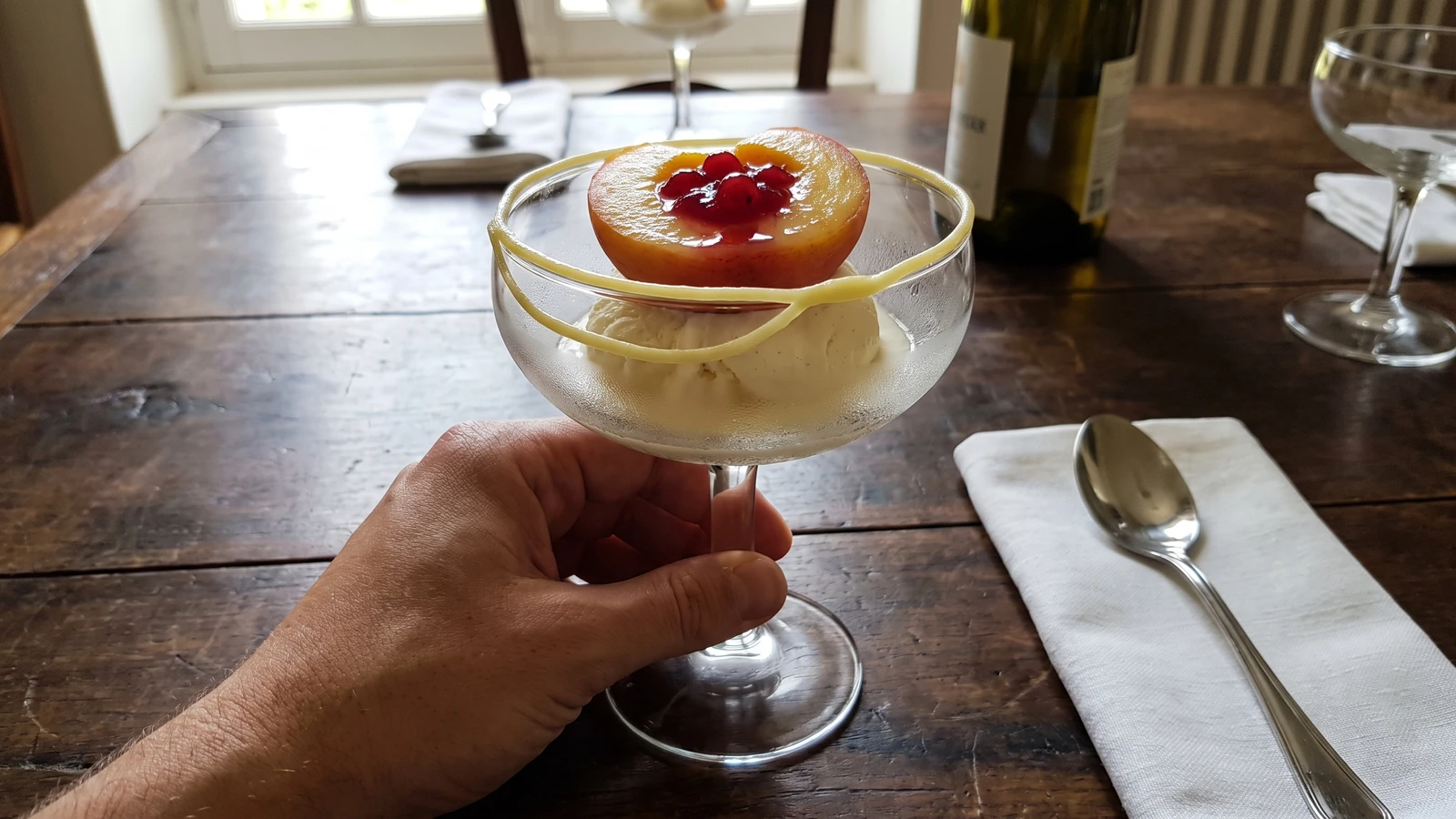
Vanilla ice cream, tender peach, jewel-bright Bar-le-Duc preserve, then the essential ring of lemon ice: a composed frozen dessert whose balance depends on keeping every element properly cold.
Coupes Petit Duc (vanilla ice with poached peach, redcurrant preserve, and lemon ice) teaches the discipline of contrast. The peach is fragrant, the vanilla is round, and the currant is sweet-sharp, but the lemon is the point. Without that cold, tart thread, the coupe sits heavily; with it, every spoonful wakes up.
The original entry assumed a glacier, the frozen-dessert cook, with two finished ices, poached fruit, and preserves waiting in service quantities. Here, a countertop churn makes the small batch of vanilla ice, while a shallow pan and food processor give the lemon ice its pipeable texture. The entry's brigade tubs and separate hands are scaffolding and can go. The vanilla, peach, currant, and encircling lemon are the dish, so their sequence stays exactly where it belongs. Four coupes, one cook, one stove, one evening's work, then the freezer holds everything until dinner.
Cold is the technique. Chill the fruit and coupes, firm the vanilla enough to support the peach, and soften the lemon ice only until it will pass through the piping tip. If either ice becomes too hard or too loose, ça se rattrape, and the method tells you how. The final assembly temperature matters most.
Coupes Petit Duc belongs to the composed coupe repertory of Parisian grand kitchens, where frozen desserts were assembled from ices, poached fruits, and preserves maintained at separate stations. Its precise regional accent comes from Bar-le-Duc in Lorraine, whose redcurrant preserve is traditionally made from berries seeded one by one, often with a sharpened goose quill, so the fruit remains whole and jewel-clear. The title follows grand-kitchen naming custom, but the geography is carried by the preserve rather than the peach.
Quantity
1 cup (240 ml / 245 g)
Quantity
1 cup (240 ml / 240 g)
Quantity
1
split and scraped
Quantity
4
Quantity
1/2 cup (120 ml / 100 g)
Quantity
2/3 cup (160 ml / 160 g)
Quantity
1/2 cup (120 ml / 100 g)
Quantity
1 tablespoon (15 ml / 6 g)
finely grated
Quantity
1/2 cup (120 ml / 120 g)
Quantity
2 large (about 500 g total)
halved and pitted
Quantity
2 1/2 cups (600 ml / 600 g)
Quantity
3/4 cup (180 ml / 150 g)
Quantity
3 tablespoons (45 ml / 60 g)
| Ingredient | Quantity |
|---|---|
| whole milk | 1 cup (240 ml / 245 g) |
| heavy cream | 1 cup (240 ml / 240 g) |
| vanilla beansplit and scraped | 1 |
| large egg yolks | 4 |
| granulated sugar, for the vanilla ice | 1/2 cup (120 ml / 100 g) |
| water, for the lemon ice | 2/3 cup (160 ml / 160 g) |
| granulated sugar, for the lemon ice | 1/2 cup (120 ml / 100 g) |
| lemon zestfinely grated | 1 tablespoon (15 ml / 6 g) |
| fresh lemon juice | 1/2 cup (120 ml / 120 g) |
| ripe but firm yellow peacheshalved and pitted | 2 large (about 500 g total) |
| water, for poaching | 2 1/2 cups (600 ml / 600 g) |
| granulated sugar, for poaching | 3/4 cup (180 ml / 150 g) |
| Bar-le-Duc redcurrant preserve | 3 tablespoons (45 ml / 60 g) |
Make the glace au citron, the lemon water ice. Combine the water, sugar, and lemon zest in a small saucepan, bring to a simmer, and stir only until the sugar dissolves. Simmer for one minute, cover, and infuse for ten minutes. Strain into a shallow metal pan, cool completely, then stir in the lemon juice. Keep the juice away from the heat so its clean acidity stays alive. Freeze for forty-five minutes, scrape the frozen edges into the centre with a fork, and repeat every thirty minutes until evenly crystalline and firm, about three hours.
Make the glace à la vanille, the vanilla ice cream. Heat the milk, cream, vanilla pod, and scraped seeds until small bubbles gather at the edge. Cover and infuse off the heat for ten minutes. Whisk the yolks with the sugar until smooth, then pour in the warm dairy gradually while whisking. Return everything to low heat and stir continuously until the crème anglaise reaches 82°C or 180°F and nappes, coating the back of a spoon. Do not let it boil. If the first fine curds appear, pull it from the heat, blend briefly, and strain at once into a cold bowl. Ça se rattrape. Chill over ice, cover, and refrigerate until thoroughly cold, at least four hours.
Bring the poaching water and sugar to a gentle simmer in a saucepan wide enough to hold the peach halves in one layer. Add the peaches cut-side up, cover the surface with a round of baking paper, and poach at the barest tremble for five to ten minutes. They are ready when a thin knife enters with slight resistance. Lift them out before they become soft enough to collapse, slip off the skins while warm, and place them in a shallow container. Strain the syrup over them and chill completely. If a half tears, place that side downward at assembly and let the preserve fill the cavity. Never apologize at your own table.
Remove the vanilla pod and churn the cold custard in a countertop ice-cream machine until thick, smooth, and softly mounded, usually twenty to twenty-five minutes. A warm base cannot freeze finely, so if the machine struggles and the custard remains loose, stop and chill the base again before continuing. Pack the vanilla ice into a covered container and freeze until firm enough to hold the peach, about two hours.
Chill four wide dessert coupes for thirty minutes. Break the firm lemon ice into chunks and pulse it in a food processor just until smooth enough to pipe, then transfer it to a piping bag fitted with a 6 mm round tip. If the blades merely rattle against hard pieces, wait five minutes and try again; if the ice becomes slushy, return it to the shallow pan for fifteen minutes. Ça se rattrape. Drain the peaches very well, and stir the preserve until spoonable. If it is stiff, loosen it with one teaspoon of the cold poaching syrup.
Spread about 1/2 cup of vanilla ice in the bottom of each chilled coupe, making a shallow bed rather than distinct scoops. Set one poached peach half on top, cut-side up, and fill its hollow with a generous two teaspoons of Bar-le-Duc redcurrant preserve. Pipe a narrow, continuous thread of lemon ice around the peach. Work with all four coupes together and serve immediately. If the first one slumps, return the components to the freezer for ten minutes before continuing. Cold control is the step that decides the dish. À table!
1 serving (about 390g)
Culinary guides, cultural storytelling, and the editorial depth that makes cooking meaningful.
Discover Culinary ExplorerChef Juliette
Five almond preparations, one discipline: remove the skins cleanly, dry every kernel through, then cut, toast, or cloak it in pale caramel without letting its fragrant oils escape.

Chef Juliette
A pastry pantry lesson in one tray: filberts warmed only until their red skins release, rubbed clean, cooled, and chopped into a fragrant mise-en-place for cakes, creams, pralines, and petits fours.

Chef Juliette
The smallest pâtisserie discipline decides whether a cake leaves its mould intact: clarified butter in every corner, followed by the lightest veil of dry flour or fécule.

Chef Juliette
Four whites, one spotless bowl, and a patient change of speed: whisk gently until loosened, then briskly to glossy stiffness, with powdered sugar waiting if the foam begins to granulate.