
Chef Juliette
Coupes d’Antigny
Coupes d’Antigny layers wild strawberry ice, fresh cream, vanilla-poached peach, and spun sugar into one cold lesson in timing: soften the ice carefully, then spin the brittle veil only when the table is ready.
A cooking platform built around craft, culture, and the stories behind what we eat.
Created by Chef Juliette
Based on No. 2799, Coupes Denise, from Le Guide Culinaire (1907) by Auguste Escoffier
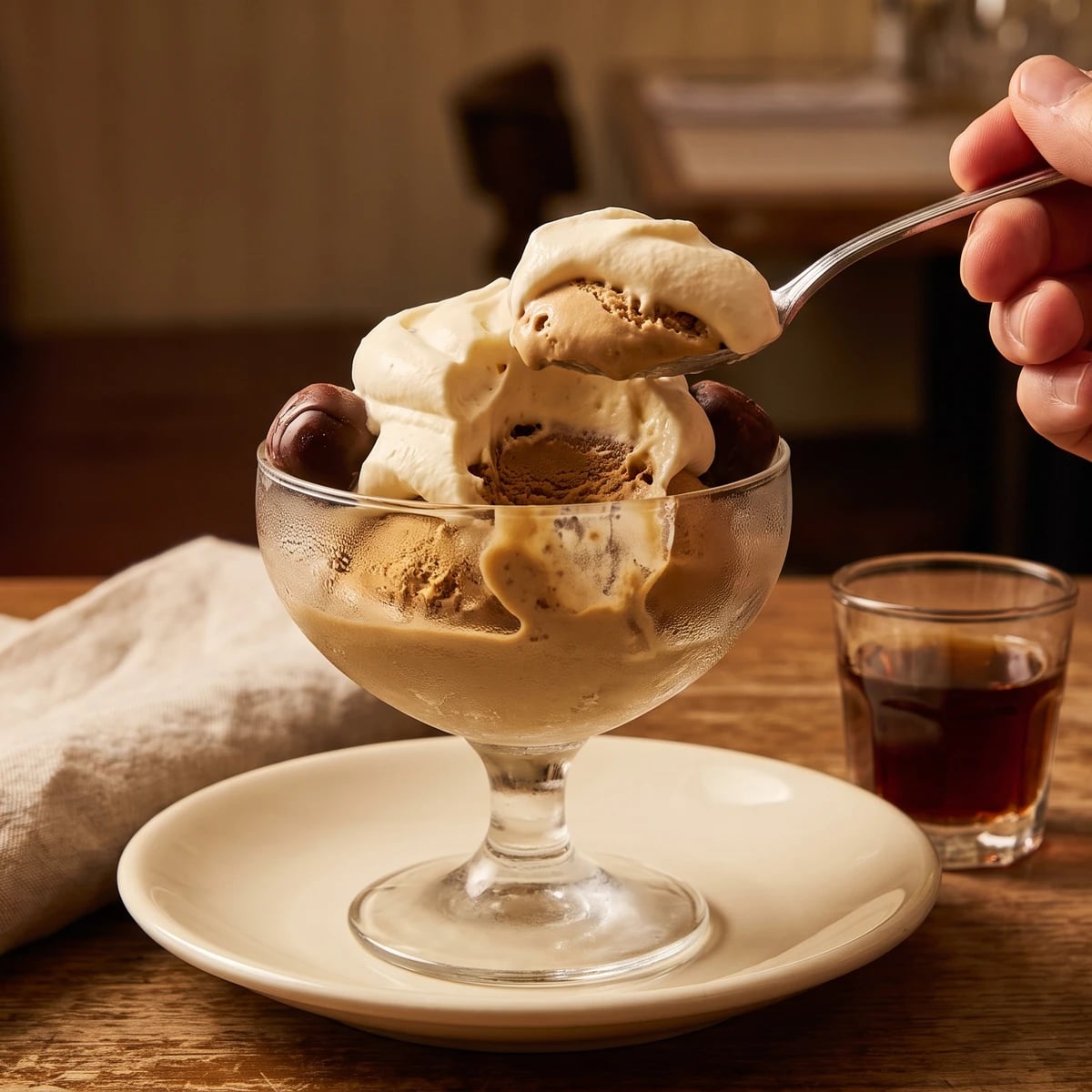
Coupes Denise set coffee-dark Moka ice against rum bonbons and softly drooping Chantilly, proving that a composed frozen dessert depends less on ornament than on temperature, proportion, and the confidence to use a spoon.
Coupes Denise (coffee-ice coupes with rum bonbons and softly whipped cream) teach a cold-dessert truth: texture changes the moment one cold thing meets another. The crème Chantilly (lightly sweetened whipped cream) must be softer than looks finished in the bowl, because the Moka ice firms it on contact. Whip to a droop, not a peak that stands at attention.
The brigade formula assumed glace moka (coffee ice cream) already frozen, Chantilly ready to order, and a confectionery drawer holding small liqueur sweets. At home, good full-fat coffee ice cream and small rum-filled bonbons are the honest equivalents, while the Chantilly takes only minutes to make. A separate ice-cream custard is brigade scaffolding here; the dish itself is the book's exact composition and sequence: Moka ice, rum bonbons, spooned cream. This version scales that composition to four coupes. One cook, one stove, one evening, though the stove gets the night off.
The pleasure is in contrast: coffee bitterness, a sudden pocket of rum, and cream settling into the hollows instead of sitting like a cold hat. The one step that decides the dish comes before assembly. Stop whipping while the Chantilly still falls from the spoon in a slow, soft ribbon.
Coupes Denise belongs to the Parisian repertoire of named coupes, individual ice-cream desserts assembled from prepared ices, confectionery, and cream at the moment of service. Such coupes traveled from grand hotel dining rooms to bourgeois dinner tables because every element could wait separately, then be composed without a pastry brigade at the table. In this formula, Moka means coffee rather than a coffee-chocolate blend, and the surviving entry gives no explanation of Denise beyond the name.
Quantity
3 cups (720 ml / about 540 g)
Quantity
¾ cup (180 ml / about 115 g), about 12
Quantity
1 cup (240 ml / 240 g), plus up to 2 tablespoons (30 ml / 30 g) for rescue
Quantity
2 tablespoons (30 ml / 15 g)
sifted
Quantity
½ teaspoon (2.5 ml / 2 g)
| Ingredient | Quantity |
|---|---|
| full-fat coffee ice cream, glace moka | 3 cups (720 ml / about 540 g) |
| small rum-filled bonbons | ¾ cup (180 ml / about 115 g), about 12 |
| cold heavy cream | 1 cup (240 ml / 240 g), plus up to 2 tablespoons (30 ml / 30 g) for rescue |
| confectioners' sugarsifted | 2 tablespoons (30 ml / 15 g) |
| pure vanilla extract | ½ teaspoon (2.5 ml / 2 g) |
Set four coupe dishes in the freezer for 30 minutes. Chill the mixing bowl and whisk in the refrigerator at the same time, but leave the rum bonbons at cool room temperature; frozen confectionery becomes unpleasantly hard beside the ice. Keep the coffee ice cream frozen until the Chantilly is nearly ready.
Pour 1 cup (240 ml / 240 g) of the cream into the cold bowl, add the confectioners' sugar and vanilla, and whisk at medium speed until the whisk leaves loose trails. Finish by hand and stop when a lifted spoonful bends into a soft droop and falls back in a slow ribbon. The cream must spread under its own weight. If it stands too stiffly, stop. Ça se rattrape: fold in the extra cold cream 1 teaspoon at a time until it relaxes. If visible butter grains have formed, it has gone beyond simple overwhipping and must be remade.
Take the Moka ice from the freezer and let it stand for 5 to 8 minutes, just until a scoop enters cleanly. It should be pliable, not melting around the rim. If the surface turns wet, return it to the freezer for 10 minutes; partially melted ice cream refreezes coarse. Divide it among the chilled coupes, giving each a generous ¾ cup (180 ml) in two or three rounded scoops.
Scatter three small rum-filled bonbons over each portion of Moka ice, letting them settle between the scoops. Keep them whole. The contained bite of liqueur is the point, and cutting liquid-centred bonbons only loses the rum onto the board.
Lay the Chantilly generously over the bonbons with a large spoon, allowing broad, soft folds to cover the ice. Don't pipe it and don't sculpt it. A pastry bag makes the cream too orderly and encourages the stiff whipping that spoils the contrast. Serve at once, while the cream still yields and the Moka ice holds its shape. À table!
1 serving (about 236g)
Culinary guides, cultural storytelling, and the editorial depth that makes cooking meaningful.
Discover Culinary Explorer
Chef Juliette
Coupes d’Antigny layers wild strawberry ice, fresh cream, vanilla-poached peach, and spun sugar into one cold lesson in timing: soften the ice carefully, then spin the brittle veil only when the table is ready.

Chef Juliette
Coupes Clo-clo marry vanilla ice, maraschino-soaked marrons glacés, and strawberry Chantilly in a festive glass: cold against cream, cherry perfume against chestnut, softness against a firm piped ridge.

Chef Juliette
Coupes Dame Blanche set a vanilla-poached peach over snowy almond-milk ice, hiding Bar-le-Duc currant jam beneath its dome and circling it with a bright piped cord of lemon ice.

Chef Juliette
Vanilla ice cream, cherries chilled until their syrup gleams, and raspberry-pink Chantilly piled high: a named French coupe whose success rests on one last, gentle fold.