
Chef Juliette
The Making of Ices
Freezing is the recipe: pack ice hard with salt, keep the canister moving, and scrape each frozen film into the base until the Glaces turn smooth, fine, and homogeneous.
A cooking platform built around craft, culture, and the stories behind what we eat.
Created by Chef Juliette
Based on No. 2750, Filbert Ice-cream, from Le Guide Culinaire (1907) by Auguste Escoffier
Lightly torrified filberts, pounded with milk and infused for twenty minutes, give this custard ice its round, toasted perfume. Stop at pale gold, because one shade darker turns the whole churn bitter.
Glace aux avelines (filbert ice cream) teaches one exact lesson: torréfaction, light dry toasting, must stop at pale gold. Heat wakes the filberts' fragrant oils, but one shade too dark makes them bitter, and neither sugar nor cream can hide it. That is the one true thing to know before you touch a pan.
The book's compact instruction assumed a pastry section with boiled milk ready, a heavy mortar for pounding, a familiar ice-cream base, and a salt-and-ice freezing pail worked by another pair of hands. This home version keeps its 3½ ounces of filberts, its milk-softened paste, and its twenty-minute infusion exactly where they belong, then writes out a one-quart crème anglaise (stirred custard) and hands the pounding to a food processor and the freezing to a countertop churn. The large service quantity and freezing pail were brigade scaffolding. The light toast and hot-milk infusion are the dish, and they stay.
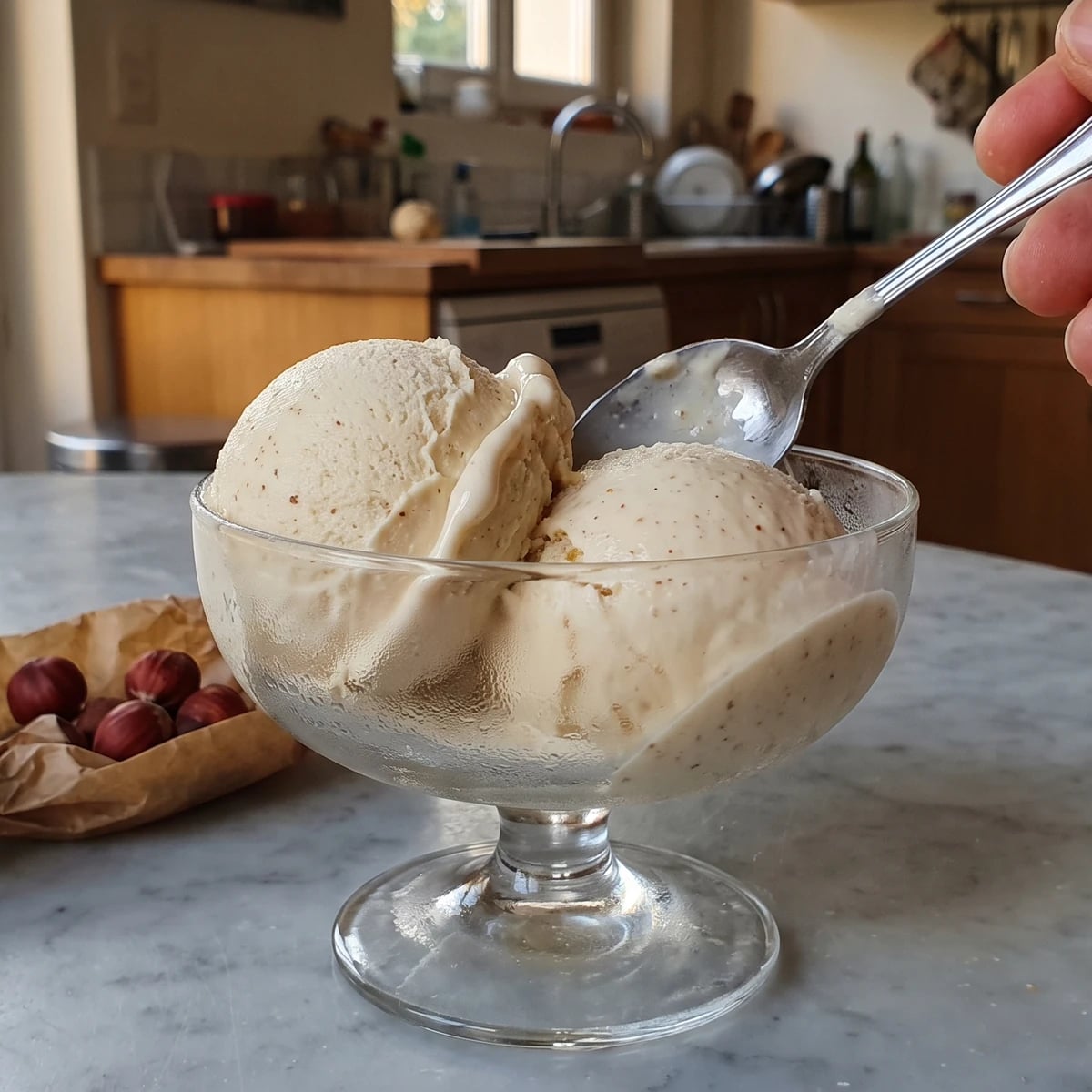
The finished glace is pale ivory with fine russet flecks, full of warm hazelnut fragrance but clean and milky on the tongue. Nothing needs vanilla, caramel, or liqueur to announce the nut. One cook, one stove, one evening. Before you begin, learn the colour that decides everything: pale gold, never brown.
Glace aux avelines belongs to the repertory of Parisian confiseurs and pastry kitchens, where pounded nut pastes carried their perfume into custard ices served at both grand and bourgeois tables. In classical kitchen vocabulary, the filbert, or aveline, meant the large red-skinned hazelnut prized for the fragrance released by gentle torréfaction. This is an infused milk ice rather than a praline ice cream, so the nuts are toasted and steeped, never caramelized with sugar.
Quantity
¾ cup (100 g / 3½ oz)
Quantity
1½ cups (360 ml / 370 g)
divided
Quantity
1 cup (240 ml / 240 g)
kept cold
Quantity
½ cup plus 2 tablespoons (150 ml / 125 g)
Quantity
5 large (about 90 g)
| Ingredient | Quantity |
|---|---|
| whole red-skinned filberts (hazelnuts) | ¾ cup (100 g / 3½ oz) |
| whole milkdivided | 1½ cups (360 ml / 370 g) |
| heavy cream, 35 to 40% fatkept cold | 1 cup (240 ml / 240 g) |
| granulated sugar | ½ cup plus 2 tablespoons (150 ml / 125 g) |
| large egg yolks | 5 large (about 90 g) |
Heat the oven to 325°F (165°C). Spread the filberts in one layer on a small rimmed pan and toast for 7 to 10 minutes, shaking the pan once, until their skins deepen slightly and a cut nut is pale honey-gold inside. Their fragrance should be warm and sweet, never sharp or coffee-like. Cool for 5 minutes, then rub away only the skins that slip off readily. If one or two nuts have scorched, remove them and replace their weight; if the whole batch is brown within, begin again. Bitterness cannot be strained out.
Measure 3 tablespoons (45 ml / 46 g) from the milk and set the rest aside. Pulse the warm filberts in a food processor until finely ground, then add the measured milk a spoonful at a time and continue until you have a thick, fine paste. Scrape the bowl often. Stop if oil begins pooling around the blade, then work in another spoonful taken from the remaining milk to bring the paste together. A mortar and pestle gives the same result with more elbow, but no greater virtue.
Bring the remaining milk to a full boil in a heavy saucepan, then take it off the heat at once. Scrape in every bit of filbert paste, whisk until evenly dispersed, cover, and infuse for exactly 20 minutes. This hot-milk infusion is the heart of the formula. A longer steep does not make the flavour nobler; it begins drawing bitterness from the red skins.
Pass the infused milk through a fine-mesh sieve into the rinsed saucepan. Press the paste steadily with a flexible spatula to recover the fragrant milk, but don't force coarse grit through the mesh. Reserve 2 tablespoons (30 ml / 30 g) of the cold cream in a metal bowl set over ice, then add the remaining cream to the saucepan. Warm gently until small bubbles gather around the edge, without letting it boil.
Whisk the yolks and sugar in a bowl just until smooth and slightly lighter. Pour in one-third of the hot filbert milk while whisking, then return everything to the saucepan. Cook over low heat, stirring constantly along the floor and into the corners with a flexible spatula, until the crème anglaise reaches 175 to 180°F (79 to 82°C) and coats the back of the spatula. Draw a finger through it; the line should remain clean. Never boil it.
Immediately strain the crème anglaise into the reserved cold cream over the ice bath. If you see the first fine grains of curdled yolk, pour it onto that cold cream at once, blend briefly until smooth, and then strain. Ça se rattrape when caught early. Stir over the ice for about 15 minutes, until thoroughly cool, then cover and refrigerate for at least 2 hours, or overnight, until the base is no warmer than 40°F (4°C). A warm base churns slowly and forms coarse crystals.
Stir the cold base, pour it into the prepared ice-cream machine, and churn according to the machine's directions, usually 20 to 25 minutes. Stop when the glace holds soft ridges and falls from the paddle in a heavy fold. If it remains loose after 30 minutes, stop before the cream turns grainy, return the base to the cold, refreeze the machine bowl completely, and churn again.
Pack the freshly churned glace into a shallow freezer container, press parchment directly against the surface, cover, and freeze for about 2 hours for a firm, scoopable texture. Let it stand at room temperature for 5 to 10 minutes before serving, just until a spoon enters without a struggle. Serve generous scoops with nothing scattered over them. The clean filbert perfume is the finish. À table!
1 serving (about 110g)
Culinary guides, cultural storytelling, and the editorial depth that makes cooking meaningful.
Discover Culinary Explorer
Chef Juliette
Freezing is the recipe: pack ice hard with salt, keep the canister moving, and scrape each frozen film into the base until the Glaces turn smooth, fine, and homogeneous.

Chef Juliette
Pack a prepared glace until no air remains, harden it under salted ice, and turn it out with one quick tepid dip: clean fluting, a close surface, and no hollow pockets.

Chef Juliette
One cream base, one fruit-syrup base, and the classical rule beneath both: sugar and yolks set the texture before the freezer does, so measure first and churn only when the balance is right.

Chef Juliette
The custard beneath every French cream ice: yolks and sugar drawn to the ribbon, hot milk added slowly, then gentle heat until the spoon wears a satin veil and never a bubble.