
Chef Juliette
Various Almond Preparations
Five almond preparations, one discipline: remove the skins cleanly, dry every kernel through, then cut, toast, or cloak it in pale caramel without letting its fragrant oils escape.
A cooking platform built around craft, culture, and the stories behind what we eat.
Created by Chef Juliette
Based on No. 2749, Asparagus Ice-cream, from Le Guide Culinaire (1907) by Auguste Escoffier
Glace aux asperges sounds mischievous, but its lesson is exact: blanch the tips for two minutes, no more, then let milk, cream, and cold turn their green flavor into silk.
Glace aux asperges teaches the discipline of green flavor: two minutes in boiling water, no more. The asparagus should emerge vivid, sweet, and unmistakable inside a pale custard. Let it linger and the green goes grey before the freezer can save you. That timer is the one true thing to know before touching a pan.
The written entry gives the flavoring operation and assumes its cook already knows the house ice-cream base, has a mortar and tammy, the fine cloth sieve, ready, and can tend an ice-and-salt freezing pot. Here the implicit base is written out as a small crème anglaise, a stirred custard, scaled around the source's full six ounces of tips to make about one quart. A blender replaces the mortar, a fine sieve replaces the tammy, and a countertop machine freezes the custard quickly. The repeated pounding and hand-freezing were brigade scaffolding and can go; the two-minute blanch, milk infusion, and fine straining are the dish and must stay. One cook, one stove, one evening.
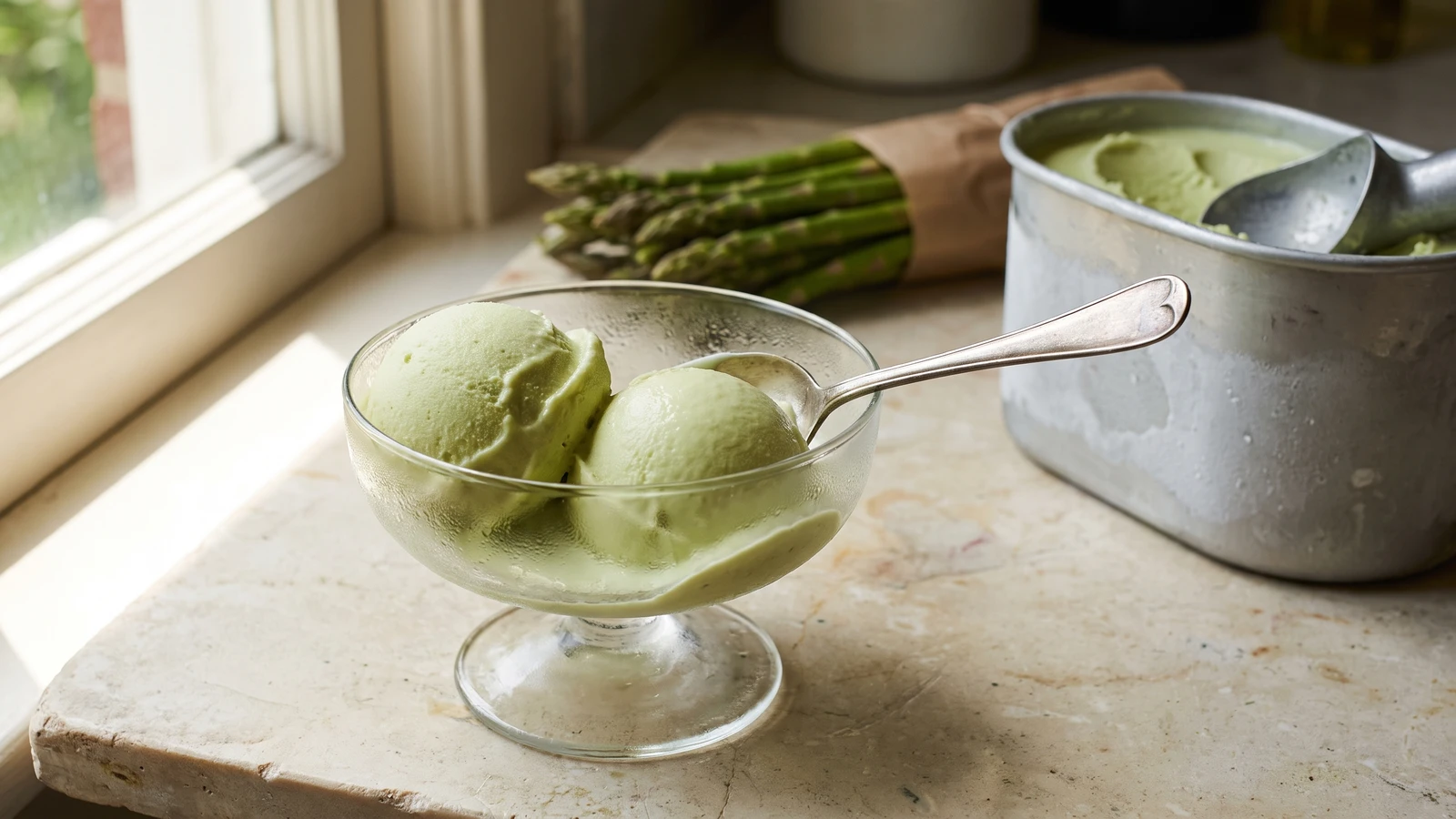
Once churned, the Glace aux asperges is cool ivory-green, creamy rather than icy, with sweet cream arriving first and asparagus following clearly behind it. Prepare the sieve and ice bath before you blanch, and if the custard catches later, don't surrender it. Ça se rattrape. Above all, set the timer before the asparagus meets the water; those two minutes decide the dish.
Glace aux asperges belongs to the Parisian grand-kitchen repertoire rather than a regional farmhouse table, one of the vegetable ices served among the sweet entremets of formal dinners. Its method treats spring asparagus tips as a perfume, blanching, pounding, and infusing them in boiled milk before the familiar ice-cream base is frozen. Mechanical freezing carried the dish naturally to domestic tables, but its identity remains precise: a sweet dairy ice from the national classical canon, not a frozen potage or a provincial specialty in disguise.
Quantity
6 oz (170 g)
woody ends discarded
Quantity
2 cups (480 ml / 495 g)
divided
Quantity
1 cup (240 ml / 240 g)
cold
Quantity
3/4 cup (180 ml / 150 g)
Quantity
5
| Ingredient | Quantity |
|---|---|
| tender green asparagus tips or spruewoody ends discarded | 6 oz (170 g) |
| whole milkdivided | 2 cups (480 ml / 495 g) |
| heavy creamcold | 1 cup (240 ml / 240 g) |
| superfine sugar | 3/4 cup (180 ml / 150 g) |
| large egg yolks | 5 |
Have the ice-cream maker ready according to its instructions. Set a fine-mesh sieve over a clean bowl, then nest a second bowl containing the cold cream inside a larger bowl of ice water. Bring a large pot of water to a strong boil. Everything after the blanch moves quickly, so arrange it now, while your hands are calm.
Lower the asparagus tips into the boiling water and start the timer immediately. Parboil for exactly two minutes, then drain thoroughly, shaking away every drop you can. Work at once. Wet asparagus dilutes the custard, while an extra minute of heat turns its clean green flavor dull and its color grey. If you overshoot by a few seconds, drain immediately and spread the tips on a cold tray; the flavor survives, though the green will be quieter.
Take 3 tablespoons (45 ml / 46 g) from the measured milk and blend it with the warm asparagus until you have the smoothest paste possible. Meanwhile, bring the remaining milk just to a boil in a heavy saucepan, then remove it from the heat. Stir in the asparagus paste, cover, and infuse for ten minutes. This preserves the source's sequence exactly: blanch, drain, pound with a few spoonfuls of milk, then infuse in boiled milk.
Pour the asparagus milk through the prepared fine-mesh sieve into a clean saucepan. Press firmly with a flexible spatula, working in small circles until only dry, stringy fibers remain. Do not skip this pass. Asparagus fibers that seem harmless while warm freeze into threads on the tongue; the sieve is what turns vegetable purée into a proper ice.
Reheat the strained asparagus milk until small bubbles appear around the edge, but do not boil it. Whisk the yolks and sugar in a bowl just until smooth. Pour one-third of the hot milk slowly into the yolks while whisking, then return everything to the saucepan. Stir constantly over low heat until the crème anglaise reaches 170 to 175°F (77 to 80°C), coats the back of a spoon, and leaves a clean track when you draw a finger through it. Never let it boil. If tiny curds appear, lift the pan from the heat, set its base briefly in the ice bath, and blend for ten seconds before straining. Ça se rattrape.
Immediately strain the crème anglaise into the cold cream waiting over the ice bath, even if the custard looks perfectly smooth. Stir until the mixture feels thoroughly cold and falls below 50°F (10°C). Cover directly against the surface and refrigerate until it reaches 40°F (4°C) or colder, about one hour after a proper ice-bath chilling. A warm base freezes slowly, and slow freezing makes coarse crystals.
Churn the cold base according to the machine's instructions, usually twenty to thirty minutes, until it has the body of thick crème fraîche and the dasher leaves deep furrows behind it. Scrape it into a shallow chilled container, cover the surface directly, and freeze for about two hours to ripen. If the machine finishes while the base is still pourable, transfer it to a shallow metal pan, freeze for thirty minutes, then beat it firmly with a whisk and repeat once. The texture will be denser, but it will serve proudly.
Let the Glace aux asperges stand at room temperature for five to eight minutes, just until a spoon enters without force. Shape two modest scoops or quenelles into each chilled coupe and serve without a distracting garnish. The color should be a quiet spring green, not pistachio-bright, and the texture should yield before it melts. À table!
1 serving (about 185g)
Culinary guides, cultural storytelling, and the editorial depth that makes cooking meaningful.
Discover Culinary ExplorerChef Juliette
Five almond preparations, one discipline: remove the skins cleanly, dry every kernel through, then cut, toast, or cloak it in pale caramel without letting its fragrant oils escape.

Chef Juliette
A pastry pantry lesson in one tray: filberts warmed only until their red skins release, rubbed clean, cooled, and chopped into a fragrant mise-en-place for cakes, creams, pralines, and petits fours.

Chef Juliette
The smallest pâtisserie discipline decides whether a cake leaves its mould intact: clarified butter in every corner, followed by the lightest veil of dry flour or fécule.

Chef Juliette
Four whites, one spotless bowl, and a patient change of speed: whisk gently until loosened, then briskly to glossy stiffness, with powdered sugar waiting if the foam begins to granulate.