
Chef Juliette
Various Almond Preparations
Five almond preparations, one discipline: remove the skins cleanly, dry every kernel through, then cut, toast, or cloak it in pale caramel without letting its fragrant oils escape.
A cooking platform built around craft, culture, and the stories behind what we eat.
Created by Chef Juliette
Based on No. 2742, Fraisalia Timbale, from Le Guide Culinaire (1907) by Auguste Escoffier
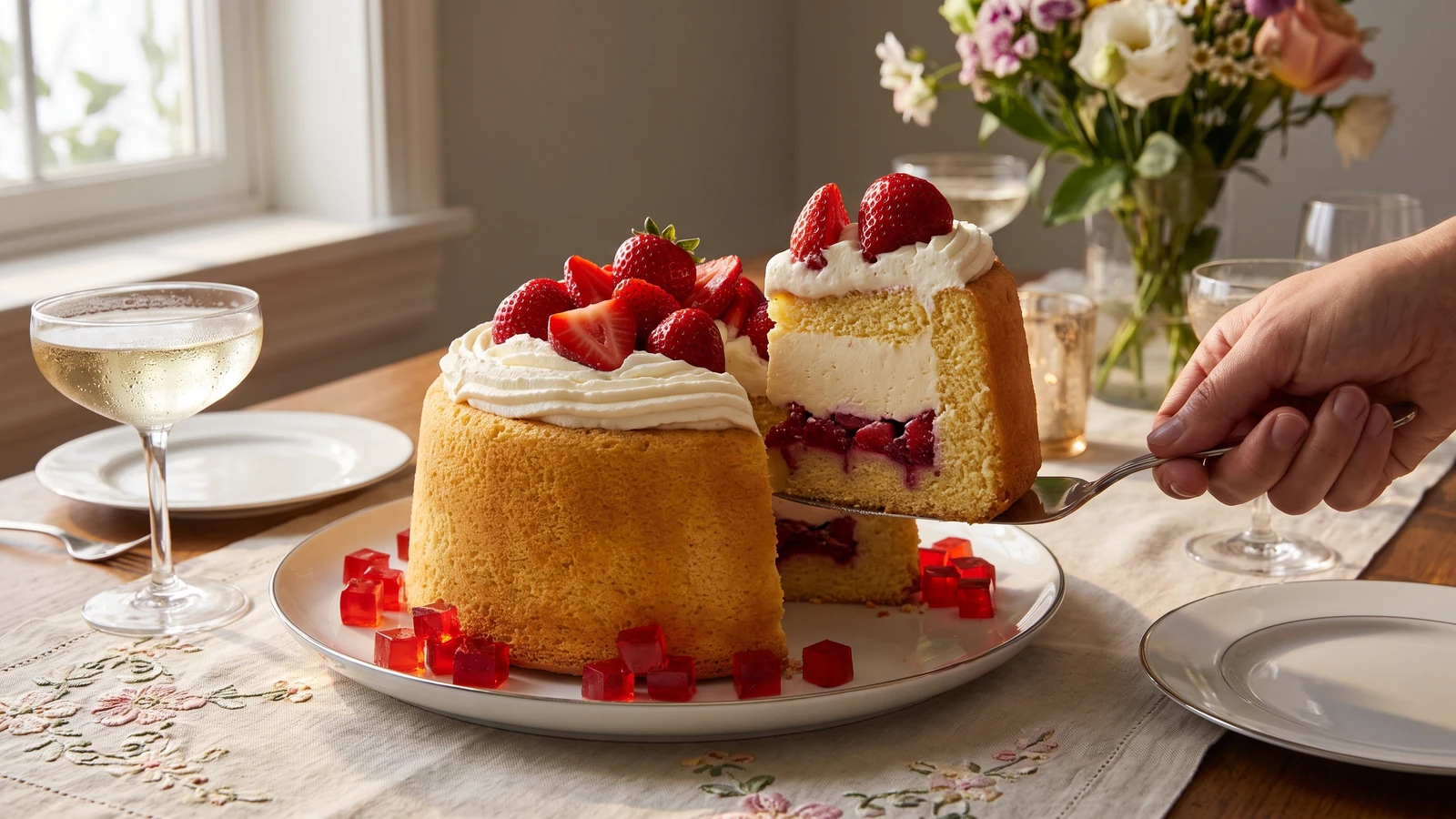
A golden savarin shell hides cool layers of vanilla Bavarois and kirsch-bright strawberries, then rises under a generous pyramid of Chantilly, red berries, and jewel-cut strawberry jelly.
Timbale Fraisalia (a hollow yeast-raised cake filled with vanilla cream and kirsched strawberries) teaches architecture before ornament. The one true thing to know is this: the baked shell must keep a full half-inch wall and base when you hollow it. Cut thinner and the cream-filled timbale gives way; leave it stout and it unmoulds cleanly, carrying its cool vanilla layers with quiet confidence.
The original assumed separate hands making pâte à savarin, Bavarois, Chantilly, and clarified strawberry jelly, plus a Charlotte mould held in crushed ice. Here the quantities fit one 6-inch mould, the refrigerator replaces the ice surround, and a shallow pan of gelatin-set strawberry purée replaces the brigade's jewel-clear jelly. That clarity was service polish, not the dish. The yeast-raised shell, kirsch syrup, alternating Bavarois and berries, double turn, and Chantilly crown all stay because they are the dish. Wild strawberries are rarely sold by the punnet, so very small ripe cultivated berries take their place; they are less musky, but they hold their shape and carry the kirsch beautifully.
The Bavarois, a set vanilla custard folded with whipped cream, must be cool and just beginning to thicken before it meets the shell. Warm filling soaks the crumb, while over-set filling won't settle into the corners. Catch it between those states and the timbale slices into pale vanilla, scarlet fruit, and butter-gold cake. One cook, one stove, one evening, with the refrigerator doing the waiting. Before you fill it, measure that half-inch wall; this is the step that decides the whole timbale.
Timbale Fraisalia belongs to the Parisian entremets repertoire rather than to a regional farmhouse table: a Charlotte mould supplies the architecture, while pâte à savarin, Bavarois, Chantilly, kirsch, and strawberries unite several classical pastry preparations. In grand kitchens those components passed between separate hands and the filled mould was held in ice, allowing an elaborate cold dessert to reach the celebration table intact. It is sometimes mistaken for a strawberry charlotte, but its yeast-raised savarin wall, baked and then hollowed, gives the timbale its distinct character.
Quantity
7 tablespoons (105 ml / 100 g)
divided, softened for the mould and melted for the pâte à savarin
Quantity
1⅔ cups (400 ml / 200 g)
Quantity
2 teaspoons (10 ml / 6 g)
Quantity
2 tablespoons (30 ml / 25 g)
for the pâte à savarin
Quantity
½ teaspoon (2.5 ml / 3 g)
Quantity
2 tablespoons (30 ml / 30 g)
lukewarm
Quantity
3
at room temperature
Quantity
1 cup (240 ml / 240 g)
Quantity
¼ cup (60 ml / 60 g)
for the strawberry jelly
Quantity
¼ cup (60 ml / 50 g)
for the strawberry jelly
Quantity
2 teaspoons (10 ml / 6 g)
for the strawberry jelly
Quantity
⅓ cup (80 ml / 80 g)
for the kirsch syrup
Quantity
⅓ cup (80 ml / 67 g)
for the kirsch syrup
Quantity
¼ cup (60 ml / 56 g)
divided between the syrup and strawberries
Quantity
2 cups (480 ml / 300 g)
hulled, for the filling
Quantity
2 tablespoons (30 ml / 25 g)
for macerating the strawberries
Quantity
2 tablespoons (30 ml / 30 g)
for the Bavarois
Quantity
2¼ teaspoons (11 ml / 7 g)
for the Bavarois
Quantity
1 cup (240 ml / 245 g)
for the Bavarois
Quantity
1
split and scraped
Quantity
4
Quantity
⅓ cup (80 ml / 67 g)
for the Bavarois
Quantity
1 cup (240 ml / 240 g)
for the Bavarois
Quantity
1 cup (240 ml / 240 g)
for the Chantilly
Quantity
2 tablespoons (30 ml / 15 g)
Quantity
1 teaspoon (5 ml / 5 g)
Quantity
2 cups (480 ml / 300 g)
hulled, left whole or halved for finishing
| Ingredient | Quantity |
|---|---|
| unsalted butterdivided, softened for the mould and melted for the pâte à savarin | 7 tablespoons (105 ml / 100 g) |
| strong bread flour | 1⅔ cups (400 ml / 200 g) |
| instant yeast | 2 teaspoons (10 ml / 6 g) |
| granulated sugarfor the pâte à savarin | 2 tablespoons (30 ml / 25 g) |
| fine salt | ½ teaspoon (2.5 ml / 3 g) |
| whole milklukewarm | 2 tablespoons (30 ml / 30 g) |
| large eggsat room temperature | 3 |
| strained strawberry purée | 1 cup (240 ml / 240 g) |
| cold waterfor the strawberry jelly | ¼ cup (60 ml / 60 g) |
| granulated sugarfor the strawberry jelly | ¼ cup (60 ml / 50 g) |
| powdered gelatinfor the strawberry jelly | 2 teaspoons (10 ml / 6 g) |
| waterfor the kirsch syrup | ⅓ cup (80 ml / 80 g) |
| granulated sugarfor the kirsch syrup | ⅓ cup (80 ml / 67 g) |
| kirschdivided between the syrup and strawberries | ¼ cup (60 ml / 56 g) |
| very small ripe strawberrieshulled, for the filling | 2 cups (480 ml / 300 g) |
| granulated sugarfor macerating the strawberries | 2 tablespoons (30 ml / 25 g) |
| cold waterfor the Bavarois | 2 tablespoons (30 ml / 30 g) |
| powdered gelatinfor the Bavarois | 2¼ teaspoons (11 ml / 7 g) |
| whole milkfor the Bavarois | 1 cup (240 ml / 245 g) |
| vanilla beansplit and scraped | 1 |
| large egg yolks | 4 |
| granulated sugarfor the Bavarois | ⅓ cup (80 ml / 67 g) |
| cold heavy creamfor the Bavarois | 1 cup (240 ml / 240 g) |
| cold heavy creamfor the Chantilly | 1 cup (240 ml / 240 g) |
| confectioners' sugar | 2 tablespoons (30 ml / 15 g) |
| pure vanilla extract | 1 teaspoon (5 ml / 5 g) |
| small red strawberrieshulled, left whole or halved for finishing | 2 cups (480 ml / 300 g) |
Sprinkle the gelatin over 2 tablespoons of the cold water and leave it for 5 minutes to swell. Warm the remaining water with the sugar and half the strawberry purée just until the sugar dissolves, then remove it from the heat and stir in the bloomed gelatin. Add the remaining purée and pass the mixture through a fine sieve. Pour it into a lined 8-inch (20 cm) square pan, making a shallow layer, and refrigerate until firmly set, about 2 hours. If threads of gelatin remain, warm the mixture gently and strain it again before chilling. Ça se rattrape.
Use 1 tablespoon of the softened butter to coat the Charlotte mould thoroughly, paying attention to the bottom edge. Combine the flour, yeast, sugar, and salt in a mixer bowl. Add the lukewarm milk and eggs, then beat with the paddle on low speed until no dry flour remains. Increase to medium and beat for 6 to 8 minutes, until the pâte à savarin, a soft yeast-raised dough, looks elastic and falls from the paddle in sticky ribbons. Beat in the remaining melted, cooled butter one spoonful at a time. If the dough turns greasy, stop adding butter and beat until it absorbs what is already there, then continue. Cover and let it rise until doubled, 60 to 90 minutes.
Stir the risen dough down firmly, then scrape it into the buttered mould and smooth the surface with damp fingers. It should fill roughly one-third of the mould. Cover and let it rise until it reaches about three-quarters of the height, 30 to 45 minutes. Bake at 350°F (175°C) for 30 to 35 minutes, until deep butter-gold and about 190°F (88°C) at the centre. If the top browns before the middle is ready, lay foil loosely over it. Rest for 10 minutes, loosen the edge with a thin knife, and turn it onto a rack. Cool completely before hollowing, at least 1 hour; warm crumb tears instead of cutting.
Bring the syrup water and sugar to a boil, stirring only until the sugar dissolves, then simmer for 1 minute. Cool it until merely warm and stir in 2 tablespoons of the kirsch; adding the spirit off the heat keeps its cherry perfume. Toss the filling strawberries with the macerating sugar and remaining 2 tablespoons of kirsch. Leave them for 20 minutes, then drain them thoroughly in a sieve. Do not let them sit in the liquor for hours, or they soften and bleed into the Bavarois.
Set the cooled savarin upright as it baked. With a small serrated knife, cut a circle exactly ½ inch (1.25 cm) inside the rim, stopping ½ inch above the base. Lift out the centre crumb in pieces, then neaten the cavity with a spoon while measuring the wall and base in several places. Brush the cavity thinly with kirsch syrup, stopping when the crumb is fragrant and lightly tacky rather than sodden. If the knife nicks through a wall, press a piece of reserved crumb into the opening from inside and brush it lightly with syrup. Ça se rattrape. Return the shell to the clean, dry Charlotte mould in its original position.
Sprinkle the Bavarois gelatin over its cold water and leave it to bloom for 5 minutes. Heat the milk with the vanilla seeds and pod until small bubbles appear at the edge. Whisk the yolks and sugar until smooth, then pour in the hot milk gradually while whisking. Return everything to the saucepan and cook over gentle heat, stirring constantly, until the crème anglaise coats the spoon and reaches 170 to 175°F (77 to 79°C). Never let it boil. If tiny curds appear, remove it from the heat at once, blend briefly, and strain; ça se rattrape before the eggs cook hard. Remove the vanilla pod, dissolve the bloomed gelatin in the hot custard, and strain it into a bowl set over ice. Stir until cool and just beginning to gain body. Whip the cold cream to soft peaks and fold it into the custard in three additions. If the custard sets around the bowl before folding, hold it over lukewarm water for a few seconds and stir until smooth again.
Spoon a layer of Bavarois into the hollow shell, spreading it into every corner without soaking the wall. Scatter over a layer of well-drained kirsched strawberries, keeping them level rather than pressing them down. Continue with alternating layers, finishing with Bavarois flush with the opening. Tap the mould once against a folded towel to settle any hidden air pockets. Cover and refrigerate until completely firm, at least 4 hours and preferably overnight.
Whip the Chantilly cream with the confectioners' sugar and vanilla to medium peaks that hold their shape without looking grainy. Place a flat plate over the mould and invert the timbale onto it. If it refuses to release, wrap the mould for 5 seconds in a towel wrung out with hot water, then try again without tugging. Place the final serving dish over the exposed base and turn the timbale a second time, restoring it to its baked position as the source method requires. Pile the Chantilly into a generous pyramid and stud it with whole small strawberries or large strawberry halves. Cut the set jelly into fine dice and arrange them around the base. Serve well chilled. À table!
1 serving (about 315g)
Culinary guides, cultural storytelling, and the editorial depth that makes cooking meaningful.
Discover Culinary ExplorerChef Juliette
Five almond preparations, one discipline: remove the skins cleanly, dry every kernel through, then cut, toast, or cloak it in pale caramel without letting its fragrant oils escape.

Chef Juliette
A pastry pantry lesson in one tray: filberts warmed only until their red skins release, rubbed clean, cooled, and chopped into a fragrant mise-en-place for cakes, creams, pralines, and petits fours.

Chef Juliette
The smallest pâtisserie discipline decides whether a cake leaves its mould intact: clarified butter in every corner, followed by the lightest veil of dry flour or fécule.

Chef Juliette
Four whites, one spotless bowl, and a patient change of speed: whisk gently until loosened, then briskly to glossy stiffness, with powdered sugar waiting if the foam begins to granulate.