
Chef Juliette
Various Almond Preparations
Five almond preparations, one discipline: remove the skins cleanly, dry every kernel through, then cut, toast, or cloak it in pale caramel without letting its fragrant oils escape.
A cooking platform built around craft, culture, and the stories behind what we eat.
Created by Chef Juliette
Based on No. 2737, Mousselines d’Œufs Rejane, from Le Guide Culinaire (1907) by Auguste Escoffier
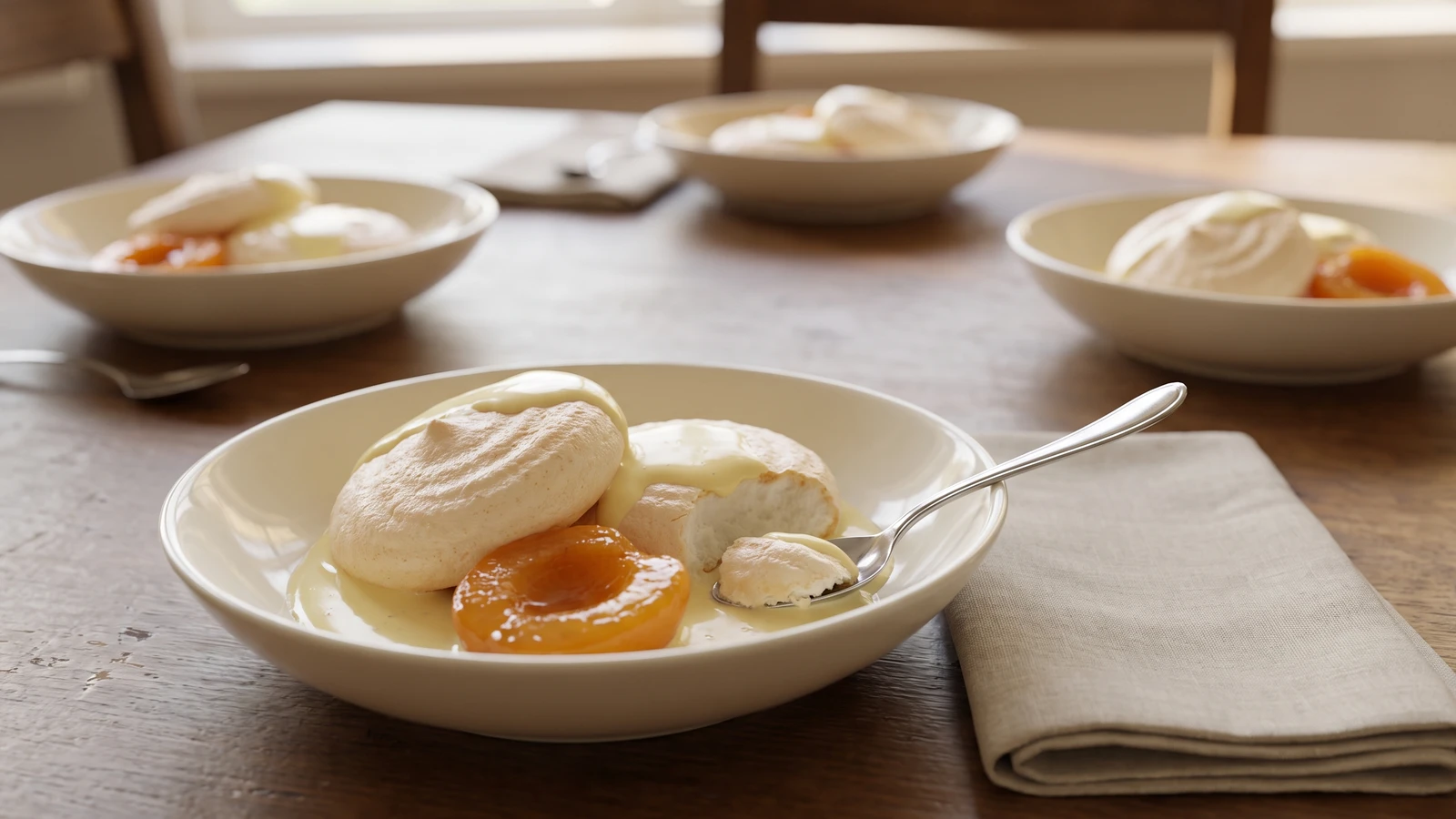
Mousselines d’Œufs Rejane turn ordinary meringue into vanilla-poached cushions, arranged two by two around apricot and veiled with crème anglaise, a lesson in gentle heat and confident timing.
Mousselines d’Œufs Rejane (vanilla-poached meringues with apricot and custard) teaches the gentleness behind every poached egg-white dessert in the canon. The one true thing to know before touching the pan is this: the milk must reach the boil, as the source directs, then settle to the barest tremble before the meringues float free. A rolling boil tears them; timid warmth leaves them pasted to the paper.
The original entry assumed a pastry station with Ordinary Meringue (No. 2382) already whipped, sweet vanilla milk beside it, poached apricots and crème anglaise ready, plus silver or porcelain egg dishes waiting for service. At home, use a quarter batch of that same finished meringue, food-safe parchment in place of white paper, one wide pan, and four small porcelain dishes. The separate brigade hands were scaffolding, so they go; the paper-release poach, the apricot at the center, and the custard veil are the dish, so they stay. One cook, one stove, one evening.
The finished mousselines are soft and buoyant, with vanilla in the milk, sunny apricot at the center, and just enough cool custard to bind each spoonful. Before the pan, have every dish, apricot, spoon, and draining cloth in place; once the milk is ready, the clean release from the paper is the step that decides the whole dessert.
Mousselines d’Œufs Rejane belongs to the named entremets of the Parisian grand-kitchen canon, where familiar pastry and custard techniques were composed as tributes for the dining room. Réjane was a celebrated Parisian actress, and the dessert bearing her stage name follows that custom without pretending to be regional farmhouse cooking. The title can mislead: these are not whole eggs, but piped meringue forms served in egg dishes, with apricot and crème anglaise supplying the yolk color and creamy finish.
Quantity
¼ batch, about 1½ cups (360 ml / 175 g) Ordinary Meringue (No. 2382)
freshly made
Quantity
4 cups (960 ml / 990 g)
for poaching
Quantity
¼ cup (60 ml / 50 g)
for the poaching milk
Quantity
1
split lengthwise and halved crosswise
Quantity
⅔ cup (160 ml / 165 g)
for the crème anglaise
Quantity
2
Quantity
2 tablespoons (30 ml / 25 g)
for the crème anglaise
Quantity
4 halves (about 120 g drained)
well drained
| Ingredient | Quantity |
|---|---|
| Ordinary Meringuefreshly made | ¼ batch, about 1½ cups (360 ml / 175 g) Ordinary Meringue (No. 2382) |
| whole milkfor poaching | 4 cups (960 ml / 990 g) |
| granulated sugarfor the poaching milk | ¼ cup (60 ml / 50 g) |
| vanilla beansplit lengthwise and halved crosswise | 1 |
| whole milkfor the crème anglaise | ⅔ cup (160 ml / 165 g) |
| large egg yolks | 2 |
| granulated sugarfor the crème anglaise | 2 tablespoons (30 ml / 25 g) |
| poached apricot halves, homemade or canned in light syrupwell drained | 4 halves (about 120 g drained) |
Make the crème anglaise (English custard) first. Heat the ⅔ cup milk with one half of the vanilla bean until small bubbles gather at the edge, then take it from the heat and let the vanilla stand for 5 minutes. Whisk the yolks with the 2 tablespoons sugar until smooth, pour in the warm milk gradually, and return everything to gentle heat. Stir constantly until the custard reaches 82 to 84°C and nappes the spoon, meaning a finger drawn through the coating leaves a clean path. Never let it boil. If fine curds appear, lift it from the heat at once, whisk over cold water, and pass it through a fine sieve. Ça se rattrape. Cover the surface and cool it over cold water, then chill.
Drain the apricot halves and set out four small egg dishes. Cut four rectangles of uncoated parchment, each about 10 by 15 cm. Fit a piping bag with a 12 mm plain tip and fill it with the finished Ordinary Meringue (No. 2382). Pipe two smooth rounds onto each paper, about 5 to 6 cm wide and 2 cm high, resembling large macaroons. Keep them equal so they poach at the same rate, and leave space between them for the milk to circulate.
Pour the 4 cups milk into a wide, deep-sided pan and add the ¼ cup sugar and remaining vanilla. Stir over medium heat until the sugar dissolves, then bring the milk once to a full boil. Lower the heat immediately until the surface barely trembles, about 88 to 92°C. The first boil prepares the wet heat that releases the meringue; the quiet poach keeps its shape. Watch the pan closely, because sweetened milk climbs without warning.
Working with one parchment sheet at a time, hold it by the short edges and lay it flat on the milk with the meringues facing upward. Let the milk wet the paper from beneath; after 10 to 20 seconds, the rounds should sever cleanly and float. Lift away the empty paper. If one clings, spoon hot milk against the underside and wait rather than scraping it. Ça se rattrape. Poach at the barest tremble for about 2 minutes, turn gently with a slotted spoon, and poach for another 1½ to 2 minutes, until each mousseline feels set and softly springy at its center. Drain on a clean cloth and repeat with the remaining sheets. If the milk begins rolling, pull the pan partly off the heat before continuing.
Set two drained mousselines side by side in each porcelain egg dish and place one poached apricot half in the middle, rounded side up. Spoon about 2 tablespoons of cool crème anglaise over and around each arrangement, giving the meringue a light veil rather than drowning it. Serve promptly while the mousselines remain buoyant and the apricot holds its bright shape. À table!
1 serving (about 135g)
Culinary guides, cultural storytelling, and the editorial depth that makes cooking meaningful.
Discover Culinary ExplorerChef Juliette
Five almond preparations, one discipline: remove the skins cleanly, dry every kernel through, then cut, toast, or cloak it in pale caramel without letting its fragrant oils escape.

Chef Juliette
A pastry pantry lesson in one tray: filberts warmed only until their red skins release, rubbed clean, cooled, and chopped into a fragrant mise-en-place for cakes, creams, pralines, and petits fours.

Chef Juliette
The smallest pâtisserie discipline decides whether a cake leaves its mould intact: clarified butter in every corner, followed by the lightest veil of dry flour or fécule.

Chef Juliette
Four whites, one spotless bowl, and a patient change of speed: whisk gently until loosened, then briskly to glossy stiffness, with powdered sugar waiting if the foam begins to granulate.