
Chef Juliette
Various Almond Preparations
Five almond preparations, one discipline: remove the skins cleanly, dry every kernel through, then cut, toast, or cloak it in pale caramel without letting its fragrant oils escape.
A cooking platform built around craft, culture, and the stories behind what we eat.
Created by Chef Juliette
Based on No. 2732, Mont-Blanc aux Fraises, from Le Guide Culinaire (1907) by Auguste Escoffier
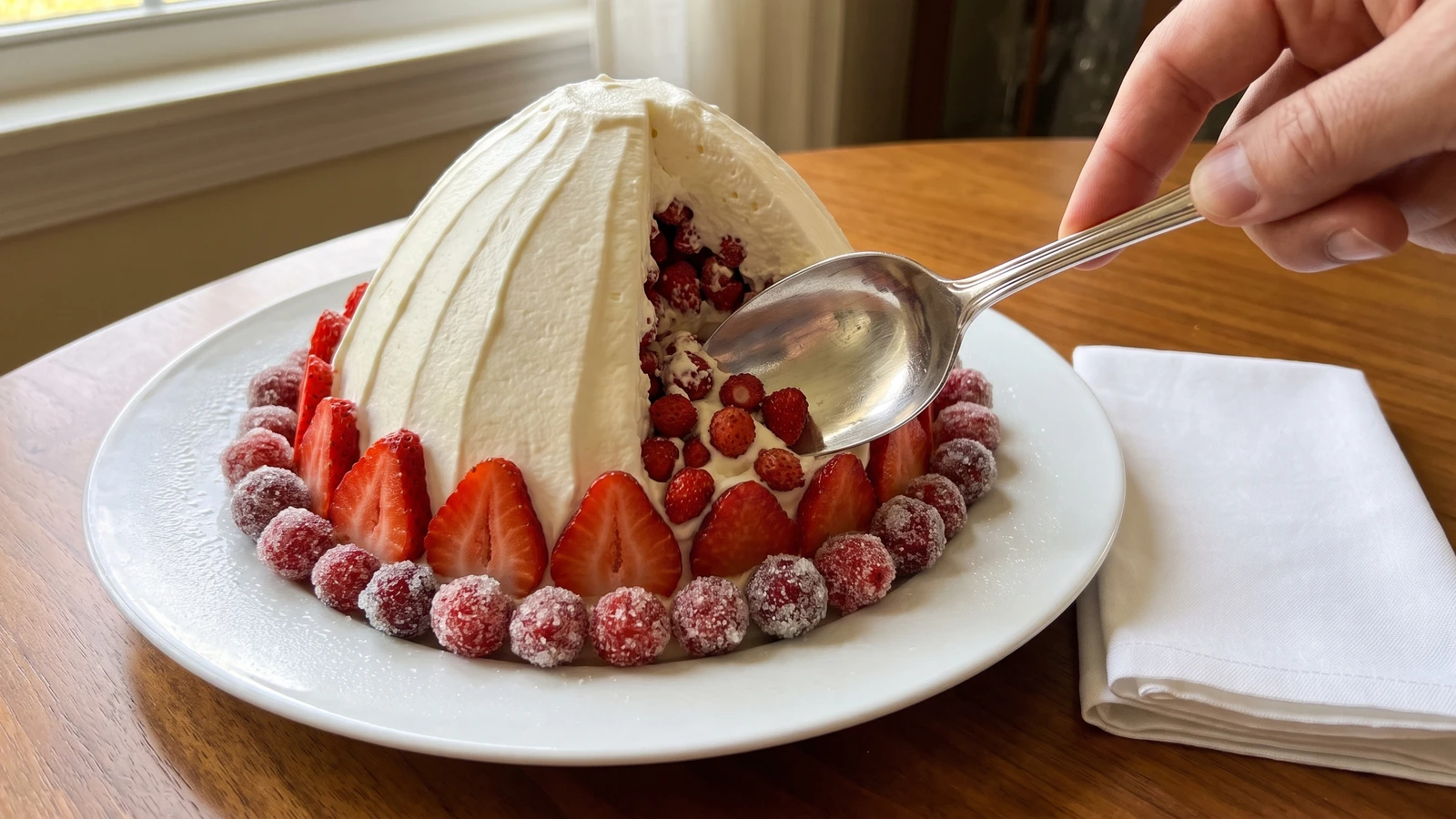
A snow-white dome of very stiff Chantilly holds vanilla-scented wild strawberries, with sugared berries at its foot and scarlet halves above. Drain the fruit completely, and the mountain stands.
Mont-Blanc aux fraises (strawberry Mont-Blanc) teaches one true thing before you touch a pan: water is the enemy of whipped cream. The tiny wild strawberries must absorb the cold vanilla syrup, then surrender every loose drop before they meet the Chantilly. Drain them until their surface looks matte. That dryness, more than forceful whipping, is what keeps the dome standing.
This entry never needed a saucier or salamander. Its hidden luxuries were a cold pastry room, a quart of finished Chantilly, and another pair of hands ready to assemble it at service. Here, 1 cup of liquid cream whips to roughly 1 pint, so the original proportion becomes exactly 2 ounces of wild strawberries. The brigade quantity is scaffolding and goes; the low fruit-to-cream ratio, the stiff Chantilly, and the careful draining are the dish and must stay. One cook, one stove, one evening.
When it is right, the Mont-Blanc is generous rather than fussy: an ivory mound lightly freckled with wild fruit, a ring of crystalline strawberries at its foot, and very red halves laid across the snow-white surface. Give the drained berries your full attention before folding. Everything afterward is assembly.
Mont-Blanc aux fraises belongs to the Parisian grand-kitchen repertoire of chilled entremets, where mountain names often described a dish’s domed, snow-covered architecture rather than its regional origin. The Alpine name has become closely associated with chestnut purée, but this strawberry formula proves that chestnuts were never the definition: here the mountain is very stiff Chantilly, crowned and ringed with red fruit. Its move to the home celebration table requires no new machinery, only a smaller proportion and the same discipline with cold cream and dry berries.
Quantity
¼ cup (60 ml / 60 g)
Quantity
¼ cup (60 ml / 50 g)
Quantity
1
divided
Quantity
Scant ½ cup (100 ml / 57 g; 2 oz)
hulled
Quantity
1 cup (240 ml / 240 g)
thoroughly chilled
Quantity
2 tablespoons (30 ml / 15 g)
Quantity
16
12 left whole with hulls intact and 4 hulled and halved lengthwise
Quantity
2 tablespoons (30 ml / 30 g)
lightly beaten
Quantity
½ cup (120 ml / 100 g)
for frosting
| Ingredient | Quantity |
|---|---|
| water | ¼ cup (60 ml / 60 g) |
| granulated sugar | ¼ cup (60 ml / 50 g) |
| vanilla beandivided | 1 |
| small wild strawberrieshulled | Scant ½ cup (100 ml / 57 g; 2 oz) |
| heavy cream with at least 36% fatthoroughly chilled | 1 cup (240 ml / 240 g) |
| confectioners’ sugar | 2 tablespoons (30 ml / 15 g) |
| large ripe red strawberries12 left whole with hulls intact and 4 hulled and halved lengthwise | 16 |
| pasteurized liquid egg whitelightly beaten | 2 tablespoons (30 ml / 30 g) |
| fine granulated sugar (sucre semoule)for frosting | ½ cup (120 ml / 100 g) |
Split the vanilla bean lengthwise. Scrape the seeds from one half into a small saucepan, then add its pod, the water, and the granulated sugar. Bring just to a simmer, stirring until the sugar dissolves, and cook for one minute. Take it off the heat and cool it completely, then chill it. The syrup must be cold before it touches the wild strawberries; warm syrup softens them and draws out too much juice.
Put the wild strawberries in a small bowl and pour the cold vanilla syrup over them. Turn them once with a spoon and leave them for 10 minutes, just long enough to perfume the fruit without collapsing it. Tip everything into a fine sieve and drain for 15 minutes without pressing. Spread the berries on a double layer of absorbent kitchen paper and blot around them gently. They are ready when they look matte rather than lacquered. If they still glisten, give them another dry paper and five more minutes; this is the step that holds up the mountain.
Make certain the 12 whole strawberries are perfectly dry. Whisk the pasteurized egg white only until loosened and lightly bubbly, not foamy. Roll each berry in the thinnest possible coat, let the excess drip away, then roll it in the sucre semoule, the fine granulated sugar, until evenly frosted. Set the berries on parchment for 30 to 45 minutes so the crystalline shell can settle. If the sugar clumps or slides, the egg-white coat was too heavy; brush away the wet patch, blot the berry dry, and coat it again. Ça se rattrape.
Put a deep metal mixing bowl, the whisk or mixer beaters, a broad spatula, and the serving platter in the refrigerator for at least 15 minutes. Keep the drained wild strawberries cold as well. Chantilly gains its strength from cold fat holding air, so a warm bowl gives you volume without enough structure.
Scrape the seeds from the remaining half vanilla bean into the chilled bowl. Add the heavy cream and confectioners’ sugar, then whisk at medium speed until the cream thickens. Slow down as it reaches firm peaks and stop when the whisk leaves deep tracks and an upright peak holds without drooping. The Chantilly should be very stiff but still smooth and satin-like, never grainy. It will have nearly doubled to about 2 cups, preserving the source proportion of 2 ounces of fruit to 1 pint of finished Chantilly. Set aside ¼ cup of the stiff Chantilly in the cold.
Scatter one-third of the drained wild strawberries over the larger bowl of Chantilly. Cut down through the centre with the broad spatula, sweep along the bottom, and turn the cream over the fruit. Repeat with the remaining berries, using as few strokes as possible. Fold in the reserved Chantilly with the last two turns. If the mixture slackens, stop moving it, chill the bowl over ice for five minutes, then use that reserved stiff cream to rebuild the outside of the mass. Ça se rattrape. If it still cannot hold a mound, spoon it into chilled coupes and finish them with the same berries; the architecture has changed, not the pleasure.
Spoon the strawberry Chantilly into the centre of the chilled platter. With the broad spatula, draw the cream upward and inward to form a compact dome about 5 inches across, smoothing the sides with long, light strokes. Do not press or fuss at the surface. A mold and a pastry hand were useful brigade scaffolding, but the dish asks only for a generous dome that stands cleanly.
Arrange the 12 frosted whole strawberries closely around the foot of the dome. Lay the 8 very red strawberry halves over its surface, cut sides showing, with their pointed ends following the curve. Serve at once, or chill uncovered for no more than 30 minutes. The sugar frost gradually drinks in moisture and the Chantilly softens as it waits, so this is a dessert for the moment it is finished. À table!
1 serving (about 200g)
Culinary guides, cultural storytelling, and the editorial depth that makes cooking meaningful.
Discover Culinary ExplorerChef Juliette
Five almond preparations, one discipline: remove the skins cleanly, dry every kernel through, then cut, toast, or cloak it in pale caramel without letting its fragrant oils escape.

Chef Juliette
A pastry pantry lesson in one tray: filberts warmed only until their red skins release, rubbed clean, cooled, and chopped into a fragrant mise-en-place for cakes, creams, pralines, and petits fours.

Chef Juliette
The smallest pâtisserie discipline decides whether a cake leaves its mould intact: clarified butter in every corner, followed by the lightest veil of dry flour or fécule.

Chef Juliette
Four whites, one spotless bowl, and a patient change of speed: whisk gently until loosened, then briskly to glossy stiffness, with powdered sugar waiting if the foam begins to granulate.