
Chef Juliette
Various Almond Preparations
Five almond preparations, one discipline: remove the skins cleanly, dry every kernel through, then cut, toast, or cloak it in pale caramel without letting its fragrant oils escape.
A cooking platform built around craft, culture, and the stories behind what we eat.
Created by Chef Juliette
Based on No. 2726, Eugenia: Italian Cream, from Le Guide Culinaire (1907) by Auguste Escoffier
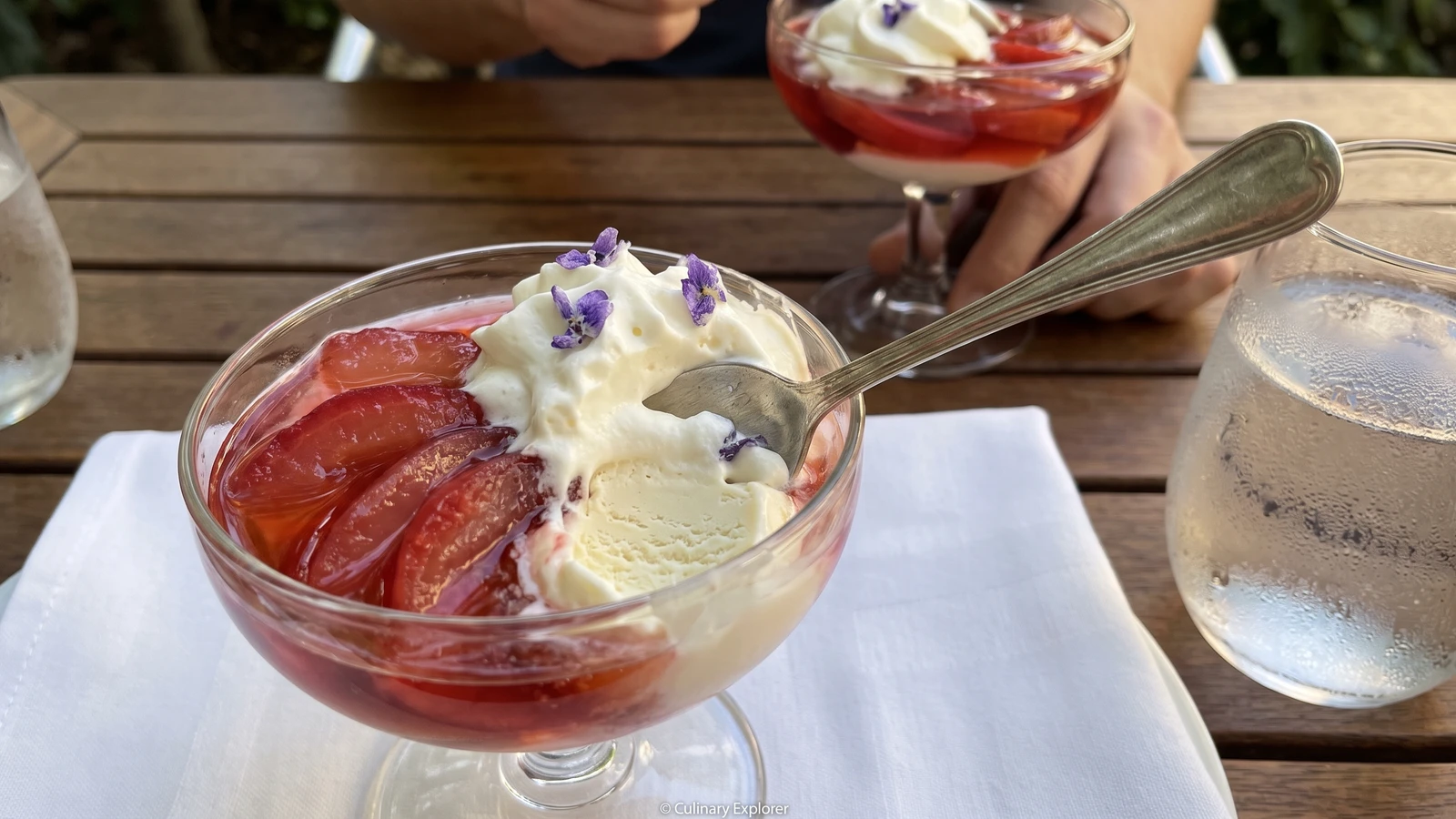
Ripe Eugenia, brightened with maraschino syrup and nested over vanilla ice cream, wears a generous crown of Chantilly and violets. The lesson is temperature: cold components, quick assembly, immediate pleasure.
Eugenia à l’Italienne (Italian-style Eugenia cream) teaches one clean principle: in a frozen dessert, temperature is structure. The fruit must be ripe enough to perfume the syrup, the syrup fully cold, the ice cream firm, and the crème Chantilly, sweetened vanilla whipped cream, supple enough to fall in soft folds. Warm syrup or tired ice cream turns the layers into one sweet puddle.
The original entry assumed a cold pastry station with vanilla ice cream, Chantilly, and chilled timbales waiting, plus a free pair of hands at service. At home, use a small saucepan, four cold coupes, and good prepared vanilla ice cream. This version scales the composition to four and makes only the maraschino syrup fresh. The rows of molds and separate pastry station are brigade scaffolding; the brief maceration, vanilla ice, Chantilly, and crystallized violets are the dish and stay. One cook, one stove, one evening.
When it lands properly, the fruit glistens, the ice cream keeps its clean cold body, and the violets crunch softly against the cream. The step that matters most is simple: cool the syrup completely before it touches either fruit or ice cream.
Eugenia à l’Italienne belongs to the Parisian grand-kitchen repertoire of composed ices, where imported fruit met liqueur syrup, vanilla ice cream, Chantilly, and confectioners’ flowers in an individual timbale. Eugenia is a botanical genus rather than a single French orchard variety, so market usage has covered several aromatic, soft-fleshed fruits; the old instruction’s demand for extreme ripeness is more useful than allegiance to one cultivar. The Italian title describes the classical service given to the fruit, not a claim that this is a regional Italian dessert, and the composition passed naturally to the home coupe once its cold components became easy to keep ready.
Quantity
About 2½ cups (590 ml / 340 g)
peeled, seeded as needed, and sliced
Quantity
¼ cup (60 ml / 50 g)
Quantity
¼ cup (60 ml / 60 g)
Quantity
2 tablespoons (30 ml / 29 g)
Quantity
1 pint (475 ml / 425 g)
Quantity
¾ cup (180 ml / 180 g)
Quantity
2 tablespoons (30 ml / 15 g)
Quantity
½ teaspoon (2.5 ml / 2 g)
Quantity
Up to 2 tablespoons (30 ml / 30 g)
kept cold for correcting overwhipped Chantilly
Quantity
2 tablespoons (30 ml / 12 g)
coarsely crushed
| Ingredient | Quantity |
|---|---|
| very ripe Eugenia fruitpeeled, seeded as needed, and sliced | About 2½ cups (590 ml / 340 g) |
| granulated sugar | ¼ cup (60 ml / 50 g) |
| water | ¼ cup (60 ml / 60 g) |
| clear maraschino liqueur | 2 tablespoons (30 ml / 29 g) |
| good vanilla ice cream | 1 pint (475 ml / 425 g) |
| cold heavy cream | ¾ cup (180 ml / 180 g) |
| confectioners’ sugar | 2 tablespoons (30 ml / 15 g) |
| vanilla extract | ½ teaspoon (2.5 ml / 2 g) |
| additional cold heavy cream (optional)kept cold for correcting overwhipped Chantilly | Up to 2 tablespoons (30 ml / 30 g) |
| crystallized violetscoarsely crushed | 2 tablespoons (30 ml / 12 g) |
Combine the sugar and water in a small saucepan. Warm gently, stirring only until the sugar dissolves, then simmer for 2 minutes without stirring. Pour the clear syrup into a heatproof bowl set over ice and cool it until no trace of warmth remains. Stir in the maraschino liqueur only after cooling, which keeps its cherry-kernel perfume alive.
Peel the Eugenia carefully with a small knife, remove any stones or firm seeds, and cut the flesh into slices about ¼ inch (6 mm) thick. Place the slices in a shallow bowl, pour over the cold maraschino syrup, and turn them once with a spoon. Chill for 20 minutes, but no longer than 30 minutes; the fruit should become glossy and perfumed without surrendering its shape. If it begins to collapse or releases too much juice, lift it from the syrup with a slotted spoon and chill it separately. Spoon rather than arrange the softened pieces at service, and no one at your table need hear an apology.
Whisk the cold heavy cream with the confectioners’ sugar and vanilla until it forms soft peaks that curl when the whisk is lifted. Stop while the surface is still smooth and satiny. If the Chantilly turns grainy, stop whisking at once. Ça se rattrape: fold in the additional cold cream, 1 teaspoon at a time, until the texture becomes supple again. Cover and keep cold.
Chill four coupes or small timbales in the freezer for 15 minutes. Divide the vanilla ice cream among them, making a generous layer across each base and a shallow hollow in the center for the fruit. If the ice cream softens around the rim, return the coupes to the freezer for 10 minutes. Firm ice cream keeps the layers distinct; this pause is discipline, not fuss.
Lift the Eugenia from its syrup and divide it over the vanilla ice cream. Spoon just enough maraschino syrup over each serving to glaze the fruit without flooding the ice. Crown with soft folds of Chantilly and sprinkle with the crystallized violets. Serve at once, while the fruit is fragrant, the cream is light, and the vanilla ice still holds its shape. À table!
1 serving (about 285g)
Culinary guides, cultural storytelling, and the editorial depth that makes cooking meaningful.
Discover Culinary ExplorerChef Juliette
Five almond preparations, one discipline: remove the skins cleanly, dry every kernel through, then cut, toast, or cloak it in pale caramel without letting its fragrant oils escape.

Chef Juliette
A pastry pantry lesson in one tray: filberts warmed only until their red skins release, rubbed clean, cooled, and chopped into a fragrant mise-en-place for cakes, creams, pralines, and petits fours.

Chef Juliette
The smallest pâtisserie discipline decides whether a cake leaves its mould intact: clarified butter in every corner, followed by the lightest veil of dry flour or fécule.

Chef Juliette
Four whites, one spotless bowl, and a patient change of speed: whisk gently until loosened, then briskly to glossy stiffness, with powdered sugar waiting if the foam begins to granulate.