
Chef Juliette
Various Almond Preparations
Five almond preparations, one discipline: remove the skins cleanly, dry every kernel through, then cut, toast, or cloak it in pale caramel without letting its fragrant oils escape.
A cooking platform built around craft, culture, and the stories behind what we eat.
Created by Chef Juliette
Based on No. 2701, Pêches à la Sultane, from Le Guide Culinaire (1907) by Auguste Escoffier
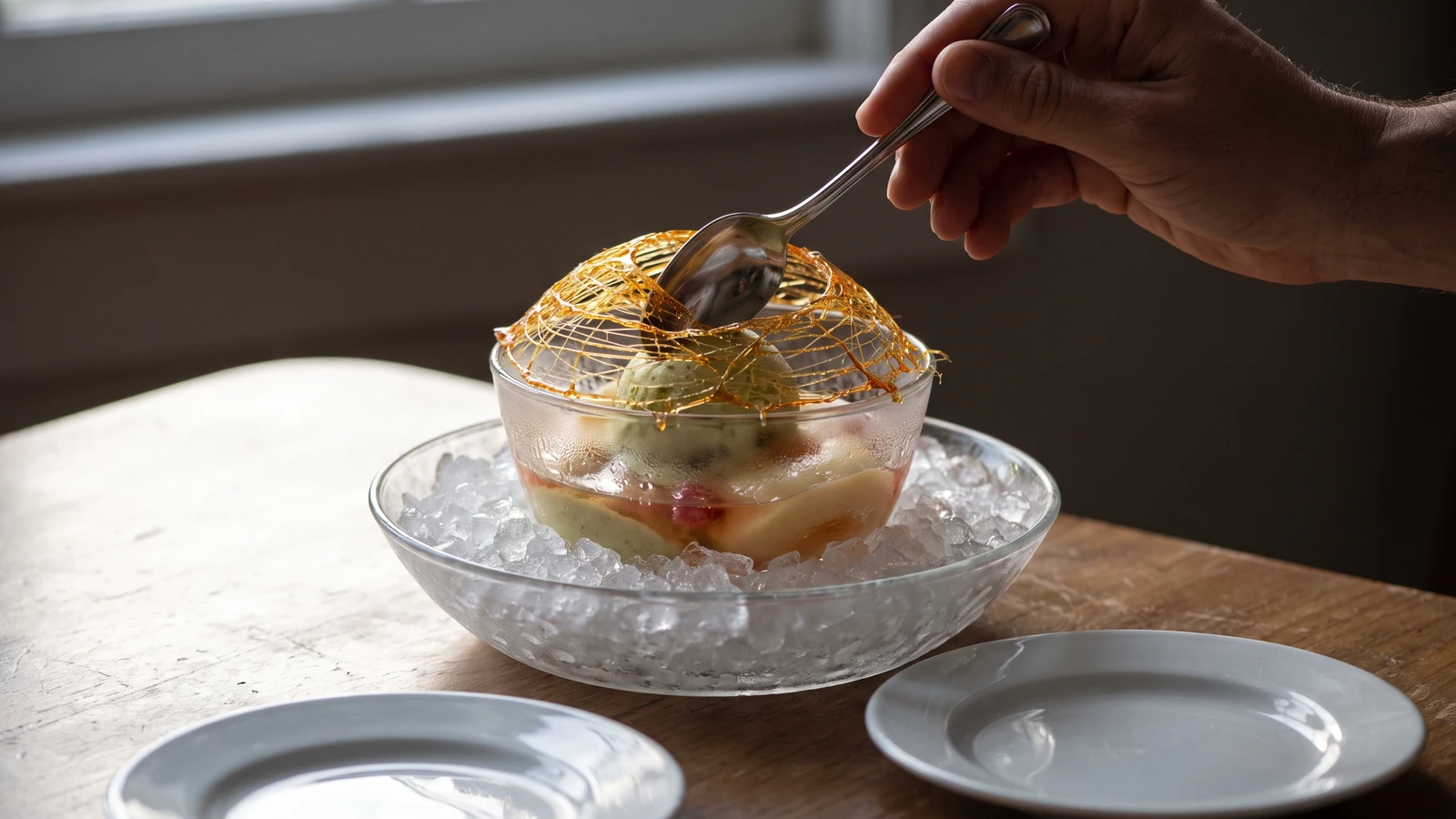
Vanilla-poached peaches settle into pale pistachio ice, then disappear beneath cold rose syrup and a fine spun-sugar veil. The lesson is restraint: perfume the syrup one drop at a time.
Pêches à la Sultane (peaches with pistachio ice and rose syrup) teaches restraint at the sweetest end of the French canon. Rose essence is fierce. Before you touch a pan, know that the syrup must be completely cold and the essence added drop by drop, or peach and pistachio vanish beneath perfume.
The original assumed a pastry brigade with glace à la pistache already churned, a sugar cook ready to spin the veil, and a timbale balanced on a sawn block of ice. For one cook, one stove, one evening, good dense pistachio ice cream replaces the brigade's ready supply, a glass serving bowl sits in crushed ice, and two forks spin the small quantity of sugar required. The ice cabinet and carved block were service scaffolding, so they can go. The vanilla-poached fruit, reduced syrup, rose, pistachio ice, and spun sugar are the dish, so they stay.
When it lands correctly, the peaches gleam beneath clear syrup, pale green pistachio ice shows around their edges, and the sugar veil gives way with a delicate crack under the serving spoon. The step that decides everything is scenting the fully cold syrup: add rose essence drop by drop, with unscented syrup held back for rescue.
Pêches à la Sultane belongs to the Paris-centered grand-kitchen repertoire, not to one of France's regional household traditions. In classical menu language, à la Sultane paired rose, pistachio, and spun sugar to suggest the luxury French dining rooms associated with the Ottoman court; the name describes a French composition, not a Turkish household dessert. Its move to the home table changes the service apparatus, while the defining arrangement of fruit, frozen pistachio, perfumed syrup, and sugar veil remains intact.
Quantity
4 medium (about 1½ lb / 680 g)
ripe but firm
Quantity
3 cups (710 ml / 710 g)
Quantity
1½ cups (355 ml / 300 g)
Quantity
1
split lengthwise
Quantity
2 cups (475 ml / about 450 g)
dense and deeply nutty
Quantity
4 to 8 drops
Quantity
¾ cup (180 ml / 150 g)
Quantity
¼ cup (60 ml / 60 g)
Quantity
1 tablespoon (15 ml / 20 g)
Quantity
1 teaspoon (5 ml / 4 g)
for greasing the sugar-spinning setup
Quantity
6 cups (1.4 L / about 900 g)
for serving, not eating
| Ingredient | Quantity |
|---|---|
| yellow peachesripe but firm | 4 medium (about 1½ lb / 680 g) |
| water | 3 cups (710 ml / 710 g) |
| granulated sugar | 1½ cups (355 ml / 300 g) |
| vanilla beansplit lengthwise | 1 |
| glace à la pistache (pistachio ice cream)dense and deeply nutty | 2 cups (475 ml / about 450 g) |
| food-grade rose essence | 4 to 8 drops |
| granulated sugar for the spun sugar | ¾ cup (180 ml / 150 g) |
| water for the spun sugar | ¼ cup (60 ml / 60 g) |
| glucose syrup or light corn syrup | 1 tablespoon (15 ml / 20 g) |
| neutral oilfor greasing the sugar-spinning setup | 1 teaspoon (5 ml / 4 g) |
| crushed icefor serving, not eating | 6 cups (1.4 L / about 900 g) |
Place a 2-quart glass timbale or compote bowl and four dessert plates in the freezer for at least 20 minutes. Keep the pistachio ice cream fully frozen. The cold bowl is the home equivalent of setting the timbale on a solid block of ice, and it buys enough time to arrange the peaches without losing the firm pistachio layer.
Cut a shallow cross through the skin at the base of each peach. Lower them into gently boiling water for 20 to 40 seconds, then cool them under running water just until they can be handled. Slip off the skins, halve the peaches along their seams, and remove the stones. If a skin clings, return that peach to the hot water for another 10 seconds rather than gouging away its flesh.
Combine the 3 cups water and 1½ cups sugar in a snug 3-quart saucepan. Scrape in the vanilla seeds and add the pod. Bring slowly to a simmer, stirring only until the sugar dissolves, then simmer for 5 minutes. The liquid should remain clear and smell distinctly of vanilla.
Lower the peach halves into the vanilla syrup and cover them with a round of baking parchment so they remain submerged. Hold the syrup at the barest tremble for 4 to 8 minutes, turning the fruit once, until a thin knife enters with faint resistance. Remove the pan from the heat and leave the peaches in the syrup for 15 minutes, then lift them carefully into a shallow covered dish and chill for at least 2 hours. If a half tears, set the torn side downward at service. Ça se rattrape.
Strain the poaching syrup into a clean saucepan and boil steadily until about 1¼ cups (300 ml) remain. Chill it completely. Test a spoonful on a cold plate: it should run slowly and coat the spoon in a clear sheet. If it remains watery, reduce it again before adding the rose; if it becomes sticky, loosen it with cold water a teaspoon at a time. Reserve ¼ cup of the unscented syrup, then stir 4 drops of rose essence into the remainder. Taste it cold and add further drops only until the rose appears behind the peach, never in front. If the perfume goes too far, whisk in the reserved syrup one spoonful at a time. Ça se rattrape.
Cover the work surface and floor below with parchment. Lightly oil two wooden spoon handles, anchor them beneath a heavy cutting board so they project over the counter, and keep children and pets away. Combine the ¾ cup sugar, ¼ cup water, and glucose syrup in a small heavy saucepan. Heat without stirring until the syrup reaches 300 to 310°F (150 to 155°C) and turns the palest amber. Remove it from the heat and wait 60 to 90 seconds, until a fork dipped into it draws fine threads rather than drops. Dip two forks held back-to-back into the sugar and flick them rapidly across the spoon handles, building a loose web. Once completely cool, gather the threads gently into a veil and keep it on dry parchment. If crystals form before the sugar colors, add 2 tablespoons of water and dissolve them over low heat before beginning again. Never touch or taste molten sugar.
Fill a broad shallow bowl with the crushed ice and nest the chilled glass timbale securely inside it. Let the pistachio ice cream soften for 3 to 5 minutes, only until spreadable, then press it into an even layer across the bottom. Drain the peach halves and arrange two per serving, rounded sides upward. Spoon the very cold rose syrup generously over the fruit, allowing it to pool lightly around the pistachio ice. Lay the spun-sugar veil over the whole arrangement only when everyone is ready, because moisture begins dissolving it at once. Bring the timbale and chilled plates straight to the table. À table!
1 serving (about 400g)
Culinary guides, cultural storytelling, and the editorial depth that makes cooking meaningful.
Discover Culinary ExplorerChef Juliette
Five almond preparations, one discipline: remove the skins cleanly, dry every kernel through, then cut, toast, or cloak it in pale caramel without letting its fragrant oils escape.

Chef Juliette
A pastry pantry lesson in one tray: filberts warmed only until their red skins release, rubbed clean, cooled, and chopped into a fragrant mise-en-place for cakes, creams, pralines, and petits fours.

Chef Juliette
The smallest pâtisserie discipline decides whether a cake leaves its mould intact: clarified butter in every corner, followed by the lightest veil of dry flour or fécule.

Chef Juliette
Four whites, one spotless bowl, and a patient change of speed: whisk gently until loosened, then briskly to glossy stiffness, with powdered sugar waiting if the foam begins to granulate.