
Chef Juliette
Various Almond Preparations
Five almond preparations, one discipline: remove the skins cleanly, dry every kernel through, then cut, toast, or cloak it in pale caramel without letting its fragrant oils escape.
A cooking platform built around craft, culture, and the stories behind what we eat.
Created by Chef Juliette
Based on No. 2579, Pêches Maintenon, from Le Guide Culinaire (1907) by Auguste Escoffier
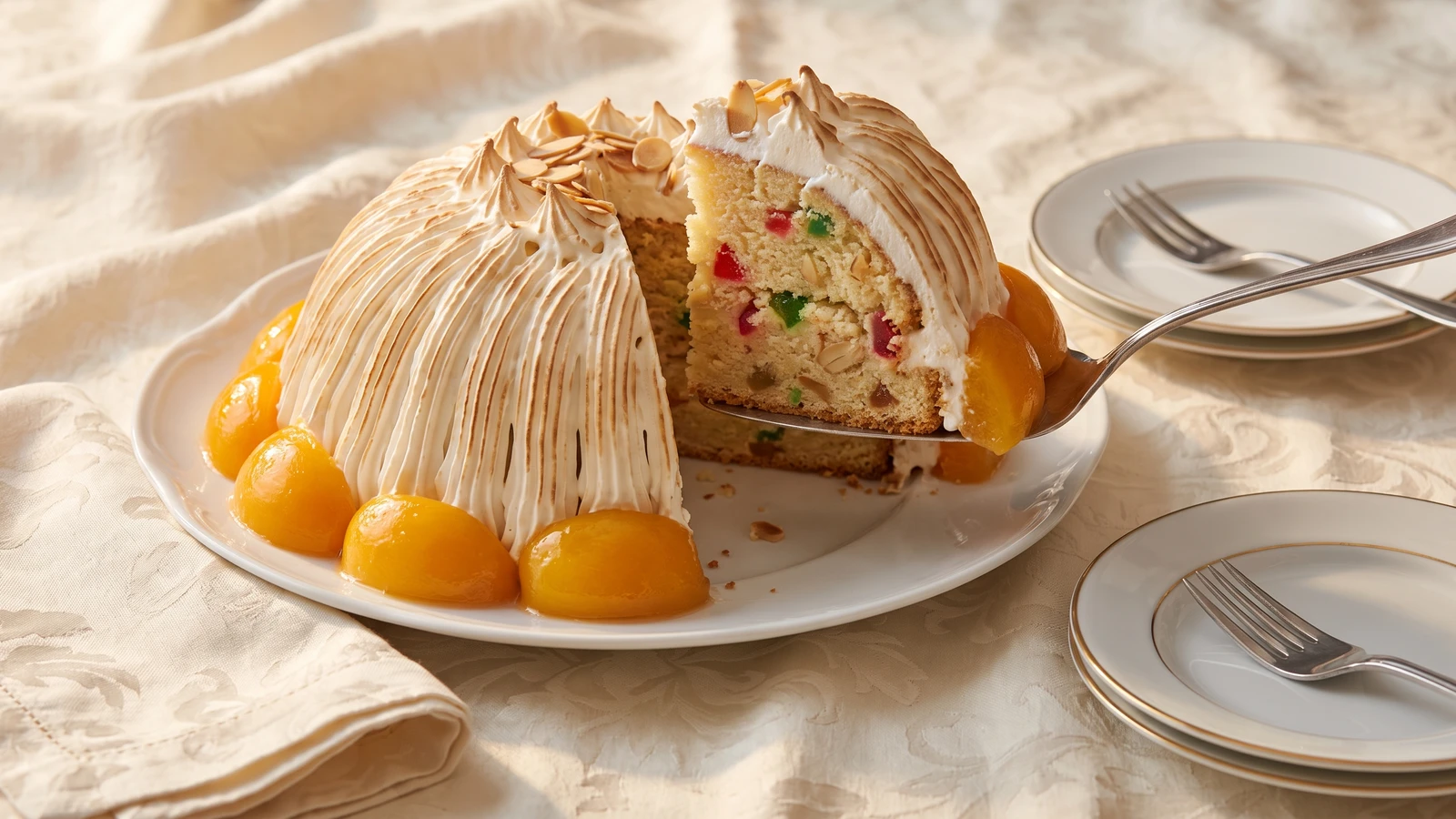
Pêches Maintenon turns a fully cooled biscuit dome into celebration architecture: frangipane and candied fruit within, piped meringue outside, and vanilla-poached peach halves standing generously around it.
Pêches Maintenon (a meringued biscuit dome with frangipane and peaches) teaches architecture before ornament. The one true thing to know is brutally simple: the biscuit must be completely cold before you cut it. A warm crumb compresses, tears, and drinks the filling unevenly; a cold one can be sliced crosswise, layered, and rebuilt into the same proud dome.
The original entry assumed a pastry brigade had a dome biscuit, frangipane, candied fruit, toasted almonds, and Meringue à l’Italienne (No. 2383), Italian meringue, waiting on the bench, plus an oven kept ready to dry the piping. Your honest equivalent is a 15 cm metal bowl, one cooked almond custard, and a low home oven. Cooking the frangipane in one saucepan replaces the brigade's separate bench components while preserving its almond richness and sliceable body.
That production schedule was scaffolding and can go. The transverse layers, frangipane bound with a salpicon (fine dice) of candied fruit, reconstructed dome, piped meringue shell, and vanilla-poached peach border are the dish and must stay. One cook, one stove, one evening. Cool the biscuit fully, and the rest is generous assembly.
Pêches Maintenon belongs to the courtly grand-kitchen repertory centered on Versailles and Paris, where composed dishes often carried aristocratic names rather than the name of a province. Maintenon recalls Madame de Maintenon, but the structure corrects a common assumption: the peaches form the poached border, while the dome itself is biscuit layered with frangipane, candied fruit, and almonds. As the dessert moved from banquet service to home celebration tables, its architecture remained even when the brigade and its shelves of prepared components disappeared.
Quantity
1 tablespoon (15 ml / 14 g)
softened
Quantity
1 tablespoon (15 ml / 8 g)
Quantity
3
at room temperature
Quantity
1/2 cup (120 ml / 100 g)
Quantity
3/4 cup (180 ml / 90 g)
sifted
Quantity
2 tablespoons (30 ml / 28 g)
melted and cooled
Quantity
1 cup (240 ml / 245 g)
Quantity
1/2 cup (120 ml / 50 g)
Quantity
1/3 cup (80 ml / 67 g)
Quantity
2 tablespoons (30 ml / 16 g)
Quantity
2
Quantity
1
Quantity
2 tablespoons (30 ml / 28 g)
softened
Quantity
1/2 cup (120 ml / 85 g)
cut into a 3 to 4 mm salpicon
Quantity
1/3 cup (80 ml / 35 g)
toasted and chopped
Quantity
4 medium, about 1 1/2 pounds (680 g)
Quantity
3 cups (720 ml / 720 g)
Quantity
1 1/4 cups (300 ml / 250 g)
Quantity
1
split lengthwise
Quantity
2 cups (480 ml / 400 g) Meringue à l’Italienne (No. 2383)
still supple
| Ingredient | Quantity |
|---|---|
| unsalted butter for the mouldsoftened | 1 tablespoon (15 ml / 14 g) |
| cake flour for the mould | 1 tablespoon (15 ml / 8 g) |
| large eggs for the biscuitat room temperature | 3 |
| granulated sugar for the biscuit | 1/2 cup (120 ml / 100 g) |
| cake flour for the biscuitsifted | 3/4 cup (180 ml / 90 g) |
| unsalted butter for the biscuitmelted and cooled | 2 tablespoons (30 ml / 28 g) |
| whole milk | 1 cup (240 ml / 245 g) |
| fine almond flour | 1/2 cup (120 ml / 50 g) |
| granulated sugar for the frangipane | 1/3 cup (80 ml / 67 g) |
| cornstarch | 2 tablespoons (30 ml / 16 g) |
| large egg yolks | 2 |
| large egg for the frangipane | 1 |
| unsalted butter for the frangipanesoftened | 2 tablespoons (30 ml / 28 g) |
| mixed candied fruitcut into a 3 to 4 mm salpicon | 1/2 cup (120 ml / 85 g) |
| sliced almondstoasted and chopped | 1/3 cup (80 ml / 35 g) |
| ripe but firm yellow peaches | 4 medium, about 1 1/2 pounds (680 g) |
| water for the poaching syrup | 3 cups (720 ml / 720 g) |
| granulated sugar for the poaching syrup | 1 1/4 cups (300 ml / 250 g) |
| vanilla beansplit lengthwise | 1 |
| freshly prepared Meringue à l’Italiennestill supple | 2 cups (480 ml / 400 g) Meringue à l’Italienne (No. 2383) |
Heat the oven to 350°F (175°C). Butter a 6-inch (15 cm) ovenproof metal bowl or dome mould, dust it with flour, and support it in a ring of crumpled foil on a baking sheet. Whisk the eggs and sugar over a bain-marie, a barely simmering water bath, until just warm to the touch. Beat with an electric mixer for 7 to 9 minutes, until very pale and thick enough to fall from the whisk in a ribbon. Fold in the sifted flour in three additions. Stir a large spoonful of batter into the melted butter first, then fold this lightened butter gently through the remaining batter; poured in alone, butter sinks and leaves a heavy seam. Fill the mould and bake for 28 to 35 minutes, until the dome is deep gold, springs back under a fingertip, and a skewer comes out clean.
Warm the milk in a saucepan until small bubbles gather at the edge. In a bowl, whisk the egg yolks, whole egg, sugar, and cornstarch until smooth. Pour in half the hot milk gradually while whisking, then return everything to the saucepan. Cook over medium-low heat, whisking constantly, until the cream boils at the center; continue for 1 minute so the starch and eggs cook fully. Whisk in the almond flour and softened butter. The frangipane should be thick, glossy, and able to hold a soft ridge. If it forms lumps, take it off the heat and press it through a fine sieve while warm. Cover the surface directly and cool completely.
Combine the water, sugar, vanilla bean, and scraped seeds in a wide saucepan. Bring to a boil, stirring only until the sugar dissolves, then simmer for 5 minutes. Peel the peaches, halve them neatly through the seam, and remove the stones. Lower the eight halves into the syrup and hold it at the barest tremble for 5 to 9 minutes, turning once, until a knife enters with light resistance. Lift any half as soon as it is ready; peaches ripen at their own pace and must not be punished for it. Cool them in a shallow dish with enough syrup to cover, then drain cut-side down before assembling.
Rest the biscuit in its mould for 10 minutes, turn it onto a rack, and leave it until completely cold throughout, at least 1 hour. Mark three level cutting lines with toothpicks, then use a long serrated knife to cut the dome transversely into four slices, keeping them in order. Do not press down on the knife. If the crumb begins to tear, stop and chill the biscuit for 30 minutes before continuing. Ça se rattrape. A cracked slice can be aligned during assembly and joined with a thin layer of frangipane.
Fold the candied-fruit salpicon and chopped toasted almonds through the cold frangipane. Set the broad bottom slice on a parchment-lined baking sheet and spread it evenly with one-third of the cream, stopping about 1/4 inch (5 mm) from the edge. Repeat with the next two slices, then replace the top and align every layer to reconstruct the dome. If it tries to slide, pass a thin wooden skewer vertically through the center and chill for 20 minutes; remove the skewer before coating.
Lower the oven to 275°F (135°C). Cover the rebuilt biscuit completely with about half of the Meringue à l’Italienne (No. 2383), using an offset spatula to seal the layers and form an even ivory coat. Transfer the remainder to a piping bag fitted with a large star tip and pipe firm ribs, shells, or rosettes over the dome. Dry it in the oven for 18 to 25 minutes, until the surface feels set and the highest ridges have taken only a pale biscuit-gold color. If the piping colors before the surface dries, lower the oven to 230°F (110°C) and place an empty sheet pan on the rack above as a shield. Let the dome cool for 20 minutes.
Transfer the cooled dome to a broad serving platter. Drain the peach halves thoroughly so their syrup does not flood the meringue, then arrange all eight snugly around the base, rounded sides up, forming a generous border. Cut with a serrated knife using a light sawing motion, wiping the blade between slices so the frangipane bands and candied-fruit salpicon remain distinct. Serve the peaches beside each wedge. À table!
1 serving (about 320g)
Culinary guides, cultural storytelling, and the editorial depth that makes cooking meaningful.
Discover Culinary ExplorerChef Juliette
Five almond preparations, one discipline: remove the skins cleanly, dry every kernel through, then cut, toast, or cloak it in pale caramel without letting its fragrant oils escape.

Chef Juliette
A pastry pantry lesson in one tray: filberts warmed only until their red skins release, rubbed clean, cooled, and chopped into a fragrant mise-en-place for cakes, creams, pralines, and petits fours.

Chef Juliette
The smallest pâtisserie discipline decides whether a cake leaves its mould intact: clarified butter in every corner, followed by the lightest veil of dry flour or fécule.

Chef Juliette
Four whites, one spotless bowl, and a patient change of speed: whisk gently until loosened, then briskly to glossy stiffness, with powdered sugar waiting if the foam begins to granulate.