
Chef Juliette
The Preparation of Soups
Préparation des Potages teaches the first obligation of soup: it must announce the dinner in one clear, savory spoonful, then reach every guest fiercely hot in a properly warmed bowl.
A cooking platform built around craft, culture, and the stories behind what we eat.
Created by Chef Juliette
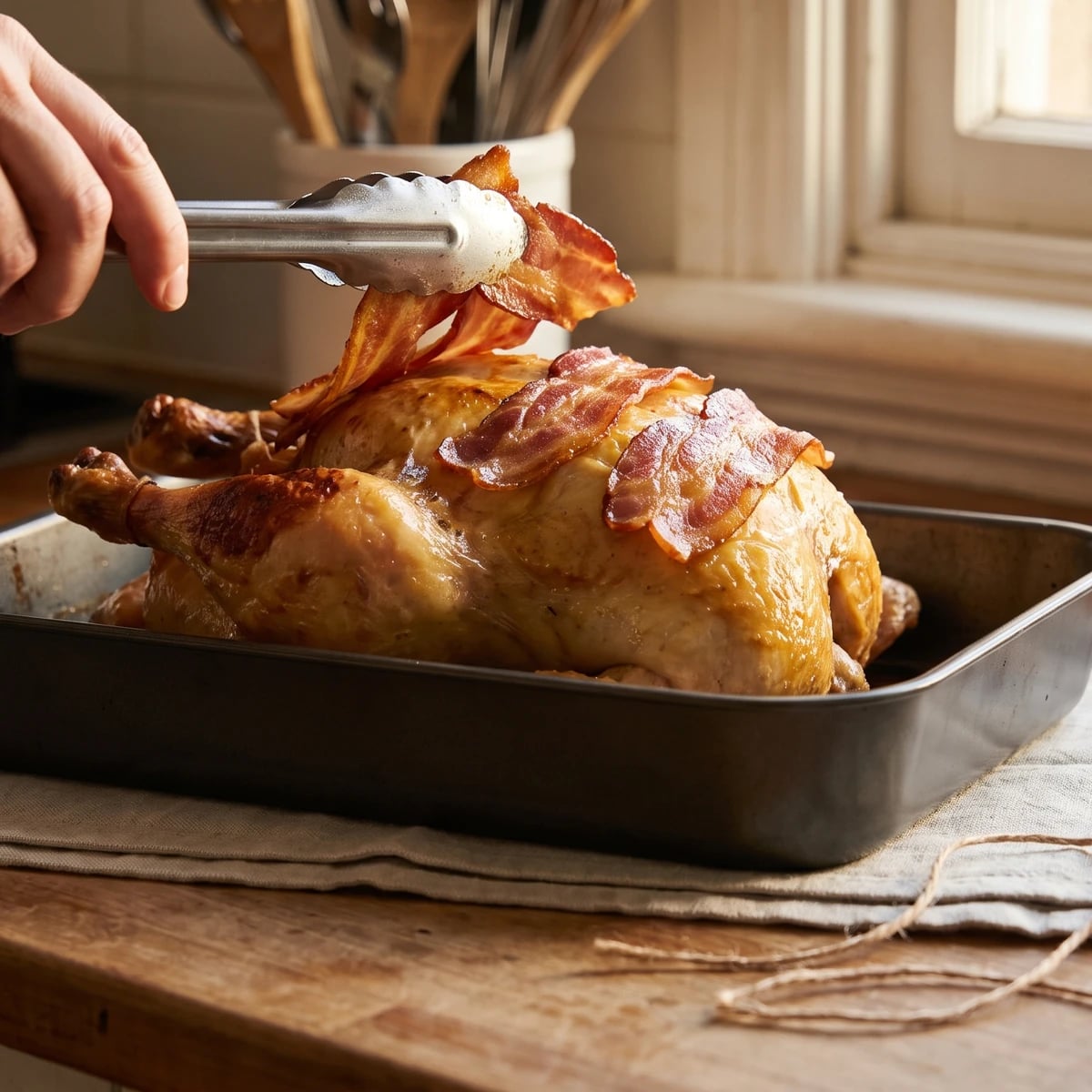
A thin bard of unsmoked bacon protects the delicate breast while the legs catch up, then lifts away so the skin can bronze: one modest preparation that makes a holiday bird roast evenly.
Bardage au lard d’une volaille (barding a bird with larding bacon) teaches one true thing about roasting: protect the part that cooks first. A bird's breast is lean and exposed, while its jointed, muscular legs need longer heat. Cover the breast completely and leave the legs bare, and both arrive at the table succulent instead of negotiating a surrender.
The original preparation assumed the fierce radiant heat of a roasting fire and a larder able to cut one broad, nearly translucent sheet of larding bacon. Your honest equivalents are a conventional oven, a wire rack, and overlapping paper-thin slices of unsmoked fatback tied over one chicken for four. The brigade's tray of birds becomes one bird. A saucier, standing stockpot, and salamander have no work here, because this entry is about protection, not sauce. What changed is the equipment and scale, never the intent. One cook, one stove, one evening.
Repeated basting is brigade scaffolding and can go; a complete barde and an accurate temperature check are the dish and must stay. The bacon comes off only after the legs have gained their necessary lead, giving the breast skin time to bronze at the finish. Before the chicken meets the oven, check the lower edges of the barde closely. Complete coverage is the step that decides the roast.
Bardage belongs to the classical roasting kitchens of Paris and to bourgeois tables throughout France, wherever poultry and lean game met the fierce radiant heat of a spit. The English heading “larding bacon” can mislead: lardage inserts strips of fat into meat, while bardage ties a sheet of fat over the surface, and the source method is plainly bardage. The same protection was used on butcher's meat with sheets of veal or beef fat, proof that the principle is heat management rather than bacon flavor.
Quantity
1 bird, about 4 lb (1.8 kg)
giblets removed and bird thoroughly dried
Quantity
6 oz (170 g)
sliced paper-thin into broad sheets
Quantity
2 teaspoons (10 ml / 12 g)
Quantity
1 teaspoon (5 ml / 2 g)
| Ingredient | Quantity |
|---|---|
| whole chickengiblets removed and bird thoroughly dried | 1 bird, about 4 lb (1.8 kg) |
| unsmoked larding bacon or fresh pork fatbacksliced paper-thin into broad sheets | 6 oz (170 g) |
| fine sea salt | 2 teaspoons (10 ml / 12 g) |
| freshly ground black pepper | 1 teaspoon (5 ml / 2 g) |
Set a rack in the lower third of the oven and heat it to 425°F (220°C). Put a wire rack inside a rimmed roasting pan. Dry the chicken inside and out, because moisture trapped beneath the bard softens the skin, then season the cavity and every surface evenly with the salt and pepper. Tuck the wing tips behind the shoulders so they don't scorch.
Lay the larding bacon between two sheets of parchment and flatten it lightly with a rolling pin until it is thin, supple, and broad enough to follow the bird's shape. If you have separate slices, overlap them by about 1 inch (2.5 cm) to make one continuous barde, the protective fat sheet. It must cover both breast fillets completely, from the wishbone down to the point where the breast narrows, while leaving the legs exposed to the oven's heat.
Cut three lengths of unwaxed kitchen twine and place them across the roasting rack before setting the chicken breast-side up on top. Drape the barde smoothly over the breast, bring each string around the bird, and knot it firmly enough to hold the fat against the skin without cutting deep grooves. If the barde tears or leaves a corner of breast exposed, overlap another thin piece across the gap and catch it beneath the nearest string. Ça se rattrape. Complete coverage matters more than a beautiful knot.
Roast the bird for 20 minutes at 425°F (220°C), then lower the oven to 375°F (190°C) without opening the door. Continue roasting for 35 to 40 minutes. The barde will turn glossy and pale gold as its fat renders over the breast; leave it alone and don't baste. The bacon is already doing that work without spilling the oven's heat.
When the thickest part of the thigh registers about 145°F (63°C), cut the strings and lift away the barde with tongs. Increase the oven to 425°F (220°C). If the breast skin looks wet, blot only the surface while leaving its thin sheen of rendered fat, then roast for another 15 to 25 minutes. The bird is ready when the breast reaches 165°F (74°C), the thigh reaches at least 170°F (77°C), and the skin is evenly burnished. If the breast bronzes before the thigh is ready, cover only the breast with a small piece of foil and continue roasting. Ça se rattrape.
Move the chicken to a board and rest it uncovered for 20 minutes. Covering would soften the skin you have just worked to bronze, while the uncovered rest allows the juices to settle without trapping moisture. Carve the legs first, then remove and slice the breast meat. Spoon the clear roasting juices over the meat, leaving excess fat in the pan. À table!
1 serving (about 250g)
Culinary guides, cultural storytelling, and the editorial depth that makes cooking meaningful.
Discover Culinary Explorer
Chef Juliette
Préparation des Potages teaches the first obligation of soup: it must announce the dinner in one clear, savory spoonful, then reach every guest fiercely hot in a properly warmed bowl.

Chef Juliette
A true clear soup is one method, not one flavor: clarify a powerful stock until limpid, add a restrained garnish, and serve it brilliant enough to reflect the spoon.

Chef Juliette
Three small pots teach the whole family: a vegetable purée, a stock-and-roux velouté, and a milk-softened crème, each thickened by its own logic and named for what truly gives it body.

Chef Juliette
Purées de légumes teach the first law of the soup pot: floury vegetables bind themselves, watery vegetables need measured help, and both become silken through skimming, butter, and one final sieve.