
Chef Juliette
Various Almond Preparations
Five almond preparations, one discipline: remove the skins cleanly, dry every kernel through, then cut, toast, or cloak it in pale caramel without letting its fragrant oils escape.
A cooking platform built around craft, culture, and the stories behind what we eat.
Created by Chef Juliette
Based on No. 2508, Orange, Curaçao, Anisette, and Bénédictine Puddings, etc., from Le Guide Culinaire (1907) by Auguste Escoffier
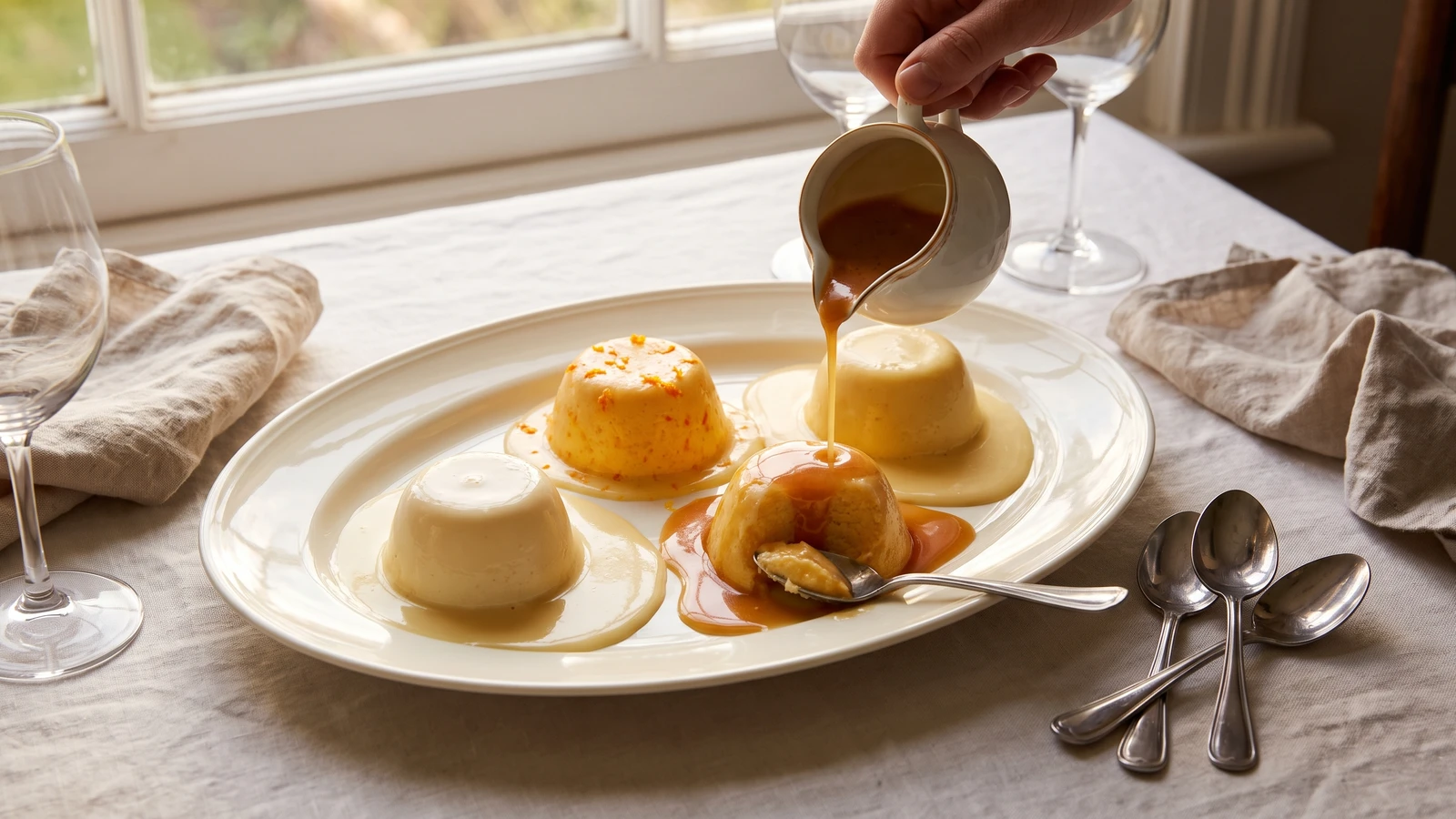
One base becomes four perfumed desserts, each gently poached and paired with its own crème anglaise. The lesson is restraint: add every liqueur off the heat, or its finest aroma escapes.
Poudings à l’orange, au Curaçao, à l’anisette et à la Bénédictine teach a particularly French kind of restraint: one airy, butter-rich base can carry four perfumes, but only if each remains a perfume rather than becoming a drink. The custard must echo its pudding, and every liqueur enters after direct heat has ended, because boiling sends its fragrance into the kitchen instead of the bowl.
The source sends the cook to Saxon Pudding (No. 2504) and assumes a pastry station able to repeat the formula in several flavours, a deep poaching pan, and a saucier on staff holding separate custards. At home, make a three-fifths batch based on three eggs, divide it among four ramekins, poach them steadily in an oven bain-marie, and cook one crème anglaise (English custard) before dividing that too. This cuts brigade repetition, not the dish: the panade, the careful fold, and the gentle poach remain exactly where they belong. One cook, one stove, one evening.
Measure the liqueurs, fold them through the separate portions with a light hand, and keep the bain-marie below a boil. That quiet water is the step that matters most. Boiling tightens the egg and flour into a coarse pudding; a gentle poach leaves it tender enough to drink in the matching custard.
These flavoured puddings belong to the Parisian grand-kitchen entremets, where English moulded puddings entered the French canon and were served with crème anglaise, the custard French kitchens explicitly marked as English. Curaçao, anisette, and Bénédictine came from the liqueur cupboard, so this family belongs to the cosmopolitan Paris table rather than to one producing region. The entry’s “etc.” is practical shorthand: once the base is mastered, the family expands by changing its perfume, not its procedure.
Quantity
3/5 batch Saxon Pudding (No. 2504), about 2 1/2 cups (600 ml / 580 g)
prepared through the final fold and kept unflavoured
Quantity
1 tablespoon (15 ml / 14 g)
softened, for the moulds
Quantity
2 teaspoons (10 ml / 4 g)
divided
Quantity
1 tablespoon (15 ml / 15 g)
divided
Quantity
2 teaspoons (10 ml / 10 g)
divided
Quantity
1 teaspoon (5 ml / 5 g)
divided
Quantity
2 teaspoons (10 ml / 10 g)
divided
Quantity
1 cup (240 ml / 247 g)
Quantity
3
Quantity
1/4 cup (60 ml / 50 g)
Quantity
1 small pinch
| Ingredient | Quantity |
|---|---|
| Saxon Pudding baseprepared through the final fold and kept unflavoured | 3/5 batch Saxon Pudding (No. 2504), about 2 1/2 cups (600 ml / 580 g) |
| unsalted buttersoftened, for the moulds | 1 tablespoon (15 ml / 14 g) |
| finely grated orange zestdivided | 2 teaspoons (10 ml / 4 g) |
| fresh orange juicedivided | 1 tablespoon (15 ml / 15 g) |
| clear Curaçao liqueurdivided | 2 teaspoons (10 ml / 10 g) |
| anisettedivided | 1 teaspoon (5 ml / 5 g) |
| Bénédictinedivided | 2 teaspoons (10 ml / 10 g) |
| whole milk | 1 cup (240 ml / 247 g) |
| large egg yolks | 3 |
| superfine sugar | 1/4 cup (60 ml / 50 g) |
| fine sea salt | 1 small pinch |
Heat the oven to 325°F (160°C). Butter four 6-ounce (180 ml) ramekins thoroughly, paying attention to the bottom corners, then stand them in a roasting tin. Bring a kettle of water just to the boil and let it settle while you prepare the puddings. The oven gives one home cook the steady, all-around heat that a deep poaching pan and an extra pair of hands once supplied.
Prepare three-fifths of Saxon Pudding (No. 2504), keeping its order intact and stopping when the whipped whites have been folded through. Three eggs set the home scale, and every other ingredient follows at three-fifths, so none of the source formula’s ratios move. Use the mixture promptly. If the bowl still feels hot, set it on a cool damp cloth and turn the mixture gently for half a minute; the liqueurs should meet a warm base, never a hot one.
Reserve 1/4 teaspoon of the orange zest for serving, then divide the base evenly among four bowls, preferably by weight. Fold 1 teaspoon orange zest and 1 teaspoon orange juice into the first portion; 1 teaspoon Curaçao into the second; 1/2 teaspoon anisette into the third; and 1 teaspoon Bénédictine into the fourth. Use only three or four broad folds for each. Spoon the mixtures into their buttered moulds, filling them no more than three-quarters full. If one portion loses a little volume, stop stirring and fill that mould slightly lower. Beating cannot restore the air, but the pudding will still be tender. Ça se rattrape.
Pour the hot water into the roasting tin until it reaches halfway up the moulds, then transfer the tin carefully to the oven. Poach for 25 to 30 minutes, until the puddings have risen softly, their tops spring back under a light touch, and a slender skewer finds moist crumbs rather than wet paste. Watch the bath through the oven door. If the water begins bubbling hard, lower the heat and slip in a little cool water; the puddings are rescued before their edges toughen.
While the puddings poach, heat the milk until the surface trembles and small bubbles gather at the rim. Whisk the yolks, sugar, and salt in a heatproof bowl until smooth, then pour in the hot milk slowly while whisking. Return everything to the saucepan and stir constantly over low heat until the crème anglaise reaches nappant, the coating stage, and a finger drawn across the back of the spoon leaves a clean path, about 180 to 183°F (82 to 84°C). Never let it boil. If it begins to look grainy, pour it immediately through a fine sieve into a cold bowl and whisk firmly. Ça se rattrape while the grains are tiny; hard curds mean the heat went too far.
Let the strained crème anglaise stand off the heat for 2 minutes, then divide it equally among four small bowls. Flavour the orange custard with the remaining 2 teaspoons orange juice and 3/4 teaspoon orange zest; stir 1 teaspoon Curaçao into the second, 1/2 teaspoon anisette into the third, and 1 teaspoon Bénédictine into the fourth. Cover the surfaces until serving. If they need warming, set the bowls over warm water. Do not return them to direct heat, because the liqueur’s perfume is the whole point.
Lift the moulds from the bain-marie and rest them for 3 minutes. Run a thin knife around each edge, turn the puddings onto warm dessert plates or one oval platter, and spoon the matching crème anglaise around each one. Mark only the orange pudding with the reserved zest, leaving the liqueur puddings bare and keeping them in their established order. Serve at once, while the puddings remain tender and the custards flow in a soft ribbon. À table!
1 serving (about 235g)
Culinary guides, cultural storytelling, and the editorial depth that makes cooking meaningful.
Discover Culinary ExplorerChef Juliette
Five almond preparations, one discipline: remove the skins cleanly, dry every kernel through, then cut, toast, or cloak it in pale caramel without letting its fragrant oils escape.

Chef Juliette
A pastry pantry lesson in one tray: filberts warmed only until their red skins release, rubbed clean, cooled, and chopped into a fragrant mise-en-place for cakes, creams, pralines, and petits fours.

Chef Juliette
The smallest pâtisserie discipline decides whether a cake leaves its mould intact: clarified butter in every corner, followed by the lightest veil of dry flour or fécule.

Chef Juliette
Four whites, one spotless bowl, and a patient change of speed: whisk gently until loosened, then briskly to glossy stiffness, with powdered sugar waiting if the foam begins to granulate.