
Chef Juliette
Various Almond Preparations
Five almond preparations, one discipline: remove the skins cleanly, dry every kernel through, then cut, toast, or cloak it in pale caramel without letting its fragrant oils escape.
A cooking platform built around craft, culture, and the stories behind what we eat.
Created by Chef Juliette
Based on No. 2498, English Tapioca, Sago, and Semolina Puddings, etc., from Le Guide Culinaire (1907) by Auguste Escoffier
Pouding anglais turns three humble starches into one lesson: cook the grain fully in barely sweetened milk, add exactly two eggs per pint, then let a bain-marie set the custard gently.
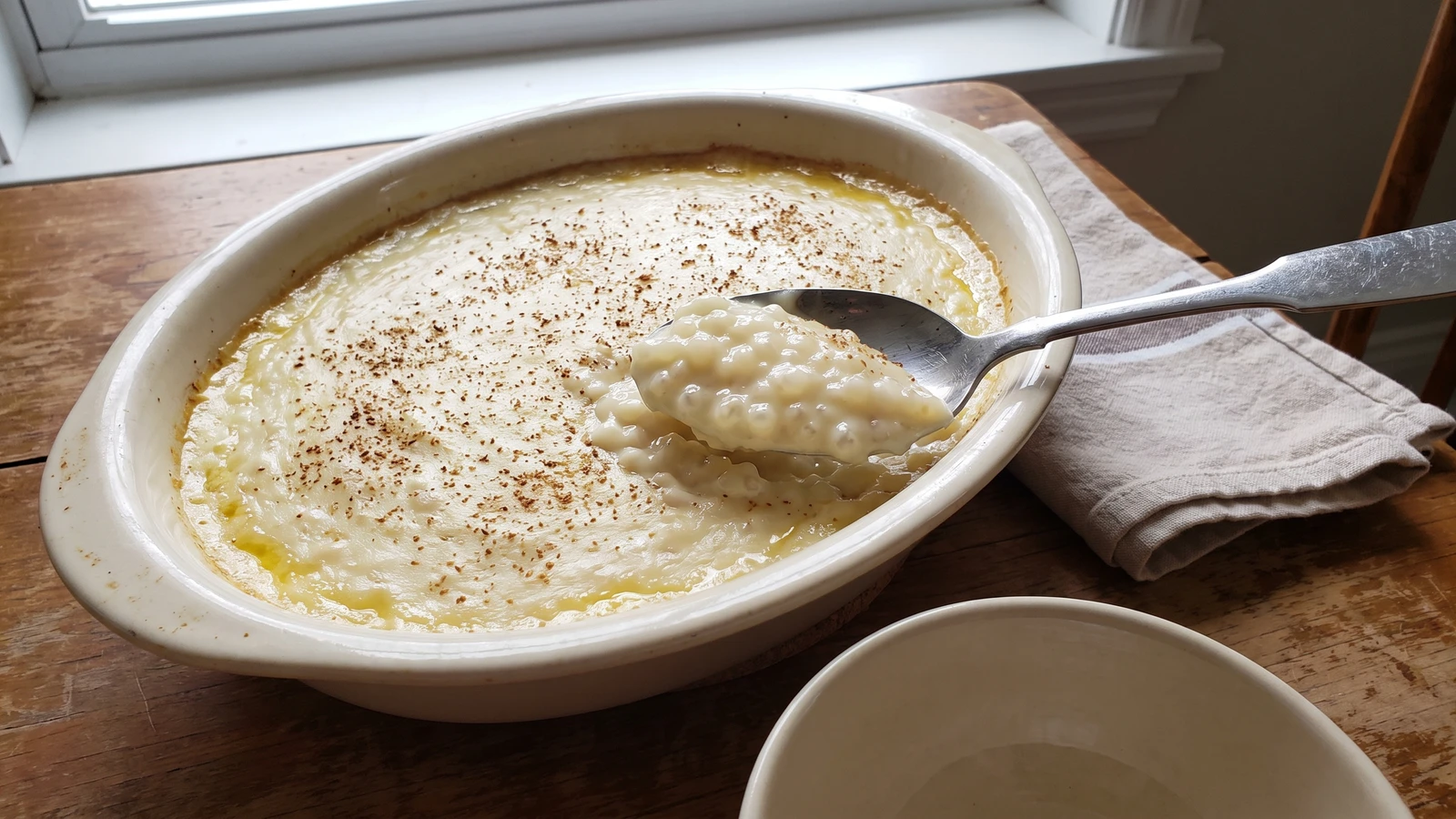
Le pouding anglais au tapioca, sagou ou semoule (English tapioca, sago, or semolina pudding) teaches one true thing: the chosen starch must be completely cooked in barely sweetened milk before the eggs go near it. The eggs cannot soften a chalky pearl or raw semolina. Their only work is to set the milk around the tender starch, giving you a pudding that yields to the spoon without running.
This entry is unusually democratic. It assumes no saucier, no stockpot kept going, no salamander, and not even a mould. What it does assume is a professional cook who already knows the quantity and cooking time for each paste, can measure a pint of preparation accurately, and has a bain-marie (hot-water bath) ready. For the home kitchen, that becomes one saucepan, a measuring jug, a buttered pie dish, and a roasting tin. The starch is scaled to 55 grams for four servings, while the book's governing ratio remains untouched: two eggs for one Imperial pint, exactly 568 millilitres, of cooked milk preparation. One cook, one stove, one evening.
Done properly, the pudding is ivory and softly set, with tender pearls or fine semolina held in a delicate custard and nutmeg freckling the surface. There is no turning out and no decorative sauce, because those would be ceremony rather than the dish. Measure the cooked base to the full 568 millilitres before adding the eggs. That is the step that decides the texture.
These puddings belong to the English nursery and family supper table, where tapioca, sago, rice, and semolina were cooked in milk and served from the baking dish rather than unmoulded. French classical kitchens recorded them as poudings anglais, preserving the English domestic method while expressing it through the precise ratio of two eggs per pint. Tapioca, sago, and semolina are not the same ingredient, since they come respectively from cassava, palm starch, and wheat, but the canon grouped them by their shared treatment in sweetened milk.
Quantity
⅓ cup (80 ml / 55 g)
choose one
Quantity
2½ cups (600 ml / 618 g)
divided, as needed to make 1 Imperial pint (568 ml) cooked base
Quantity
3 tablespoons (45 ml / 38 g)
Quantity
2
Quantity
1 teaspoon (5 ml / 4 g)
Quantity
2 teaspoons (10 ml / 10 g)
softened, for the dish
Quantity
⅛ teaspoon (0.6 ml / 0.3 g)
| Ingredient | Quantity |
|---|---|
| small pearl tapioca, small pearl sago, or fine semolinachoose one | ⅓ cup (80 ml / 55 g) |
| whole milkdivided, as needed to make 1 Imperial pint (568 ml) cooked base | 2½ cups (600 ml / 618 g) |
| granulated sugar | 3 tablespoons (45 ml / 38 g) |
| large eggs | 2 |
| pure vanilla extract | 1 teaspoon (5 ml / 4 g) |
| unsalted buttersoftened, for the dish | 2 teaspoons (10 ml / 10 g) |
| freshly grated nutmeg | ⅛ teaspoon (0.6 ml / 0.3 g) |
Heat the oven to 160°C (325°F). Butter a shallow 1-quart pie dish thoroughly, including the rim, then set it inside a deep roasting tin. Bring a kettle of water almost to the boil and keep it ready for the bain-marie.
Measure 1⅞ cups (450 ml) of the milk into a heavy saucepan. For tapioca or sago, stir the pearls into the cold milk, leave them to soak for 20 minutes, then add the sugar and vanilla. Bring the mixture slowly to a bare simmer and cook for 15 to 25 minutes, stirring frequently, until the pearls are swollen and translucent with no hard white centre. For semolina, bring the milk, sugar, and vanilla to a bare simmer first, then rain in the semolina while whisking; cook gently for 5 to 7 minutes, stirring, until smooth and free of any raw, grainy bite. Complete cooking is the dish here. The oven sets the custard, but it won't repair undercooked starch.
Scrape the cooked mixture into a heatproof measuring jug. Add enough of the reserved cold milk to bring the preparation to exactly 1 Imperial pint (568 ml), stirring well before reading the level. If the mixture is somehow above the mark, return all of it to the saucepan and simmer gently until it reduces to 568 ml. Let it cool until warm rather than hot, below 60°C (140°F) if you are using a thermometer. This exact volume preserves the book's ratio of two eggs per pint.
Whisk the eggs in a bowl only until the whites and yolks are united; a cap of foam gives the baked pudding a rough surface. Whisk in the warm milk preparation a ladleful at a time until roughly one-third has been added, then stir this tempered egg mixture back into the remaining preparation. If you see fine threads of egg, stop immediately and set the bowl over cool water while whisking. Strain the small tempered portion if necessary, cool the base a little further, and continue. Ça se rattrape.
Pour the mixture into the buttered pie dish and grate the nutmeg evenly over the surface. Put the roasting tin on the oven rack, then pour the hot water around the dish until it reaches halfway up the sides. Bake for 35 to 45 minutes, until the outer portion is set but the central 5 cm still trembles as one soft piece when the dish is nudged. If the water begins bubbling hard, add a little cool water and lower the oven to 150°C (300°F); boiling water tightens the eggs and leaves the custard pocked.
Lift the pie dish carefully from the bain-marie and rest the pudding for 20 minutes. The centre will finish setting without losing its tenderness. Serve it warm or at room temperature with a broad spoon, directly from the dish in which it baked. No mould, no turning out, no apology. À table!
1 serving (about 175g)
Culinary guides, cultural storytelling, and the editorial depth that makes cooking meaningful.
Discover Culinary ExplorerChef Juliette
Five almond preparations, one discipline: remove the skins cleanly, dry every kernel through, then cut, toast, or cloak it in pale caramel without letting its fragrant oils escape.

Chef Juliette
A pastry pantry lesson in one tray: filberts warmed only until their red skins release, rubbed clean, cooled, and chopped into a fragrant mise-en-place for cakes, creams, pralines, and petits fours.

Chef Juliette
The smallest pâtisserie discipline decides whether a cake leaves its mould intact: clarified butter in every corner, followed by the lightest veil of dry flour or fécule.

Chef Juliette
Four whites, one spotless bowl, and a patient change of speed: whisk gently until loosened, then briskly to glossy stiffness, with powdered sugar waiting if the foam begins to granulate.