
Chef Juliette
Various Almond Preparations
Five almond preparations, one discipline: remove the skins cleanly, dry every kernel through, then cut, toast, or cloak it in pale caramel without letting its fragrant oils escape.
A cooking platform built around craft, culture, and the stories behind what we eat.
Created by Chef Juliette
Based on No. 2473, Surprise Omelet “à l’Islandaise”, from Le Guide Culinaire (1907) by Auguste Escoffier
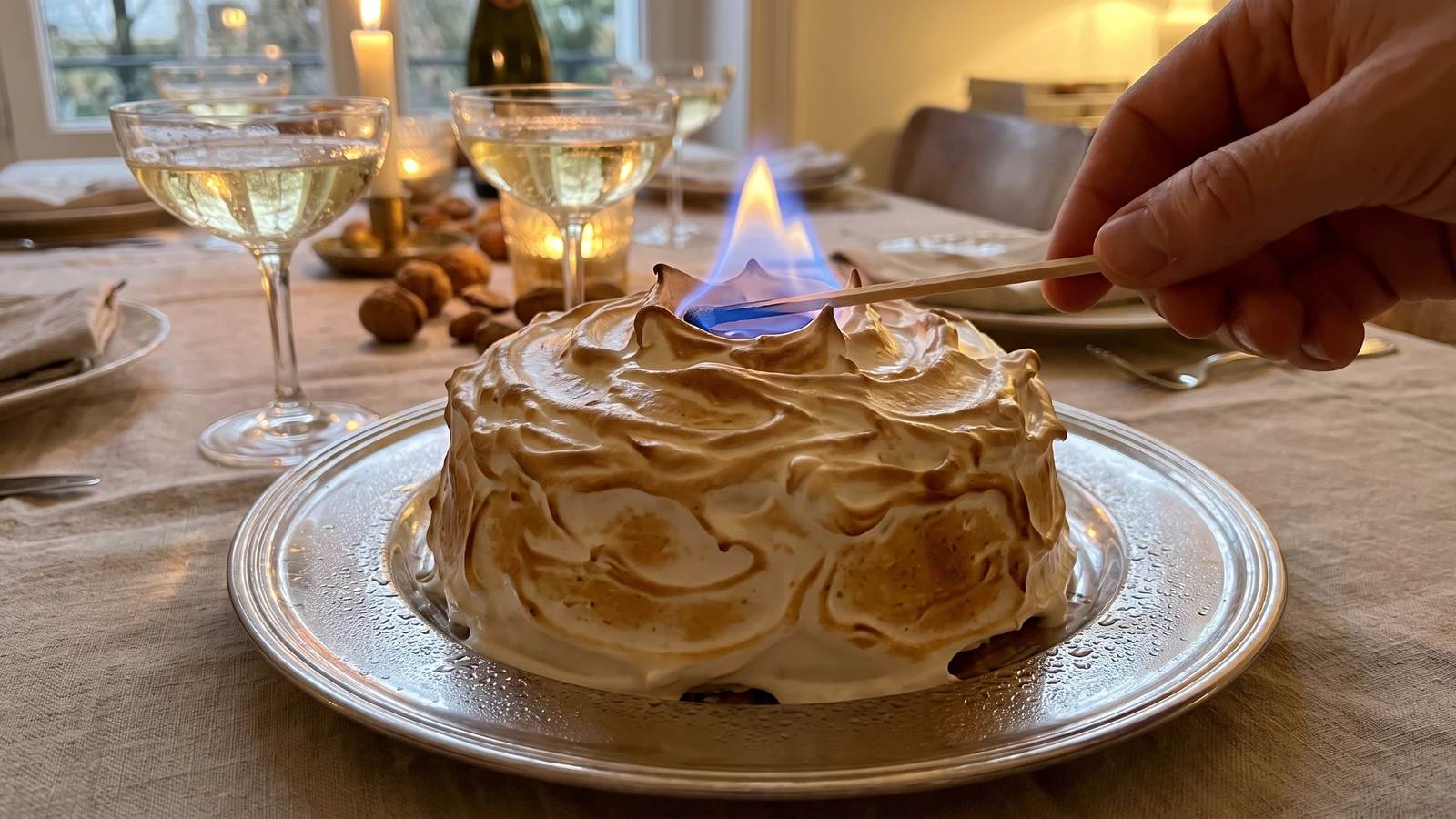
Round Génoise, a hard-frozen cone of ice cream, and a seamless coat of meringue meet the broiler for moments before a rum-filled crown burns bright at the celebration table.
Omelette surprise à l’Islandaise (a round baked Alaska crowned with flaming rum) teaches one thing above all: cold must be absolute, and heat must be fierce and brief. The Génoise supports, the meringue insulates, and the broiler paints the ridges before warmth can travel inward. Brown it slowly and you have missed the dish.
The original assumed a pastry brigade with Génoise and meringue waiting, molded ice held hard in the freezer, and a salamander already glowing. Here the cross-referenced preparations remain finished components, as the book organizes them, but their brigade batches become the exact cushion, case, and coating needed for four; a tapered pudding basin shapes the ice, and the home broiler replaces the salamander. Those large service quantities are scaffolding. The round cake, truncated cone, complete meringue seal, rapid browning, hollow crown, and heated rum flame are the dish, so none goes missing. One cook, one stove, one evening.
Bring the à l’Islandaise out deeply bronzed at its ridges, snowy between them, with blue flame alive in the little case on top. The moment is theatrical because the construction is exact, not because it is fussy. Before you touch the broiler, make certain the ice is stone-hard and every gap is sealed; that is the step that decides everything.
Omelette surprise belongs to the Parisian banquet and grand-hotel table, where pastry kitchens joined sponge cake, molded ice, and meringue to make insulation part of the spectacle. The à l’Islandaise form is not an Icelandic household dessert; it is a French classical variation distinguished by its round cushion, truncated cone, and rum-filled meringue case ignited at service. From formal dining rooms it moved easily to home celebrations because its apparent impossibility rests on one domestic fact: a thick, unbroken coat of meringue shields deeply frozen ice from very brief, fierce heat.
Quantity
1 round 6-inch by 3/4-inch (15 cm by 2 cm) cushion of Pâte à Génoise Fine (No. 2376), about 6 ounces (170 g)
completely cooled
Quantity
3 cups (720 ml / 500 g)
softened only until packable
Quantity
1 case, 3 inches by 1 1/2 inches (7.5 cm by 4 cm; about 3/4 ounce / 20 g), prepared as for Surprise Omelet “à la Napolitaine” otherwise “Bombe Vésuve” (No. 2471) with Ordinary Meringue (No. 2382)
baked pale and completely cooled
Quantity
1/4 cup (60 ml / 57 g)
40% to 50% alcohol by volume
| Ingredient | Quantity |
|---|---|
| round Génoise cushioncompletely cooled | 1 round 6-inch by 3/4-inch (15 cm by 2 cm) cushion of Pâte à Génoise Fine (No. 2376), about 6 ounces (170 g) |
| firm vanilla ice creamsoftened only until packable | 3 cups (720 ml / 500 g) |
| small round baked meringue casebaked pale and completely cooled | 1 case, 3 inches by 1 1/2 inches (7.5 cm by 4 cm; about 3/4 ounce / 20 g), prepared as for Surprise Omelet “à la Napolitaine” otherwise “Bombe Vésuve” (No. 2471) with Ordinary Meringue (No. 2382) |
| Ordinary Meringuefreshly prepared | 3 1/4 cups (780 ml / 280 g) Ordinary Meringue (No. 2382) |
| amber or dark rum40% to 50% alcohol by volume | 1/4 cup (60 ml / 57 g) |
Line a 3-cup tapered pudding basin with plastic wrap, smoothing it closely against the sides. Pack in the vanilla ice cream, pressing firmly to remove air pockets, then level the broad opening. Cover and freeze for at least 2 hours, until the ice cream is hard from edge to centre. The inverted mold must give you a truncated cone with a broad base and a small flat top, not a soft dome.
Centre the round cushion of Pâte à Génoise Fine (No. 2376) on a 9-inch broiler-safe metal serving platter. Have the small round meringue case prepared as for Surprise Omelet “à la Napolitaine” otherwise “Bombe Vésuve” (No. 2471), using Ordinary Meringue (No. 2382), close at hand. Keep the case hollow and intact. The Génoise should remain dry and level so the frozen cone cannot skate across it.
Unmold the frozen ice cream directly onto the Génoise, broad side down. Working at once, cover the cone and every visible edge of cake with a thick, unbroken coat of Ordinary Meringue (No. 2382), sealing it firmly against the metal platter. Set the baked round case from Surprise Omelet “à la Napolitaine” otherwise “Bombe Vésuve” (No. 2471) on top, then conceal its exterior with more Ordinary Meringue (No. 2382) while leaving the well completely open. Draw bold ridges with a spoon or piping bag so the broiler has proud edges to colour. If the coating slips or any ice shows, stop. Ça se rattrape: freeze the dessert for 10 minutes, patch the gap with fresh meringue, and continue only when the surface holds.
Freeze the assembled omelette for 30 minutes, uncovered, until the meringue is firm and the platter is thoroughly cold. During the final 10 minutes, set an oven rack about 6 inches (15 cm) below the broiler and heat the broiler at its highest setting. Clear the serving table, turn off candles, and place a large metal bowl nearby for smothering the rum flame if needed. Cold first, fierce heat second. A slow oven is not gentler here; it reaches the ice.
Set the metal platter on a rimmed sheet pan and place it under the fully heated broiler. Brown for 60 to 120 seconds, rotating once with oven mitts if one side colours first. The raised ridges should turn hazelnut gold while the hollows remain ivory. Do not walk away. If the colour is patchy, rotate the dish or move it one level closer to the heat; do not trade fierce heat for extra minutes. Remove it the instant the crown is evenly bronzed.
While the omelette browns, measure the rum into a small metal cup. Set the cup in a saucepan of just-boiled water, off the heat, for 3 to 4 minutes, until the rum reaches about 115 to 120°F (45 to 50°C). Lift out the cup and dry its exterior. Never heat rum in its bottle, never let it boil, and keep it away from an open burner.
Carry the browned omelette to a cleared, stable table before lighting it. Pour the warm rum into the open meringue case, set the cup aside, and ignite the rum with a long match while everyone remains seated back. Never carry the dessert while it burns and never add rum to a live flame. If it does not catch, do not pour in more. Ça se rattrape: spoon the rum back into the metal cup, warm it again in hot water, and make one more attempt. Let the blue flame burn for 10 to 20 seconds, then allow it to subside or smother it with the metal bowl. Cut four wedges immediately with a sharp knife, giving each serving Génoise, ice cream, bronzed meringue, and a piece of the rum-scented crown. À table!
1 serving (about 250g)
Culinary guides, cultural storytelling, and the editorial depth that makes cooking meaningful.
Discover Culinary ExplorerChef Juliette
Five almond preparations, one discipline: remove the skins cleanly, dry every kernel through, then cut, toast, or cloak it in pale caramel without letting its fragrant oils escape.

Chef Juliette
A pastry pantry lesson in one tray: filberts warmed only until their red skins release, rubbed clean, cooled, and chopped into a fragrant mise-en-place for cakes, creams, pralines, and petits fours.

Chef Juliette
The smallest pâtisserie discipline decides whether a cake leaves its mould intact: clarified butter in every corner, followed by the lightest veil of dry flour or fécule.

Chef Juliette
Four whites, one spotless bowl, and a patient change of speed: whisk gently until loosened, then briskly to glossy stiffness, with powdered sugar waiting if the foam begins to granulate.