Culinary Explorer

A cooking platform built around craft, culture, and the stories behind what we eat.
Discover Culinary Explorer
Vegetable Soups

Vegetable Soups

Created by Chef Juliette

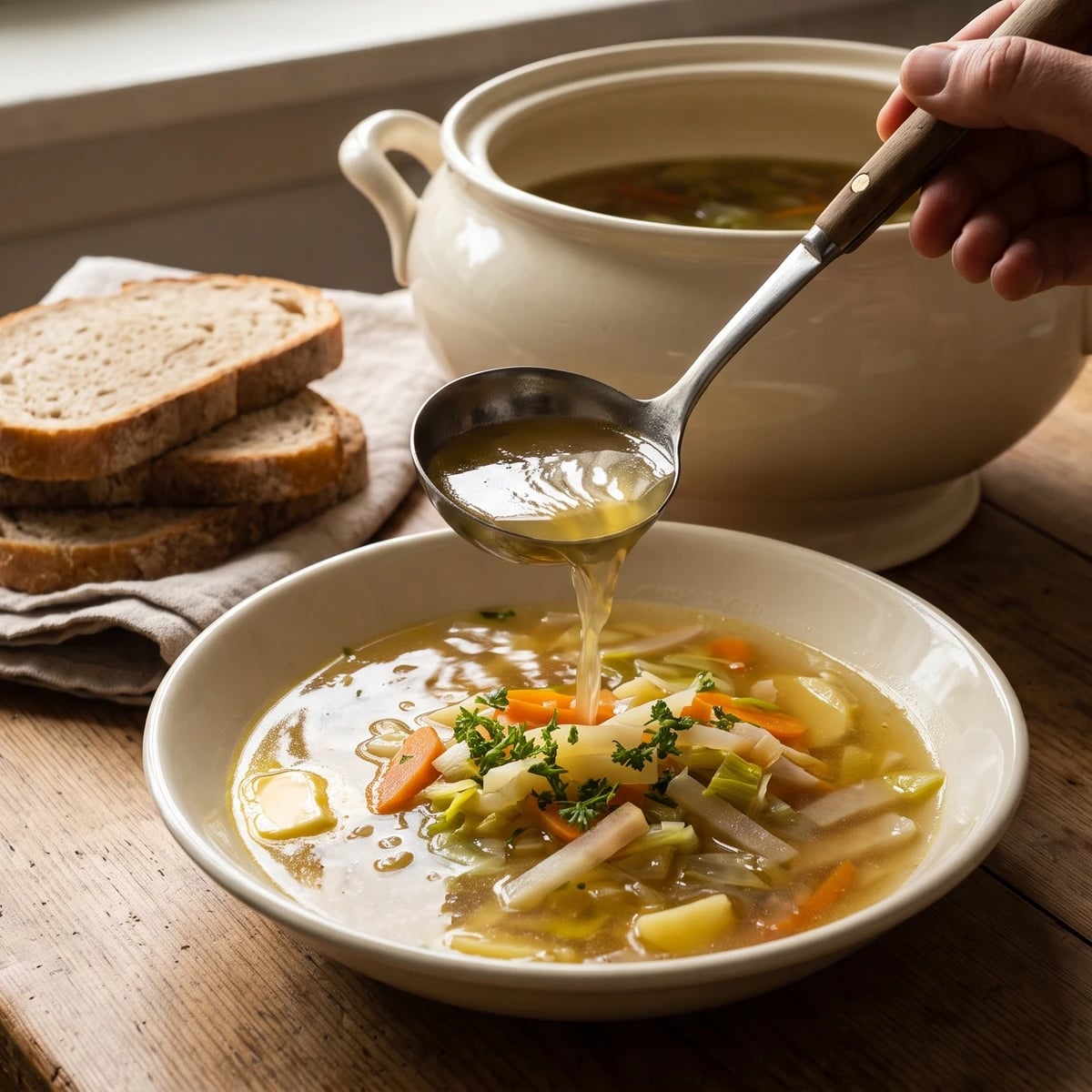
Potage Paysanne proves that butter and patience can give modest vegetables a broth of real depth: cut them thinly, stew them slowly, and let one generous pot feed the table.

Soups & Stews
French
Comfort Food
Weeknight
Budget Friendly
30 min
Active Time
1 hr 10 min cook1 hr 40 min total
YieldAbout 2 quarts

Potage Paysanne (country-style vegetable soup) teaches the first grammar of vegetable cookery: water must leave before broth goes in. The vegetables are not merely softened. They are étuvés (stewed slowly in butter) until their raw moisture has cooked away and every thin piece gleams. That patient butter stew is the soup; rush it, and the pot tastes boiled no matter how fine the vegetables.

The brigade kitchen assumed a saucier, a stockpot never off the fire, and quantities worth a great marmite. Paysanne needs none of that scaffolding. A wide heavy pot replaces the professional rondeau, plain hot water keeps the vegetable flavor clear, and the batch is scaled to about two quarts: one cook, one stove, one evening. What changed is the vessel and yield. What stays is the long étuvage in real butter.

Cut with consistency, not ceremony. A paysanne cut means thin, flat pieces that cook at the same pace, not perfect little geometry. Before you touch the pan, know the moment you are waiting for: the wet hiss quiets, the vegetables collapse, and a clear butter sheen returns to the bottom of the pot.

Potage Paysanne belongs to the broad French household table rather than a single province, and its name describes both the country-style pot and the paysanne cut, thin flat pieces shaped to the vegetable at hand. Household cooks carried the method into the classical repertoire, where it became the radical type for a whole family of vegetable soups: butter first to concentrate the vegetables, diluent second to make the broth. Its rustic name is sometimes mistaken for permission to chop carelessly, but the cut is practical discipline, modestly irregular, never coarse.

The technique, the tradition, and the story behind every dish.

Discover Culinary Explorer

Ingredients

unsalted butter

Quantity

6 tablespoons (90 ml / 85 g)

yellow onion

Quantity

1 cup (240 ml / 150 g)

cut paysanne

leeks, white and pale green parts

Quantity

2 cups (480 ml / 180 g)

thoroughly washed and cut paysanne

carrots

Quantity

1½ cups (360 ml / 180 g)

peeled and cut paysanne

turnips

Quantity

1½ cups (360 ml / 200 g)

peeled and cut paysanne

Savoy cabbage

Quantity

3 cups (720 ml / 200 g)

cut into short thin ribbons

waxy potatoes

Quantity

2 cups (480 ml / 320 g)

peeled and cut paysanne

hot water

Quantity

6 cups (1.42 L / 1.42 kg)

divided

bouquet garni of parsley stems, thyme, and bay leaf

Quantity

1

fine sea salt

Quantity

2 teaspoons (10 ml / 12 g), divided, plus more to taste

freshly ground white pepper

Quantity

½ teaspoon (2.5 ml / 1 g)

fresh chervil leaves

Quantity

¼ cup (60 ml / 10 g)

coarsely chopped

Equipment Needed

  • 5- to 6-quart wide heavy pot or Dutch oven
  • Sharp chef's knife
  • Wooden spoon or heatproof spatula
  • Deep soup ladle

Instructions

  1. 1

    Cut the paysanne

    Cut the onion, leeks, carrots, turnips, and potatoes into thin, flat pieces about ½ inch (12 mm) across and ⅛ inch (3 mm) thick, following each vegetable's natural shape. Slice the cabbage into short ribbons of similar width. Exact geometry is brigade scaffolding and can go; even thinness must stay, because it lets unlike vegetables become tender together.

    Cut the potatoes last so they do not discolor. If they must wait, cover them with cold water, then drain and dry them before they meet the butter.
  2. 2

    Soften the alliums

    Melt the butter in a wide, heavy pot over medium-low heat. Add the onion, leeks, and half the salt, then cook for 8 to 10 minutes, stirring often, until they collapse and turn glossy without taking color. Keep the heat patient. Browned onion would pull the broth toward sweetness and obscure the clean vegetable character.

  3. 3

    Étuver the vegetables

    Add the carrots and turnips and cook for 12 minutes, then fold in the cabbage and potatoes. Continue the étuvage over low heat for 18 to 22 minutes, stirring from the bottom every few minutes. The full pot will first hiss and look alarmingly crowded. It is exactly right. The vegetables are ready when their moisture has largely evaporated, their edges look supple, and the butter appears again as a clear sheen on the pot floor. If anything catches or begins to brown, add 1 tablespoon of the measured hot water, scrape gently, and lower the heat. Ça se rattrape.

  4. 4

    Moisten and simmer

    Pour in 5½ cups (1.3 L / 1.3 kg) of the hot water and add the bouquet garni, white pepper, and remaining salt. Bring the soup just to a boil, then lower the heat immediately and hold it at a quiet simmer for 25 to 30 minutes. The vegetables should be completely tender while retaining their shapes, and the broth should taste of the whole pot rather than any one vegetable. Do not skim away the fine butter beads on the surface; they are part of the foundation, not an error.

  5. 5

    Balance the broth

    Remove the bouquet garni and taste the broth. If it has become too concentrated or sits below the promised yield, add the reserved hot water a little at a time. If it tastes thin, simmer uncovered for another 5 minutes. Adjust the salt, then fold in most of the chervil and let it stand off the heat for 2 minutes so the herb keeps its fresh anise note.

  6. 6

    Serve from the pot

    Ladle the Paysanne into deep bowls, distributing the vegetables generously and finishing with the remaining chervil. Bring bread for the broth and put the pot within reach for second helpings. Cooking well is not cooking fancy. À table!

Chef Tips

  • Use a wide 5- to 6-quart pot. A narrow saucepan traps the vegetables in their own liquid, while a broad base lets that moisture escape and gives the butter room to do its work.
  • Plain water is deliberate here. A strongly flavored packaged stock makes every vegetable taste like the same stock; the long étuvage builds enough foundation for the vegetables to season their own broth.
  • Choose waxy potatoes, which remain in distinct thin pieces. Floury potatoes will soften into the broth and make it cloudy. The soup is still good, but it loses the clear, composed character of a Paysanne.
  • Fresh chervil is the classical finish. If it cannot be found, use half as much flat-leaf parsley; parsley is more forceful, so restraint keeps it from taking over.

Advance Preparation

  • The vegetables can be cut up to 6 hours ahead and refrigerated separately. Keep the potatoes submerged in cold water, then drain and dry them well before cooking.
  • The finished soup keeps for up to 3 days under refrigeration. Cool it promptly, hold back the chervil, and reheat at a quiet simmer with a spoonful of water if the broth has tightened.
  • Freezing is possible for up to 1 month, but the potatoes become softer after thawing. For the best texture, make the soup a day ahead instead and add fresh chervil only when serving.

Frequently Asked Questions

Nutrition Information

1 serving (about 245g)

Calories
150 calories
Total Fat
9 g
Saturated Fat
6 g
Trans Fat
0.4 g
Unsaturated Fat
3 g
Cholesterol
23 mg
Sodium
625 mg
Total Carbohydrates
17 g
Dietary Fiber
4 g
Sugars
5 g
Protein
2 g

Note: Chef personas and recipes are created with AI assistance. Cook with care: follow safe food-handling practices, check doneness with a thermometer when needed, and adapt for allergies and your kitchen.

Where cooking meets culture.

Culinary guides, cultural storytelling, and the editorial depth that makes cooking meaningful.

Discover Culinary Explorer

More from Leading Culinary Operations

Browse the full collection