
Chef Juliette
Various Almond Preparations
Five almond preparations, one discipline: remove the skins cleanly, dry every kernel through, then cut, toast, or cloak it in pale caramel without letting its fragrant oils escape.
A cooking platform built around craft, culture, and the stories behind what we eat.
Created by Chef Juliette
Based on No. 2388, Pistachio Paste for Infusion, from Le Guide Culinaire (1907) by Auguste Escoffier
Pâte de pistaches teaches a quiet rule of pastry: grind the nut perfectly smooth before the milk arrives, then let gentle infusion, a trace of vanilla, and restrained colour do the rest.
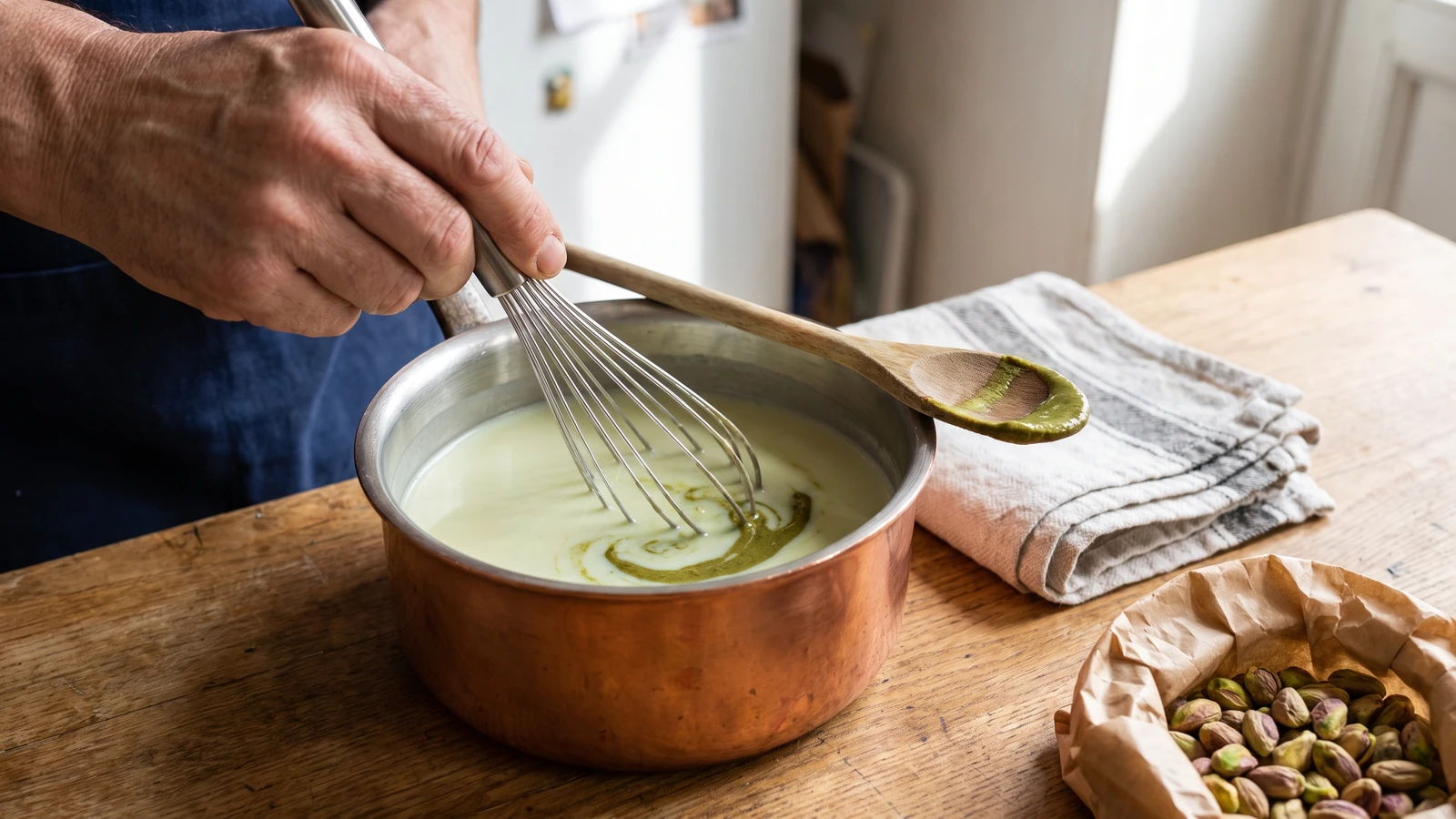
Pâte de pistaches pour infusion (pistachio paste for infusion) teaches one true thing: milk can carry pistachio flavour, but it cannot repair a coarse paste. The nuts must be skinned, washed, dried, and ground until no grit remains. Only then does the boiled milk draw out their delicate aroma and natural oil evenly.
The old kitchen assumed a heavy mortar, a strong pair of hands, and enough paste for a full service. For one cook, one stove, one evening, a small food processor does the long pounding, while a mortar stands ready if the blades cannot catch this home-sized batch. The brigade quantity and labour were scaffolding. Removing the skins, drying the nuts, grinding them smooth, and infusing them in boiled milk are the dish, so every one stays.
The finished infusion should be softly green, never emerald, with vanilla sitting behind the pistachio rather than over it. Dry the peeled nuts completely and grind without rushing. That smooth paste is the step that decides the whole preparation.
Pâte de pistaches pour infusion belongs to the working vocabulary of French pâtisserie, especially the Parisian kitchens where nut-scented milk fed crèmes, custards, frozen desserts, and entremets. The mortar paste moved from confectionery practice into the grand-kitchen repertoire because pounding exposed enough oil and aroma for hot milk to carry the nut evenly. Its pale colour is no defect: classical cooks openly strengthened it with vegetable green and used only a trace of vanilla, never enough to make pistachio the secondary flavour.
Quantity
1 cup (240 ml / 130 g)
Quantity
2 cups (475 ml / 490 g)
Quantity
2 to 3 drops
Quantity
⅛ teaspoon (0.6 ml / 0.6 g)
| Ingredient | Quantity |
|---|---|
| raw, shelled, unsalted pistachios | 1 cup (240 ml / 130 g) |
| whole milk | 2 cups (475 ml / 490 g) |
| food-grade green vegetable colouring, chlorophyll-based if available | 2 to 3 drops |
| pure vanilla extract | ⅛ teaspoon (0.6 ml / 0.6 g) |
Bring a saucepan of water to a boil, add the pistachios, and blanch them for 1 minute. Drain and rinse them under cold water, then slip or rub away every loosened skin. Wash the peeled kernels once more in clean cold water, as the original method directs, and dry them thoroughly between clean towels. Spread them out for 15 minutes so no surface moisture remains. Do not toast them; browning would trade their fresh colour and delicate perfume for a flavour this infusion isn't asking for.
Work the dry pistachios in a small food processor, pulsing first to a fine meal and then running the machine in 20-second bursts. Scrape the bowl between bursts and continue until the nuts release their oil and gather into a satin-smooth paste, about 4 to 6 minutes. Stop whenever the bowl grows warm, since excess heat dulls both aroma and colour. If the blades merely throw this small batch around, transfer it to a heavy mortar and grind firmly. If a little oil separates, don't discard anything. Ça se rattrape: cool the paste for 5 minutes, then work in the first spoonful of hot milk very slowly during the next step.
Pour the whole milk into a clean, heavy saucepan and bring it to a full boil over medium heat, stirring across the bottom with a flexible spatula. The moment the foam rises, lift the pan from the heat. This brief boil is the foundation of the infusion, but scorched milk cannot be hidden by nuts or vanilla; if it catches and smells burnt, begin again with fresh milk.
Put the pistachio paste in a heatproof bowl. Délayer, meaning loosen the paste gradually, by whisking in about ¼ cup (60 ml) of the boiled milk until perfectly smooth. Add two more small ladlefuls, whisking between each, then return the loosened mixture to the remaining milk. Cover and leave it off the heat for 30 minutes. Gradual loosening prevents hard knots of paste; if a few remain, blend for 10 seconds with an immersion blender and pass the mixture through a fine sieve. Ça se rattrape.
Whisk in the vanilla, then add the green vegetable colouring one drop at a time, using no more than 2 to 3 drops. Stop when the milk is a soft pistachio green. The colour should confirm the nut, not announce the colouring, and the vanilla should register only as a roundness behind it. Taste after the first drop and again after the vanilla; restraint is part of the formula.
Use the infusion warm in the custard or pudding that calls for it. For an impeccably smooth preparation, pass it through a fine-mesh sieve, pressing gently; for a pudding that welcomes more body, keep the finely ground pistachio suspended. If making it ahead, set the container in an ice bath, stir until cool, cover, and refrigerate promptly. Whisk before using, since a fine veil of pistachio oil may rise while it rests.
1 serving (about 600g)
Culinary guides, cultural storytelling, and the editorial depth that makes cooking meaningful.
Discover Culinary ExplorerChef Juliette
Five almond preparations, one discipline: remove the skins cleanly, dry every kernel through, then cut, toast, or cloak it in pale caramel without letting its fragrant oils escape.

Chef Juliette
A pastry pantry lesson in one tray: filberts warmed only until their red skins release, rubbed clean, cooled, and chopped into a fragrant mise-en-place for cakes, creams, pralines, and petits fours.

Chef Juliette
The smallest pâtisserie discipline decides whether a cake leaves its mould intact: clarified butter in every corner, followed by the lightest veil of dry flour or fécule.

Chef Juliette
Four whites, one spotless bowl, and a patient change of speed: whisk gently until loosened, then briskly to glossy stiffness, with powdered sugar waiting if the foam begins to granulate.