Culinary Explorer

A cooking platform built around craft, culture, and the stories behind what we eat.
Discover Culinary Explorer
Mousseline Brioche Paste

Mousseline Brioche Paste

Created by Chef Juliette

Based on No. 2369, Mousseline Brioche Paste, from Le Guide Culinaire (1907) by Auguste Escoffier

Ordinary brioche takes one exact measure of butter and a patient rise in the mould, becoming so light and silken that it can cradle fruit without losing its tender crumb.

Breads
French
Make Ahead
Dinner Party
Special Occasion
20 min
Active Time
30 min cook3 hr total
YieldOne 7-inch moulded brioche (8 servings)

Pâte à Brioche Mousseline (featherlight brioche dough) teaches a precise lesson: enrichment only makes bread delicate when the butter and dough meet at the same soft, cool consistency. The added butter is not decoration. Worked in cleanly, then given the mould's final third to claim by fermentation, it turns an ordinary brioche crumb finer, silkier, and light enough to serve as a casing for fruit sweets.

The classical pastry kitchen assumed Ordinary Brioche Paste already waiting, a temperate proving room, and enough hands to shape ranks of moulds. At home, that becomes one pound of prepared paste, exactly two ounces of extra butter, one four-to-five-cup mould, and a warm, draft-free corner. The rows of individual mousselines are service scaffolding and can go; the extra-butter ratio, the two-thirds fill, and the rise to the rim are the dish and must stay. One cook, one stove, one evening.

Your eye, not the clock, decides the proof. Before you begin, press the butter and dough separately with a fingertip: both should yield readily, but neither should shine or slump. That matching texture is the one step that matters most; get it right and the butter disappears into the paste instead of escaping from it.

Pâte à brioche mousseline belongs to the classical French entremets kitchen rather than to one regional bread basket, where it became an exceptionally delicate baked casing for timbales of fruit sweets. It is not a separate dough from the beginning: Ordinary Brioche Paste receives exactly two ounces more butter per pound, then gains its lightness by fermenting in the mould before baking. In the classical glossary, mousselines are the same preparation moulded in small quantities for one person, while a larger mould serves the shared table.

The technique, the tradition, and the story behind every dish.

Discover Culinary Explorer

Ingredients

Ordinary Brioche Paste

Quantity

1 lb, about 2¼ cups (540 ml / 454 g)

fully prepared and cool but pliable

good unsalted butter

Quantity

4 tablespoons (60 ml / 2 oz / 57 g)

softened to beurre pommade, for incorporating

unsalted butter

Quantity

1 tablespoon (15 ml / 14 g)

softened, for the mould

unsalted butter

Quantity

1 tablespoon (15 ml / 14 g)

melted and cooled slightly, for brushing

Equipment Needed

  • Digital kitchen scale
  • Stand mixer fitted with a dough hook, or a sturdy dough scraper
  • 4-to-5-cup (1-to-1.2-litre) fluted brioche or charlotte mould, about 7 inches wide
  • Soft pastry brush
  • Instant-read thermometer

Instructions

  1. 1

    Match the textures

    Butter a 4-to-5-cup (1-to-1.2-litre) fluted brioche mould liberally, working the butter into every flute but leaving no heavy puddles. Bring the additional butter to beurre pommade, an ointment-soft consistency: a finger should pass through it easily, yet the butter should remain matte and hold its shape. The Ordinary Brioche Paste should be cool but equally pliable, about 68 to 72°F (20 to 22°C). If it came from the refrigerator, let it soften only until it bends without cracking.

    Temperature matters less than matching consistency. Hard butter remains in lumps; melting butter escapes into a greasy film.
  2. 2

    Work in butter

    Place the Ordinary Brioche Paste in a mixer fitted with the dough hook and turn it on low. Add the beurre pommade in four additions, allowing each to disappear before adding the next, then mix until the paste is smooth, elastic, and satin-glossed, about 5 minutes. Do not add flour; flour would change the book's ratio and coarsen the crumb. If butter smears around the bowl or the paste becomes loose and oily, stop and chill the bowl for 10 minutes, then resume on low. If pale butter lumps remain, let the mixture rest for 5 minutes before continuing. Ça se rattrape. Without a mixer, smear and fold the butter into the paste on an unfloured counter with a sturdy dough scraper for 8 to 10 minutes.

  3. 3

    Shape and mould

    Turn the paste onto an unfloured counter. With a dough scraper and lightly buttered hands, draw the edges underneath until the surface becomes a smooth, taut ball. Set it seam-side down in the prepared mould. It should fill the mould to two-thirds of its height; if it sits markedly lower, move it to a smaller mould rather than changing the proofing target. Cover loosely with an upturned bowl or buttered wrap without letting the covering touch the paste.

  4. 4

    Proof to the rim

    Set the mould in a draft-free place at about 75 to 77°F (24 to 25°C) until the paste rises to the rim, usually 1½ to 2½ hours. The rim, not the clock, is the measure. A colder room simply asks for more time; a hot place melts the butter before the yeast can build the crumb. If butter begins beading on the surface, chill the mould for 10 minutes, then continue in a cooler spot. If the paste rises slightly beyond the edge, bake it at once; if it wrinkles and begins to sink, gently deflate it, shape it again, and give it a second proof.

  5. 5

    Brush without deflating

    During the final 30 minutes of proofing, heat a conventional oven to 350°F (180°C) with a rack in the lower-middle position. When the paste reaches the mould's edge, uncover it and brush the surface very gently with the melted butter. Use a soft brush and barely touch the crown, because dragging across the risen paste can release its carefully built air. If it dimples, leave it for 10 minutes to regain the rim before baking.

  6. 6

    Bake to bronze

    Bake for 25 to 35 minutes without opening the oven during the first 20 minutes. The brioche is ready when the crown is deeply butter-gold, the sides pull just slightly from the mould, and the centre reaches 190 to 194°F (88 to 90°C). If the crown bronzes before the centre is ready, lay a loose sheet of foil over it and finish baking. This moderate oven is the home equivalent of the pastry kitchen's steady baking chamber, and the thermometer protects the delicate crumb from an underbaked collapse.

  7. 7

    Unmould and cool

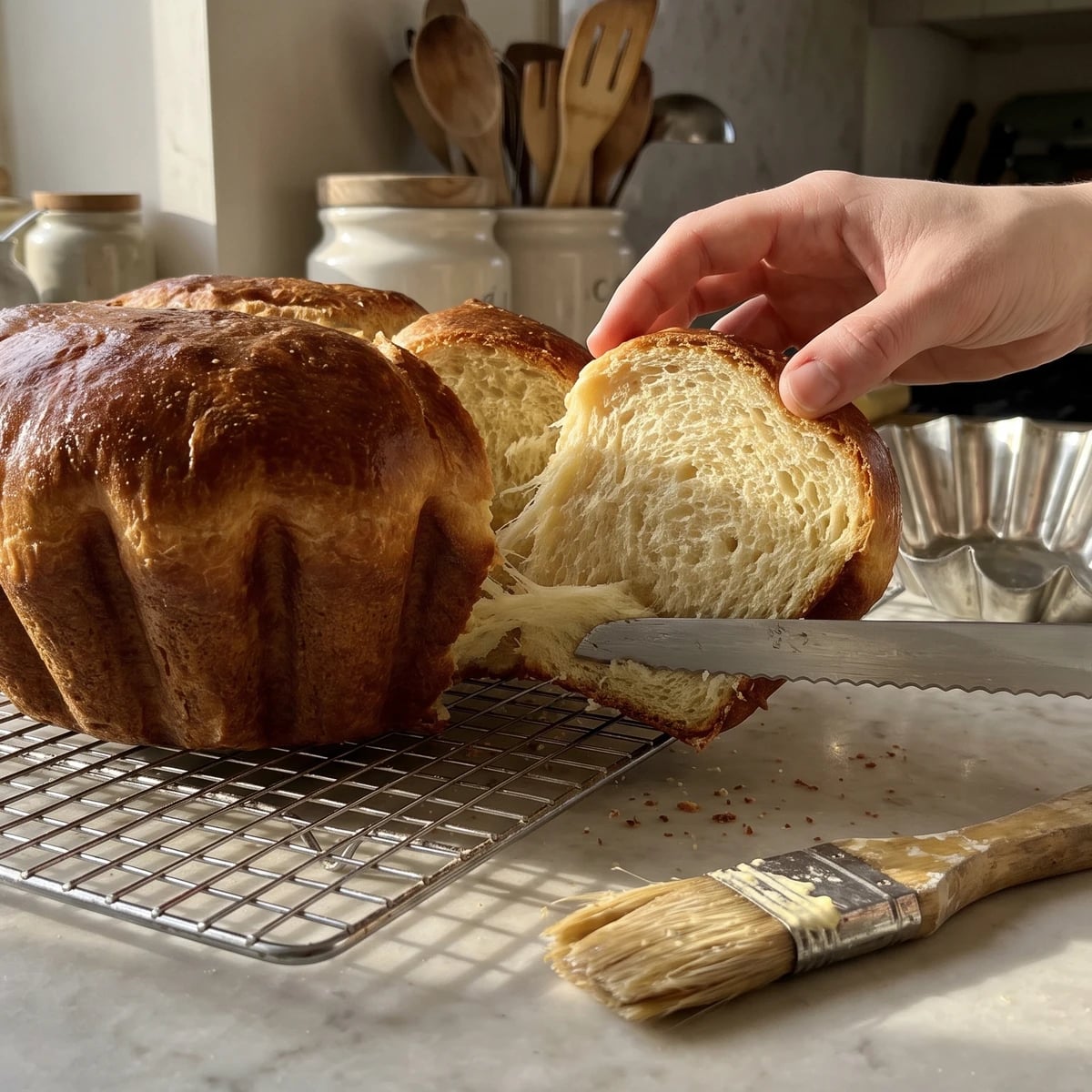
    Rest the brioche in its mould for 10 minutes, then loosen the edge carefully and turn it onto a rack. Set it upright and cool for at least 45 minutes before slicing. If it will become a fruit timbale, cool it completely before trimming or hollowing, and add the fruit filling shortly before serving so the crumb stays tender rather than sodden. À table!

Chef Tips

  • This preparation begins with Ordinary Brioche Paste as a finished component, exactly as the classical entry intends. A lean sweet dough is not an honest substitute; the extra butter is calibrated to brioche, not ordinary bread.
  • Weigh the additional butter. The governing proportion is two ounces of butter for every pound of prepared paste, and that ratio is what gives mousseline its fine crumb without overwhelming the dough's structure.
  • Choose the mould by the two-thirds rule, not by decoration. A plain charlotte mould works as well as a fluted brioche mould if the paste fills it to the correct height.
  • For individual mousselines, divide the finished paste equally among small buttered moulds, filling each two-thirds full. Proof to their rims and begin checking them after 15 minutes of baking.
  • Use real butter with a clean, fresh flavour. Margarine and spreading fats contain the wrong balance of water and fat, so they weaken the paste and leave the crumb waxy.

Advance Preparation

  • Prepare the Ordinary Brioche Paste through its own fermentation and chill it overnight if convenient. Before adding the extra butter, let it become cool and pliable, never warm or slack.
  • The finished brioche may be baked earlier on the day it is served. Cool it completely, then wrap it closely and hold it at room temperature for up to 24 hours.
  • For a fruit timbale, bake and cool the brioche in advance, but hollow and fill it shortly before serving. A moist filling left against the crumb for hours will soften the shell.
  • The completely cooled brioche can be wrapped tightly and frozen for up to one month. Thaw it while still wrapped, then uncover once it reaches room temperature.

Frequently Asked Questions

Nutrition Information

1 serving (about 60g)

Calories
285 calories
Total Fat
21 g
Saturated Fat
13 g
Trans Fat
1 g
Unsaturated Fat
7 g
Cholesterol
105 mg
Sodium
200 mg
Total Carbohydrates
20 g
Dietary Fiber
1 g
Sugars
1 g
Protein
5 g

Note: Chef personas and recipes are created with AI assistance. Cook with care: follow safe food-handling practices, check doneness with a thermometer when needed, and adapt for allergies and your kitchen.

Where cooking meets culture.

Culinary guides, cultural storytelling, and the editorial depth that makes cooking meaningful.

Discover Culinary Explorer

More from Entremets (Sweets)

Browse the full collection