
Chef Juliette
Smelt (Éperlans)
Tiny éperlans, lightly floured and fried until their tails stand crisp, arrive in a generous heap on a napkin with fried parsley and grooved lemon, a weeknight lesson in heat and restraint.
A cooking platform built around craft, culture, and the stories behind what we eat.
Created by Chef Juliette
Based on No. 2335, Welsh Rabbit, from Le Guide Culinaire (1907) by Auguste Escoffier
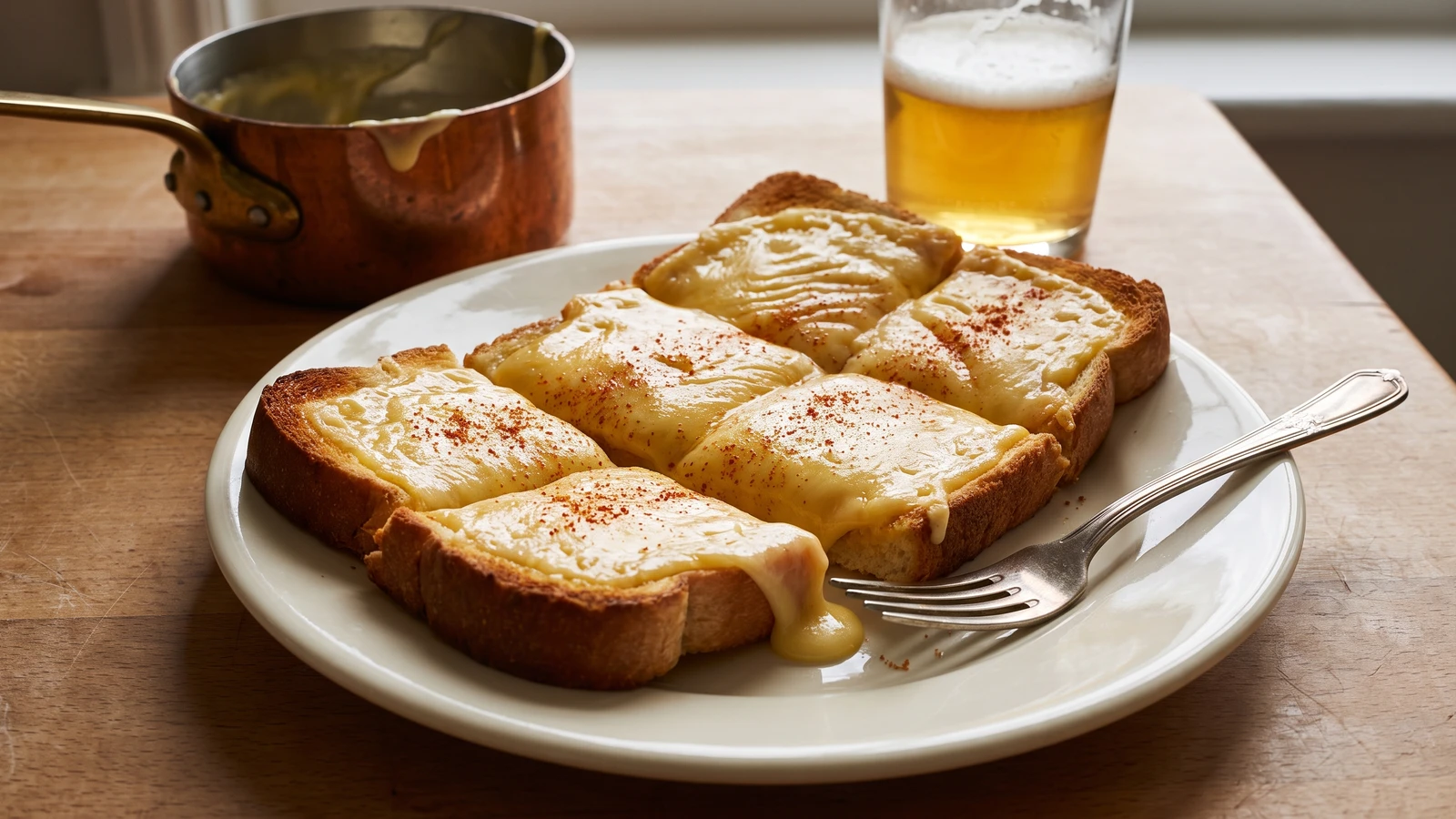
Le Welsh asks only for low heat and quick hands: Gloucester or Cheshire melted with pale ale and English mustard, poured while glossy over buttered toast and finished with cayenne.
Le Welsh (Welsh Rabbit, ale-melted cheese on buttered toast) teaches the discipline of low heat. Cheese is already an emulsion of fat, water, and protein; hurry it over a hard flame and the protein pulls tight into strings while the fat slips out. Warm it gently in pale ale and it becomes a glossy, spoon-thick savoury that flows over toast and still tastes plainly of cheese.
The old entry gives two ways, and this version follows the one it calls original: Gloucester or Chester cheese melted with pale ale and English mustard, poured at once, smoothed flat, and dusted with cayenne. A service kitchen could leave square toasts by the salamander while a saucier melted each order; your honest equivalent is a toaster or home broiler, a one-quart saucepan, and four portions made together. Its vague few tablespoonfuls become 3 tablespoons (45 ml) of ale for 225 g cheese, a repeatable home ratio. The staffed timing and salamander are scaffolding and can go; the gentle melt and immediate service are the dish and must stay. One cook, one stove, one evening.
The ale should barely quiver before the cheese enters, and the pan should never boil afterward. If the sauce tightens, you'll cool and loosen it with a little reserved ale, not bully it with more heat. The one step that decides the dish is the melt: lowest heat, brief stirring, then straight to the toast.
Welsh Rabbit belongs first to the Welsh and wider British tavern table, where cheese and ale were served over toast as a savoury. Its name has gathered competing explanations over generations, but the essential correction is simple: no rabbit was ever missing from the recipe. In France, le Welsh found its strongest home around Calais and Lille through the Channel ports, while classical manuals kept the English title and codified Gloucester or Chester cheese, pale ale, English mustard, and cayenne.
Quantity
4 slices (about 7 ounces / 200 g total)
cut square or rectangular, each 1/3 inch (8 mm) thick
Quantity
2 tablespoons (30 ml / 28 g)
softened
Quantity
1 3/4 cups (415 ml / 225 g)
cut into small dice
Quantity
3 tablespoons (45 ml / 45 g)
Quantity
1 teaspoon (5 ml / 5 g)
Quantity
1/8 teaspoon (0.6 ml / 0.25 g)
Quantity
1 tablespoon (15 ml / 15 g)
| Ingredient | Quantity |
|---|---|
| pain de mie or close-crumbed white breadcut square or rectangular, each 1/3 inch (8 mm) thick | 4 slices (about 7 ounces / 200 g total) |
| unsalted buttersoftened | 2 tablespoons (30 ml / 28 g) |
| Double Gloucester or mature Cheshire (Chester) cheesecut into small dice | 1 3/4 cups (415 ml / 225 g) |
| pale ale | 3 tablespoons (45 ml / 45 g) |
| prepared English mustard | 1 teaspoon (5 ml / 5 g) |
| cayenne pepper | 1/8 teaspoon (0.6 ml / 0.25 g) |
| cold pale ale for rescue (optional) | 1 tablespoon (15 ml / 15 g) |
Set an oven rack about 6 inches (15 cm) below the broiler, or heat a toaster oven. Put a serving plate somewhere warm. Measure the mustard and ale, dice the cheese small and evenly, and set the cayenne and flat knife beside the stove. Once the cheese melts, the Welsh waits for nobody; having the toast ready is part of the technique.
Toast the bread on both sides until evenly golden and firm enough to carry the cheese, watching the broiler closely. Butter one face of each slice all the way to its corners, then arrange the pieces buttered-side up on the warm plate. Keep the rectangles whole for a generous serving, or plan to halve them after saucing.
Put the 3 tablespoons (45 ml) pale ale and English mustard in a small heavy saucepan over the lowest heat. Stir until the mustard disperses and the liquid barely trembles at the edge, then add the cheese in three additions, stirring slowly with a spatula and letting each addition soften before the next enters. Remove the pan as soon as the cheese is fully melted and thickly pourable. Never let it boil. If it tightens into strings or releases clear fat, pull it off the heat immediately and stir in the cold ale 1 teaspoon at a time until the gloss returns. Ça se rattrape. Return it to the lowest heat for only a few seconds if necessary.
Immediately divide the melted cheese among the buttered toasts. Spread it quickly to the edges with the flat of a knife, exactly as the old method directs, then sprinkle each piece lightly with cayenne. Cut the pieces into smaller rectangles if required and serve before the cheese begins to set. À table!
1 serving (about 120g)
Culinary guides, cultural storytelling, and the editorial depth that makes cooking meaningful.
Discover Culinary ExplorerChef Juliette
Tiny éperlans, lightly floured and fried until their tails stand crisp, arrive in a generous heap on a napkin with fried parsley and grooved lemon, a weeknight lesson in heat and restraint.

Chef Juliette
Brandade de Morue turns salt cod, warm olive oil, and milk into a pale, silky emulsion: keep everything warm and add the oil slowly, then crown the generous dome with butter-fried bread.

Chef Juliette
Salt cod worked warm with cream, one patient spoonful at a time, until the rough flakes become a glossy Nîmes paste, domed generously and ringed with butter-fried croutons for the table.

Chef Juliette
Wine-poached char packed in its earthenware crock beneath butter gold: a make-ahead first course that turns careful cooling, thorough boning, and one unbroken seal into quiet abundance.