
Chef Juliette
Smelt (Éperlans)
Tiny éperlans, lightly floured and fried until their tails stand crisp, arrive in a generous heap on a napkin with fried parsley and grooved lemon, a weeknight lesson in heat and restraint.
A cooking platform built around craft, culture, and the stories behind what we eat.
Created by Chef Juliette
Based on No. 2317, Anges à Cheval, from Le Guide Culinaire (1907) by Auguste Escoffier
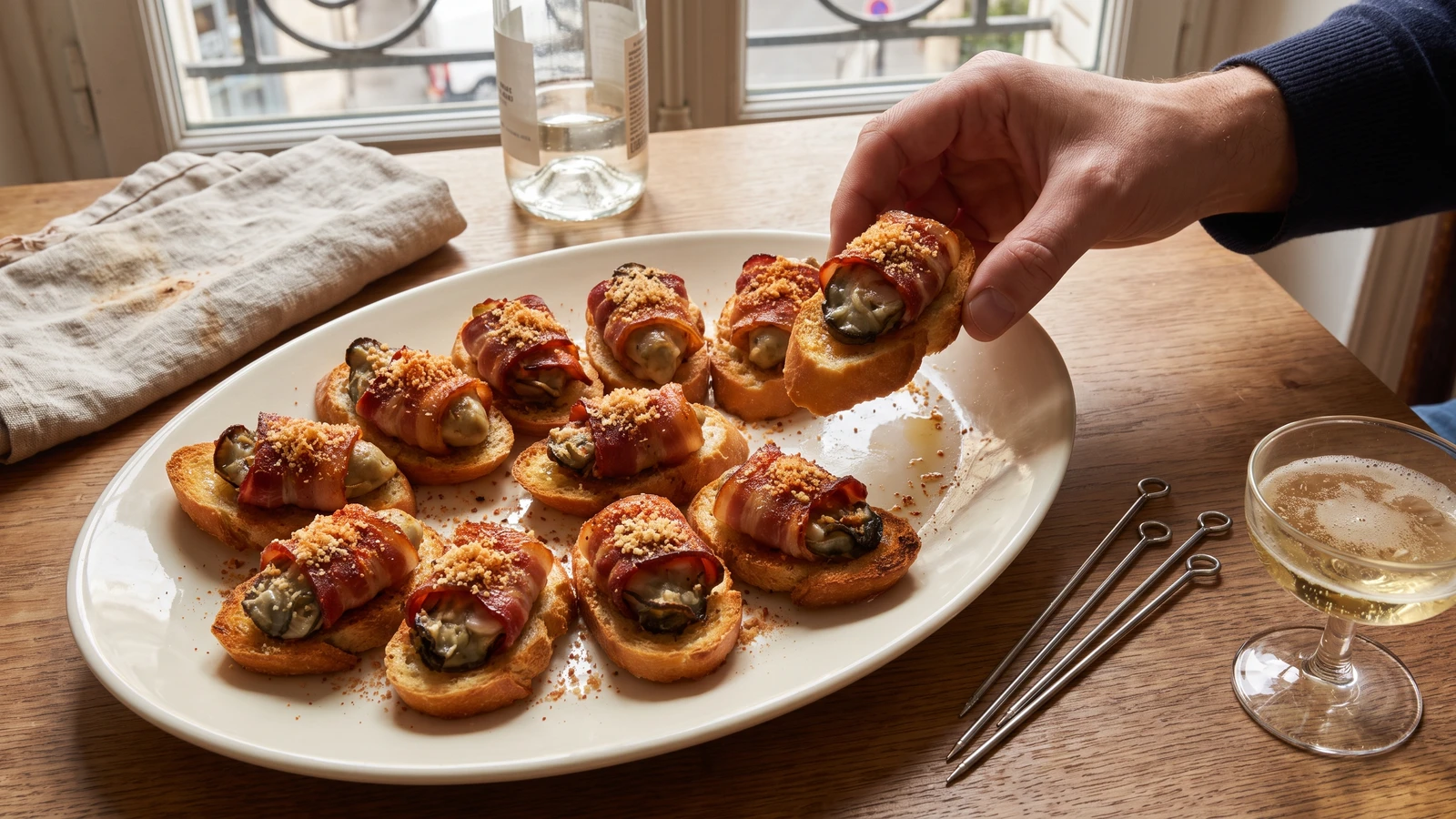
Plump oysters wrapped in paper-thin bacon, grilled on skewers until bronze at the edges, then set on crisp toast beneath breadcrumbs and cayenne. The whole art is pulling them at once.
Anges à cheval (angels on horseback) teach one hard and useful lesson: the bacon and oyster must finish together. The oyster wants barely enough heat to turn plump and opaque; the bacon must be thin enough to crisp in that same brief window. Thick bacon is not generosity here. It is bad timing.
The old entry assumed a fierce salamander, long metal skewers, and a cook tending repeat batches through service. A home broiler, a wire rack, and four short metal skewers give the same hard, direct heat. Because the entry gives no count, this version fixes the platter at twelve oysters for four guests. Repeat batches are brigade scaffolding and go, while wrapping, skewering, grilling, toast, breadcrumbs, and cayenne are the dish and stay. There is no saucier's work and no stockpot to reproduce. A sauce would bury the point. One cook, one stove, one evening.
Dry the oysters thoroughly before you wrap them. Liquor left clinging to their surfaces prevents the bacon from crisping. Watch the bacon rather than the clock, then pull the skewers the instant its edges bronze and turn crisp.
Anges à cheval belongs to the Anglo-French dining-room repertoire, not to any single French region: British supper tables called bacon-wrapped oysters angels on horseback, and French classical kitchens translated the name literally. The preparation passed easily into hotel and private-house service because it was quick, luxurious, and suited to the grill, while toast caught the oyster liquor and bacon fat. Its French title can mislead, but its journey across the Channel reflects the classical canon's habit of adopting a good idea without fuss.
Quantity
12 (about 8½ oz / 240 g drained)
drained and thoroughly patted dry
Quantity
12 slices (about 5¼ oz / 150 g)
Quantity
6 slices (about 5¼ oz / 150 g)
crusts removed and each slice cut in half
Quantity
¼ cup (60 ml / 15 g)
Quantity
⅛ teaspoon (0.6 ml / 0.25 g)
Quantity
1 small pinch (about 1/16 teaspoon / 0.4 g)
Quantity
⅛ teaspoon (0.6 ml / 0.3 g)
| Ingredient | Quantity |
|---|---|
| large freshly shucked oystersdrained and thoroughly patted dry | 12 (about 8½ oz / 240 g drained) |
| very thin streaky bacon | 12 slices (about 5¼ oz / 150 g) |
| pain de mie or firm white sandwich breadcrusts removed and each slice cut in half | 6 slices (about 5¼ oz / 150 g) |
| very fine fresh breadcrumbs | ¼ cup (60 ml / 15 g) |
| cayenne pepper | ⅛ teaspoon (0.6 ml / 0.25 g) |
| fine sea salt | 1 small pinch (about 1/16 teaspoon / 0.4 g) |
| freshly ground black pepper | ⅛ teaspoon (0.6 ml / 0.3 g) |
Set an oven rack about 4 inches (10 cm) below the broiler and heat it on high for at least five minutes. Fit a wire rack over a rimmed baking sheet. Fierce heat is essential: gentle heat cooks the oyster before the bacon has any chance to crisp.
Arrange the twelve bread pieces on the wire rack and broil until pale gold, about 45 to 60 seconds. Turn them and toast the second side. Watch closely because pain de mie colors quickly. Transfer the toasts to a warm serving platter, leaving a little space between them so their edges remain crisp.
Pat every oyster thoroughly dry. Stretch each bacon slice gently with the back of a knife until it is thin enough to wrap once around an oyster without overlapping heavily. Wrap one slice around each oyster, then thread three parcels onto each metal skewer, piercing through the bacon seam so it stays closed. Leave about ½ inch (1 cm) between parcels. Season very lightly with the salt and black pepper; the bacon already carries plenty of salt.
Lay the skewers across the wire rack and broil until the exposed bacon edges bronze, about 2 minutes. Turn each skewer and cook for another 1 to 2 minutes, watching without wandering away. They are ready when the bacon is crisp at its edges and the oysters remain swollen and just opaque, reaching 145°F (63°C) at the center. If the broiler colors unevenly, ça se rattrape: rotate the sheet and aim only the pale faces toward the element in 15-second bursts. Pull any parcel that begins to shrink before its companions.
Slide one bacon-wrapped oyster from the skewers onto each toast. Mix the breadcrumbs with the cayenne, then sprinkle a light, even veil over the oysters just before serving, exactly as the old entry directs. Bring them to the table at once, while the toast is crisp, the bacon gleams, and the oyster is still tender. À table!
1 serving (about 110g)
Culinary guides, cultural storytelling, and the editorial depth that makes cooking meaningful.
Discover Culinary ExplorerChef Juliette
Tiny éperlans, lightly floured and fried until their tails stand crisp, arrive in a generous heap on a napkin with fried parsley and grooved lemon, a weeknight lesson in heat and restraint.

Chef Juliette
Brandade de Morue turns salt cod, warm olive oil, and milk into a pale, silky emulsion: keep everything warm and add the oil slowly, then crown the generous dome with butter-fried bread.

Chef Juliette
Salt cod worked warm with cream, one patient spoonful at a time, until the rough flakes become a glossy Nîmes paste, domed generously and ringed with butter-fried croutons for the table.

Chef Juliette
Wine-poached char packed in its earthenware crock beneath butter gold: a make-ahead first course that turns careful cooling, thorough boning, and one unbroken seal into quiet abundance.