
Chef Juliette
Riz au Blanc (for Fowls and Eggs)
Riz au Blanc proves that plain rice is a technique, not an absence: parboil it in abundant salted water, drain it dry, then let butter and low oven heat separate every tender grain.
A cooking platform built around craft, culture, and the stories behind what we eat.
Created by Chef Juliette
Based on No. 2269, Purée de Tomates, from Le Guide Culinaire (1907) by Auguste Escoffier
A flourless classical purée where pork, carrot, onion, tomato, and a little white stock cook slowly, then pass through a sieve; patient reduction gives the sauce its deep red gloss and body.
Purée de tomates (tomato purée) teaches one clean law: when flour leaves the pan, patient reduction must build the body. Before you touch the heat, know this much: using less stock does not invite a fiercer boil. Tomato sugars catch easily, and a scorched purée carries the taste all the way to the table.
The source formula points to Tomato Sauce (No. 29) and assumes four-quart production, a saucier on staff, white stock never off the fire, and a broad tamis (drum sieve) ready for the finished sauce. This home batch halves every amount to make about two quarts. A heavy lidded pot replaces the professional saucepan, and a food mill followed by a fine-mesh sieve does the tamis work. Constant station attention and the larger batch are brigade scaffolding, so they can go. The salt-pork foundation, gentle oven cooking, thorough sieving, and final stirred reduction are the dish, so they stay. One cook, one stove, one evening.
There is no flour here. That isn't a shortcut but the precise distinction between the purée and its parent sauce, along with using only one quarter as much stock. The moment that decides everything comes after sieving: stir as the purée returns to the boil, then stop when it falls from the spoon in a thick, glossy ribbon. Quiet heat and a watchful hand make the body.
Purée de tomates belongs to the classical French sauce station rather than to one provincial table, although tomatoes entered everyday French cooking most readily through Provence and the Mediterranean South. In the grand-kitchen canon it sits beside Tomato Sauce (No. 29), not as a casual synonym but as its concentrated, flourless cousin: less white stock, no roux, and body earned through reduction. Passing the mixture through a tamis turned salt pork, aromatic vegetables, and tomato into a smooth working purée for sauces, braises, and garnishes.
Quantity
1 method reference, Tomato Sauce (No. 29)
use its sequence with the flour omitted and the stock reduced as specified
Quantity
1/2 cup (120 ml / 71 g)
cut into small cubes
Quantity
2 tablespoons (30 ml / 28 g)
divided
Quantity
2/3 cup (160 ml / 85 g)
cut into small cubes
Quantity
2/3 cup (160 ml / 85 g)
cut into small cubes
Quantity
1/2 leaf
Quantity
1/2 small sprig
Quantity
5 pounds (2.27 kg), yielding about 2 quarts (1.9 L) once mashed
cored and roughly crushed
Quantity
1 cup (240 ml / 240 g)
Quantity
1 1/4 teaspoons (6 ml / 7 g)
Quantity
1 tablespoon plus 1/2 teaspoon (17.5 ml / 14 g)
Quantity
1/16 teaspoon (0.3 ml / 0.1 g)
Quantity
1/2 small clove
crushed
| Ingredient | Quantity |
|---|---|
| canonical method referenceuse its sequence with the flour omitted and the stock reduced as specified | 1 method reference, Tomato Sauce (No. 29) |
| unsmoked salt pork bellycut into small cubes | 1/2 cup (120 ml / 71 g) |
| unsalted butterdivided | 2 tablespoons (30 ml / 28 g) |
| carrotcut into small cubes | 2/3 cup (160 ml / 85 g) |
| onioncut into small cubes | 2/3 cup (160 ml / 85 g) |
| bay leaf | 1/2 leaf |
| thyme | 1/2 small sprig |
| ripe raw tomatoescored and roughly crushed | 5 pounds (2.27 kg), yielding about 2 quarts (1.9 L) once mashed |
| unsalted white stock | 1 cup (240 ml / 240 g) |
| fine salt | 1 1/4 teaspoons (6 ml / 7 g) |
| granulated sugar | 1 tablespoon plus 1/2 teaspoon (17.5 ml / 14 g) |
| finely ground black pepper | 1/16 teaspoon (0.3 ml / 0.1 g) |
| garliccrushed | 1/2 small clove |
Heat the oven to 325°F (160°C) with a rack in the middle. This purée follows the sequence established by Tomato Sauce (No. 29), but the distinction is exact: add no flour, and use only 1 cup of white stock for this halved batch. Reserve 1 teaspoon (5 g) of the butter for sealing the finished surface.
Put the salt pork and remaining butter into the cold pot, then set it over medium-low heat. Cook for 8 to 10 minutes, stirring occasionally, until the pork grows translucent, releases its fat, and takes only a faint gold color around the edges. Don't crisp it hard. If it browns before the fat has rendered, lower the heat and add a teaspoon of the measured stock.
Add the mirepoix (diced carrot and onion), bay leaf, and thyme. Cook for 8 to 10 minutes, stirring and scraping the pot, until the vegetables soften, shine with pork fat and butter, and begin to color lightly at their edges. Pale vegetables give a thin foundation, but dark browning would make the tomato taste muddy. Aim for gentle gold.
Add the crushed tomatoes and white stock, mixing until the vegetables and pork are evenly distributed. Bring the mixture to a boil over medium-high heat, scraping every flavorful trace from the pot floor. Add the salt, sugar, pepper, and crushed garlic only once it boils, keeping the source formula's sequence intact.
Cover the pot and transfer it to the oven for 1 hour and 30 minutes. Stir after 45 minutes and again near the end, reaching firmly into the corners. The tomatoes should collapse completely and the mixture should deepen to a rich brick red. If the bottom feels sticky, don't scrape up a scorched layer. Spoon the clean purée into another pot, leave the dark patch behind, add 2 tablespoons of hot stock, and continue at 300°F (150°C). Ça se rattrape, provided you catch it before the burnt taste spreads.
Remove the bay leaf and thyme. Pass the hot mixture through a food mill fitted with its medium disk into a clean bowl, then through a sturdy fine-mesh sieve for the smoothest finish. If using the sieve alone, work in small batches and press firmly with a ladle or flexible scraper. The softened pork, carrot, and onion belong in the purée; leave only dry skins, seeds, fibers, and stubborn fragments behind. Scrape the thick purée clinging beneath the sieve into the bowl.
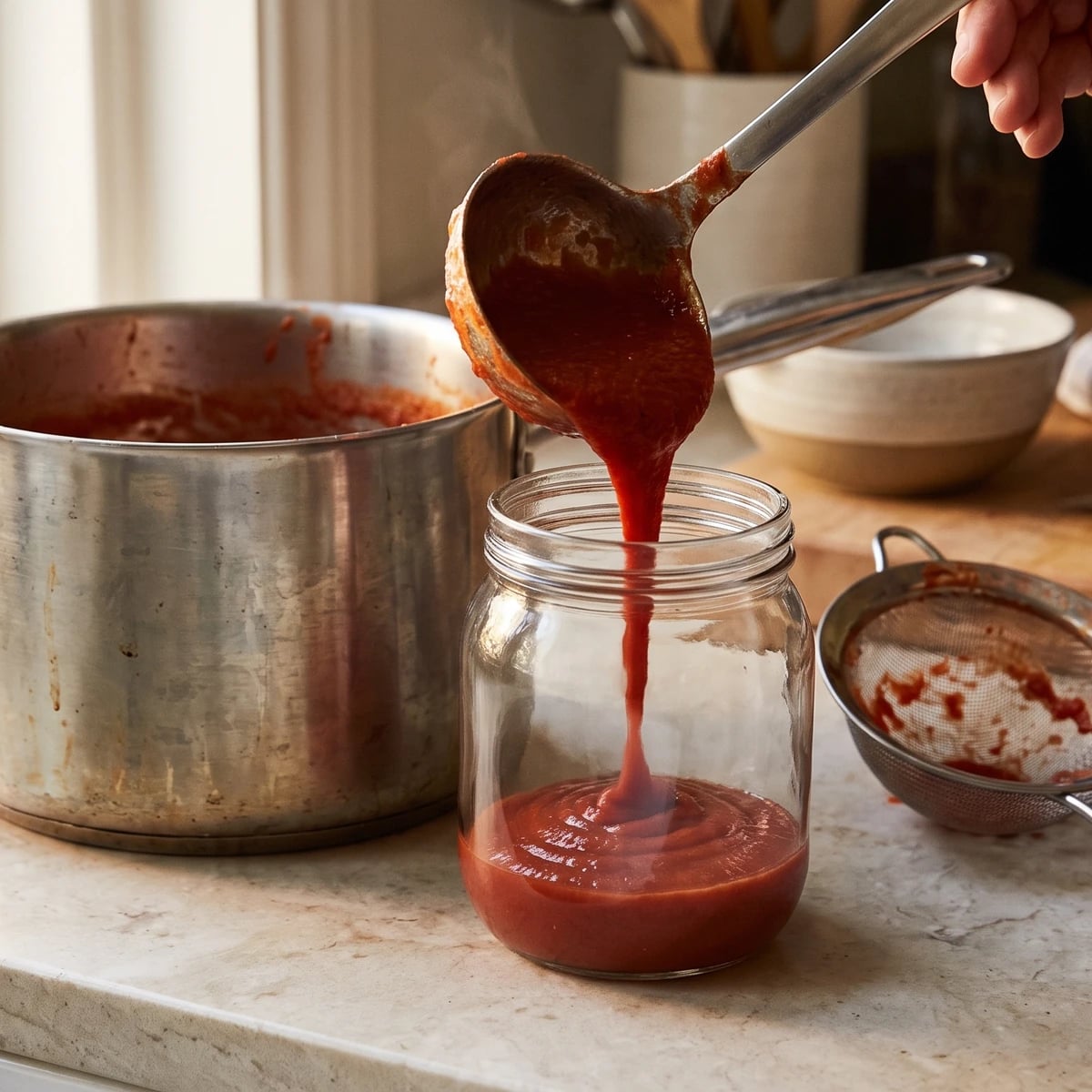
Return the strained purée to a clean tall pot and bring it to a steady boil over medium heat, stirring continuously along the bottom and into every corner. Reduce for 5 to 15 minutes, until it coats the spoon generously and falls back in a thick ribbon that slowly settles into the surface. If it remains loose, keep reducing. If it becomes too dense to stir comfortably, whisk in hot white stock 1 tablespoon at a time. Reduction is the thickener, but scorching is not technique.
Taste the purée once the texture is right, remembering that the salt pork and stock have already contributed seasoning. Transfer it to a heatproof bowl or shallow storage containers. Melt the reserved butter and brush it directly over the hot surface to prevent a skin, then cool promptly and cover. Refrigerate for up to 4 days, or freeze in useful portions. Stir gently when reheating, loosening with a spoonful of stock if needed. À table!
1 serving (about 245g)
Culinary guides, cultural storytelling, and the editorial depth that makes cooking meaningful.
Discover Culinary Explorer
Chef Juliette
Riz au Blanc proves that plain rice is a technique, not an absence: parboil it in abundant salted water, drain it dry, then let butter and low oven heat separate every tender grain.

Chef Juliette
Parboiled Carolina rice meets butter and rich white consommé, then finishes covered in the oven, each grain savory, separate, and gleaming. The consommé does the seasoning, so taste it first.

Chef Juliette
Riz à la Grecque turns disciplined pilaff into supper with pork sausage, ciseled lettuce, green peas, and red capsicum, all folded in for the final seven minutes.

Chef Juliette
Patna rice, boiled freely, washed until the water stays clear, then dried low and gentle. The washing is the dish: do it properly and every grain arrives light, dry, and separate.