
Chef Juliette
Stuffed Onions
Oignons farcis teach the discipline of the shell: mild onions hollowed without weakness, filled with their own flesh and Duxelle, braised in butter and stock, then glazed until the tops bronze.
A cooking platform built around craft, culture, and the stories behind what we eat.
Created by Chef Juliette
Based on No. 2239, Pommes de Terre Persillées, from Le Guide Culinaire (1907) by Auguste Escoffier
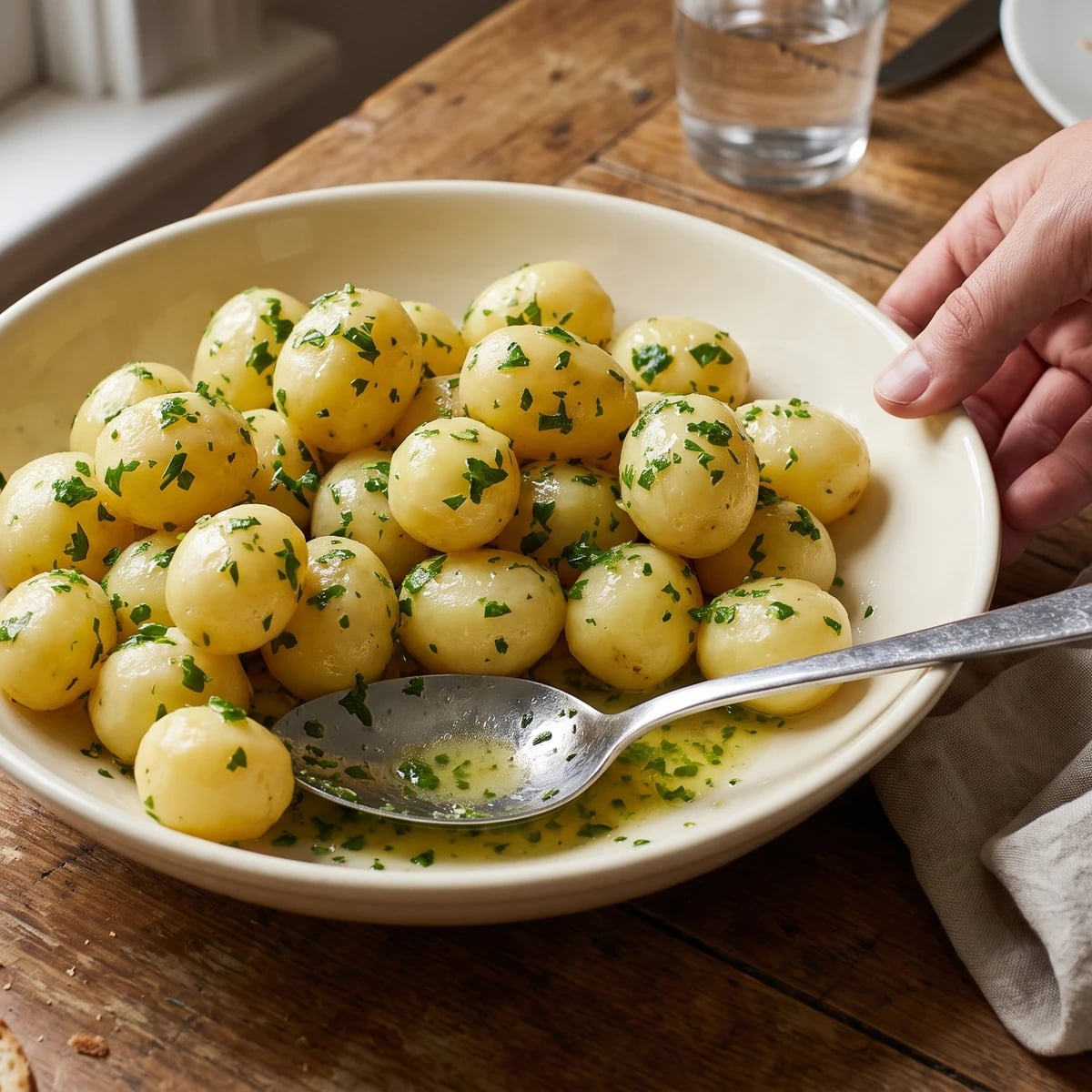
Pommes de terre persillées proves that simple is exacting: plain-boiled potatoes drained bone dry, then rolled in real butter and parsley until every piece gleams and the herb stays bright.
Pommes de terre persillées (plain-boiled potatoes with butter and parsley) teaches one useful truth: water and butter cannot occupy the same potato gracefully. If the potatoes leave the colander wet, the butter slips to the bottom of the pan. Dry them properly and it clings in a thin, gleaming coat, carrying fresh parsley over every surface.
The brigade instruction assumes an attendant selecting evenly sized potatoes and carrying them from boiling pot to service without delay. This dish asks for none of the grand kitchen's usual scaffolding: no saucier on staff, no stockpot kept hot, no salamander. A saucepan, a colander, and the same pan dried over low heat are the honest home equivalents. Only the quantity and shaping have changed for four portions; the plain boil, thorough draining, melted butter, and parsley remain exactly as the source sets them down. One cook, one stove, one evening.
When the persillées are right, each piece stays intact beneath a butter-gold sheen, and the parsley tastes green and fresh rather than cooked into submission. The decisive step is the brief return to the empty hot pan after draining. That dry minute is the dish.
Pommes de terre persillées belongs to the national cuisine bourgeoise, at home beside fish, roast chicken, or chops from Paris bistros to family tables across France, rather than to one regional larder. In classical French kitchen language, cooking potatoes à l'anglaise means boiling them plainly in salted water, so the phrase describes the method and does not make this a British dish. The butter-and-parsley finish carried that everyday preparation into formal service without costing it its domestic simplicity.
Quantity
About 6 cups (1.4 L / 900 g)
peeled and cut into even 4 cm pieces
Quantity
2 teaspoons (10 ml / 12 g)
divided
Quantity
3 tablespoons (45 ml / 43 g)
Quantity
1/4 cup lightly packed (60 ml / 15 g)
finely chopped
| Ingredient | Quantity |
|---|---|
| small waxy potatoes, such as Yukon Gold or Charlottepeeled and cut into even 4 cm pieces | About 6 cups (1.4 L / 900 g) |
| fine sea saltdivided | 2 teaspoons (10 ml / 12 g) |
| unsalted butter | 3 tablespoons (45 ml / 43 g) |
| flat-leaf parsley leavesfinely chopped | 1/4 cup lightly packed (60 ml / 15 g) |
Peel the potatoes and cut them into even pieces about 4 cm, or 1½ inches, across. Equal size matters because every piece must become tender at the same moment. Formal turning was useful for brigade presentation, but it is scaffolding here; tidy home-cut pieces preserve the cooking method without wasting good potato.
Put the potatoes in a saucepan and cover them with cold water by 2.5 cm, or 1 inch. Add 1½ teaspoons of the salt. Cook them à l'anglaise, plainly in salted water: bring the pan to a boil, then lower the heat immediately and maintain a quiet simmer for 15 to 20 minutes. They are ready when a small knife enters the center without force but the piece does not split. A violent boil knocks away the edges before the centers are cooked.
Tip the potatoes into a colander and leave them for 30 seconds, then return them to the empty saucepan over low heat. Shake the pan gently for 45 to 60 seconds, just until the wet shine disappears and the surfaces look faintly chalky. This is the step that makes the butter cling. If the edges begin to crack, take the pan off the heat and roll rather than stir; ça se rattrape, and those rough edges will take the butter beautifully.
Tip the dried potatoes back into the colander or a warm bowl. Melt the butter in the same saucepan over low heat until fully liquid and lightly foaming, without letting it color. Return the potatoes and roll the pan in a circular motion until every piece is coated. If the butter runs straight to the bottom instead of clinging, residual water remains; keep the pan over the lowest heat and roll gently for another 20 to 30 seconds until that moisture disappears. Ça se rattrape. Remove the pan from the heat, scatter in the parsley, and roll once more. Tossing with the pan protects the potatoes better than working them with a spoon.
Taste a small edge and add as much of the remaining ½ teaspoon salt as the potatoes need. Transfer them to a warm, shallow serving dish and spoon over every last fleck of parsley butter from the pan. Serve at once, while the butter gleams and the parsley is still bright. Cooking well is not cooking fancy. À table!
1 serving (about 240g)
Culinary guides, cultural storytelling, and the editorial depth that makes cooking meaningful.
Discover Culinary Explorer
Chef Juliette
Oignons farcis teach the discipline of the shell: mild onions hollowed without weakness, filled with their own flesh and Duxelle, braised in butter and stock, then glazed until the tops bronze.

Chef Juliette
Oignons frits prove that frying is temperature before timing: thin onion rings, lightly floured and cooked in very hot oil until crisp outside, yielding within, then drained and salted at once.

Chef Juliette
Oignons glacés in two classical finishes, one ivory and clear, one butter-gold, prove that gentle heat and a final turn of the pan can make the smallest onion worthy of a holiday table.

Chef Juliette
Scalded onions, dried well and stewed slowly in butter until sweet but still pale, then bound with Béchamel and passed fine: Soubise proves that deep onion flavor does not require browning.