Chef Juliette
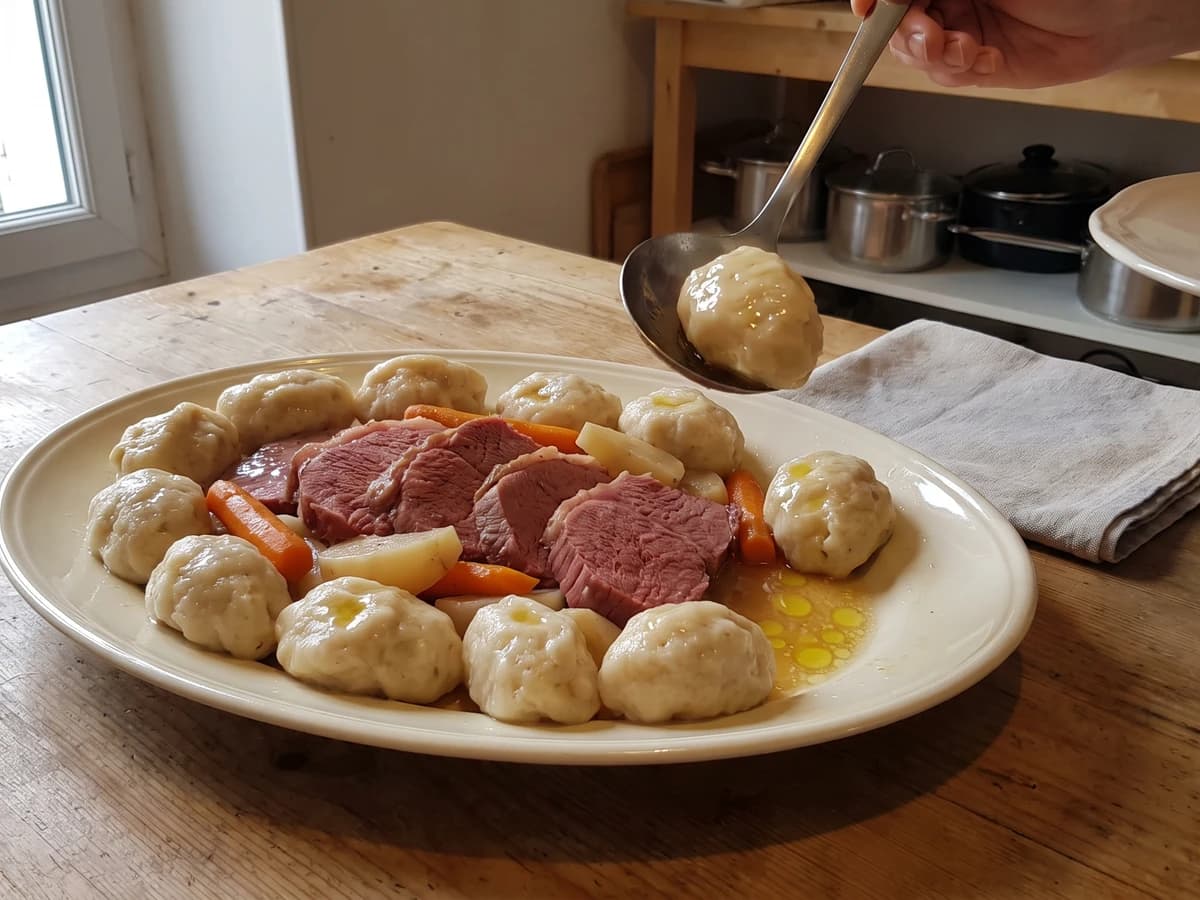
Suet Dumpling
Boulettes au suif, poached beside salt beef, turn equal weights of flour and finely chopped suet into tender, rich dumplings. Keep the beef liquor at a bare tremble and the old garnish works beautifully at home.
A cooking platform built around craft, culture, and the stories behind what we eat.

Created by Chef Juliette
Based on No. 2222, Gratin de Pommes de Terre à la Dauphinoise, from Le Guide Culinaire (1907) by Auguste Escoffier
Gratin de Pommes de Terre à la Dauphinoise turns a short list into a lesson in precision: slice evenly, season boldly, and bake until the milk custard turns tender beneath a bronzed Gruyère crown.
Gratin de Pommes de Terre à la Dauphinoise (Dauphiné potato gratin) teaches the discipline of even slicing. Potatoes cut to the same thinness soften together and drink the egg-bound milk into one tender mass; uneven rounds leave you choosing between raw centers and a tired crown. When it is right, the edge trembles with butter, the top is deeply bronzed with Gruyère, and the interior yields without collapsing into purée.
The original entry assumed a professional cook could read "moderate oven" without a number and divide two pounds of potatoes among several shallow earthenware dishes. It needed no saucier, no stockpot, and no salamander. Here, the written batch is halved in proportion for four and consolidated into one shallow dish at 350°F (180°C), with the half egg measured after beating. The source leaves its copious topping cheese and final pieces of butter unmeasured, so those receive practical quantities. Nothing else changes. One cook, one stove, one evening.
The brigade scaffolding was only the division among dishes, and that goes. The garlic-rubbed vessel, boiled milk, beaten egg, nutmeg, Gruyère, and real butter are the dish, and they stay. Before you touch the pan, set the slicer to 2 mm and keep every round there; this is the one step that decides the gratin.
Gratin de pommes de terre à la dauphinoise belongs to the Dauphiné, the Alpine country around Grenoble, where potatoes, milk, garlic, butter, and the household oven made a substantial table dish. As it traveled from home ovens into the classical repertoire, its formulas diverged: many Dauphinois cooks defend cream and no cheese, while this entry binds boiled milk with beaten egg and Gruyère. For this recipe, the source settles the debate; its egg and cheese are not embellishments but the formula being translated.
Quantity
about 3 medium, 3 cups sliced (710 ml / 1 lb / 450 g)
peeled; slice 2 mm thick just before mixing
Quantity
1¾ cups plus 2 teaspoons (425 ml / 438 g)
Quantity
½ egg, 1½ tablespoons (25 ml / 25 g)
beat 1 whole egg, measure half, and reserve the remainder
Quantity
½ cup (120 ml / 57 g)
finely grated
Quantity
¼ cup (60 ml / 28 g)
finely grated
Quantity
1½ tablespoons (22 ml / 21 g)
softened and divided
Quantity
1 large clove
halved
Quantity
1 teaspoon (5 ml / 6 g)
Quantity
¼ teaspoon (1.25 ml / 0.6 g)
Quantity
⅛ teaspoon (0.6 ml / 0.25 g)
| Ingredient | Quantity |
|---|---|
| mature yellow potatoes, such as Yukon Goldpeeled; slice 2 mm thick just before mixing | about 3 medium, 3 cups sliced (710 ml / 1 lb / 450 g) |
| whole milk | 1¾ cups plus 2 teaspoons (425 ml / 438 g) |
| large beaten eggbeat 1 whole egg, measure half, and reserve the remainder | ½ egg, 1½ tablespoons (25 ml / 25 g) |
| Gruyère for mixingfinely grated | ½ cup (120 ml / 57 g) |
| Gruyère for toppingfinely grated | ¼ cup (60 ml / 28 g) |
| unsalted buttersoftened and divided | 1½ tablespoons (22 ml / 21 g) |
| garlichalved | 1 large clove |
| fine sea salt | 1 teaspoon (5 ml / 6 g) |
| freshly ground black pepper | ¼ teaspoon (1.25 ml / 0.6 g) |
| freshly grated nutmeg | ⅛ teaspoon (0.6 ml / 0.25 g) |
Set a rack in the upper-middle of the oven and heat it to 350°F (180°C). Rub the cut garlic firmly over the bottom and sides of a shallow 1½-quart (1.4 L) earthenware or ceramic gratin dish, leaving its fragrant film behind. Butter the dish generously with 1 tablespoon (14 g) of the butter, reserving the remaining 1½ teaspoons (7 g) for the crown.
Bring the milk just to a boil in a small saucepan, then remove it from the heat and leave it for 5 minutes. Measure 1½ tablespoons of the beaten egg into a bowl. Whisk about ½ cup of the hot milk gradually into the egg, then whisk this tempered mixture back into the remaining milk. If a few cooked egg threads appear, strain the mixture into a clean bowl and continue; nothing has been lost.
Slice the peeled potatoes into even 2 mm rounds with a guarded mandoline or a sharp knife. Do not rinse them, because their surface starch helps the milk and egg settle around the slices rather than pooling beneath them. Put the potatoes in a large bowl with the salt, pepper, and nutmeg, then add the tempered milk mixture and the ½ cup of Gruyère. Turn everything thoroughly from the bottom until the seasoning and cheese reach every slice.
Pour the potatoes and all their liquid into the prepared dish, exactly as the source directs, and spread the slices into an even layer. Press them gently beneath the milk without arranging them into decorative scales. The mixture will look loose at this stage. It is exactly right. Sprinkle the remaining ¼ cup of Gruyère copiously over the surface and dot it with the reserved butter.
Bake uncovered for 40 to 45 minutes, until the rim bubbles, the Gruyère is deeply bronzed, and a thin knife slips through the center without finding a firm potato. If the crown darkens before the slices yield, lay a piece of foil loosely over the dish and continue baking in 5-minute intervals. Ça se rattrape. If the potatoes are tender but a shallow ribbon of milk remains at the edge, give the gratin another 5 minutes rather than draining it; the egg, starch, and heat must finish their work together.
Rest the gratin for 15 minutes before serving. The bubbling edge will settle, the interior will gather into tender layers, and the first spoonful will hold without becoming stiff. Bring the whole dish to the table and serve generous portions, making sure everyone receives some of the browned crown. À table!
1 serving (about 220g)
Culinary guides, cultural storytelling, and the editorial depth that makes cooking meaningful.
Discover Culinary ExplorerChef Juliette
Boulettes au suif, poached beside salt beef, turn equal weights of flour and finely chopped suet into tender, rich dumplings. Keep the beef liquor at a bare tremble and the old garnish works beautifully at home.

Chef Juliette
Bread, flour, frangipane, and rice become four cool, supple panades for binding forcemeats, each changing body and flavor while preserving tenderness. The finest Mousselines need none, and knowing that distinction is the lesson.

Chef Juliette
Panade au pain is bread, milk, salt, heat, and attention: stir until the paste releases cleanly, butter it against a skin, and you have the quiet binder behind tender French farces.

Chef Juliette
Panade de farine teaches the drying stroke behind pâte à choux: flour meets boiling buttered water, then stays over the fire until the paste gathers, smooths, and quits the pan cleanly.