Chef Juliette
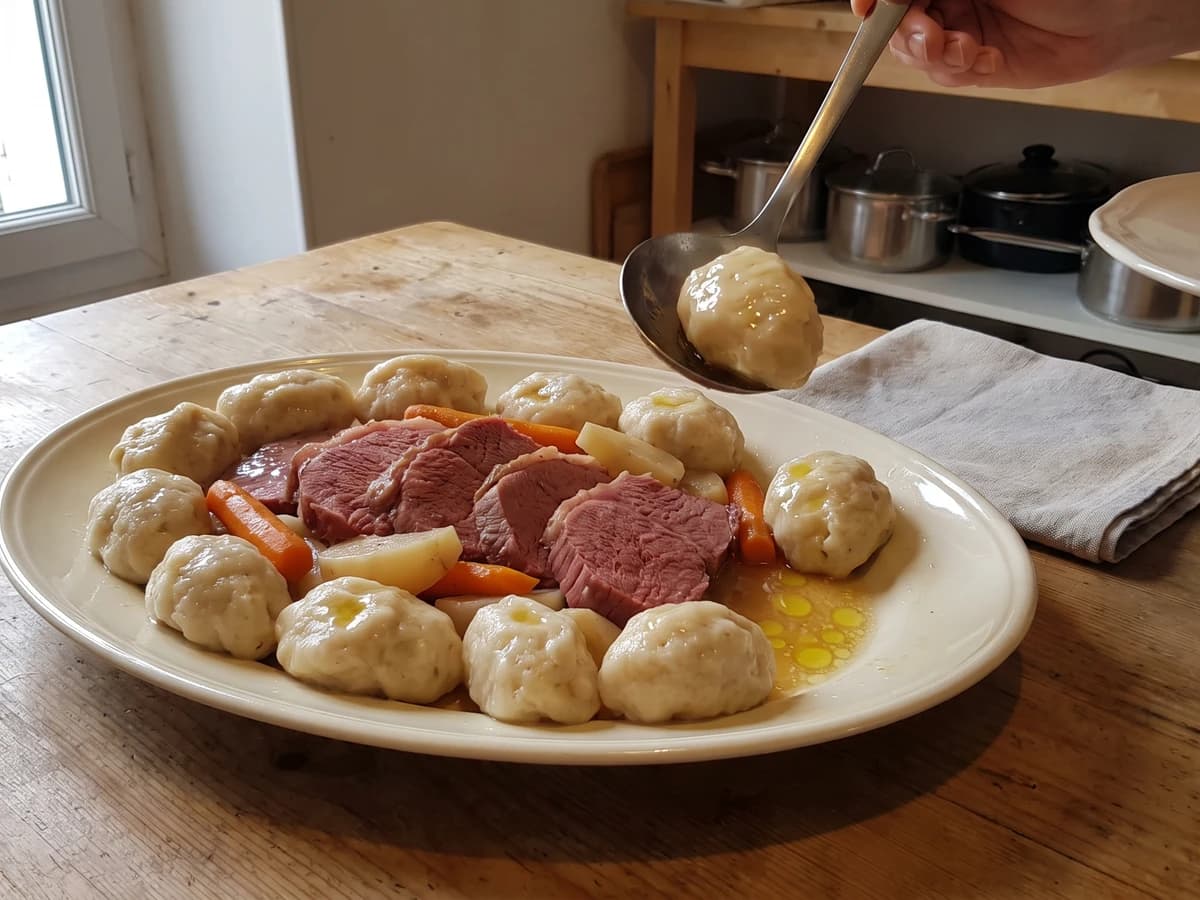
Suet Dumpling
Boulettes au suif, poached beside salt beef, turn equal weights of flour and finely chopped suet into tender, rich dumplings. Keep the beef liquor at a bare tremble and the old garnish works beautifully at home.
A cooking platform built around craft, culture, and the stories behind what we eat.

Created by Chef Juliette
Based on No. 2130, Croquettes de Crosnes, from Le Guide Culinaire (1907) by Auguste Escoffier
Croquettes de Crosnes hide firm, nutty crosnes in a close ivory binding of Sauce Allemande, then take a fine crumb and hot fat for a crisp bronze shell.
Croquettes de Crosnes (crisp croquettes of Chinese artichokes) teach the quiet law of every bound croquette: the filling must be colder and firmer than you think before it meets the egg and crumbs. The crosnes stay somewhat firm, held together with very reduced Sauce Allemande, then chill until the mass can be cut cleanly. That hard chill is the one true thing to know before you touch the fat. Skip it and the croquettes open in the pan.
The original kitchen assumed a saucier with stock never off the fire and Sauce Allemande ready, a deep-fat range, and enough hands to fashion balls, pears, or quoits just before service. At home, use a measured portion of the finished sauce, a buttered shallow dish, the refrigerator, and a heavy saucepan. I keep the permitted ball shape because it fries evenly. Decorative forms and linen for draining were brigade scaffolding; the sauce ratio, firm crosnes, hard chill, egg-and-crumb coat, and very hot fat are the dish itself. One cook, one stove, one evening.
When they are right, the crust is evenly bronze and crisp, while the center remains ivory and soft around the nutty, still-distinct crosnes. Test the Allemande before mixing: a spatula drawn through it must leave a groove that does not immediately close. If it flows like gravy, reduce it gently and test again. Ça se rattrape. Get that texture right, then chill the bound mixture without negotiation.
Crosnes take their French name from Crosne in Essonne, southeast of Paris, where the East Asian tuber was acclimatized and sent into Parisian markets; the familiar crosne du Japon name reflects its route through Japanese cultivation rather than a French regional origin. In the classical Parisian kitchen, the vegetable moved from garnish to entremets, and binding it with Sauce Allemande placed it among the croquettes shaped for formal service. These are not mashed vegetable croquettes: the stachys remain firm and recognizable inside the reduced sauce, which is precisely why thorough draining and chilling matter.
Quantity
1 pound (454 g)
scrubbed thoroughly
Quantity
2 quarts (1.9 L / 1.9 kg)
Quantity
1 tablespoon plus 1/2 teaspoon (17.5 mL / 21 g)
divided
Quantity
Scant 1/2 cup (115 mL / about 120 g)
Quantity
1 teaspoon (5 mL / 5 g)
for the dish
Quantity
2
thoroughly beaten
Quantity
1 1/2 cups (360 mL / 150 g)
Quantity
5 cups (1.2 L / about 1.1 kg), or enough for a 2-inch (5 cm) depth
Quantity
1 packed cup (240 mL / 25 g)
washed and dried completely
| Ingredient | Quantity |
|---|---|
| fresh crosnes (stachys or Chinese artichokes)scrubbed thoroughly | 1 pound (454 g) |
| water | 2 quarts (1.9 L / 1.9 kg) |
| fine sea saltdivided | 1 tablespoon plus 1/2 teaspoon (17.5 mL / 21 g) |
| prepared, very reduced Sauce Allemande | Scant 1/2 cup (115 mL / about 120 g) |
| unsalted butterfor the dish | 1 teaspoon (5 mL / 5 g) |
| large eggsthoroughly beaten | 2 |
| very fine dry breadcrumbs | 1 1/2 cups (360 mL / 150 g) |
| refined peanut or grapeseed oil | 5 cups (1.2 L / about 1.1 kg), or enough for a 2-inch (5 cm) depth |
| flat-leaf parsley sprigswashed and dried completely | 1 packed cup (240 mL / 25 g) |
Bring the water and 1 tablespoon of the salt to a lively boil. Add the scrubbed crosnes and cook for 6 to 9 minutes, depending on their size, until a knife enters with slight resistance. They must be tender enough to eat but still somewhat firm, because they cook no further except for their brief time in the fat. Drain them thoroughly, spread them on a clean towel, and leave them for 5 minutes so every trace of surface water disappears.
Warm the prepared, very reduced Sauce Allemande over the gentlest heat, stirring constantly. Draw the spatula across the pan floor: the groove must remain open for a moment, and the sauce should fall heavily rather than pour. If it runs, keep reducing gently before the crosnes go in. Do not let it boil. The scant 1/2 cup is the original proportion of one-fifth imperial pint of sauce per pound of crosnes, converted to a home measure without changing the binding.
Fold the drained crosnes carefully through the Sauce Allemande until every piece is thickly coated, keeping the tubers whole. Butter an 8-inch (20 cm) shallow dish, spread the mixture in an even layer about 3/4 inch (2 cm) thick, and press a piece of buttered parchment directly against the surface. The sauce should hold the crosnes together without pooling around them.
Refrigerate the mixture for at least 2 hours, until thoroughly cold and firm enough to cut with clean edges. If it still slumps when pressed, return it to the cold rather than stirring breadcrumbs into the filling. For a final nudge, give it 15 to 20 minutes in the freezer, but do not let it freeze solid. The hard chill is the structure of the croquette.
Turn the cold mixture onto a board and divide it into ten portions of about 2 ounces (55 to 60 g) each. With cool, lightly buttered hands, press each portion into a compact ball. Dip each ball completely in beaten egg, let the excess fall away, then roll it in the fine breadcrumbs and press gently so no bare patch remains. Set the crumbed croquettes on a tray and chill for another 30 minutes. If one softens or loses its shape, stop and return the tray to the refrigerator.
Pour the oil into a deep, heavy saucepan with ample room above it and heat to 350°F (175°C). Make certain the parsley is completely dry, then lower it into the fat with a wire skimmer. It will bubble fiercely for a few seconds. Lift it out as soon as the bubbling subsides and the leaves are crisp but still vividly green, then drain it on a rack over paper. Wet parsley makes hot fat spit, so this is no place for optimism.
Raise the oil to 355°F (180°C). Begin no more than 5 or 6 minutes before serving. Fry the croquettes in two batches for 2 to 3 minutes, turning gently, until evenly deep gold. If one splits, lift it out at once, chill the remaining croquettes harder, and let the oil return fully to temperature before continuing. Ça se rattrape. Drain on a wire rack, season moderately with the reserved salt, and arrange on a warm platter with the fried parsley. À table!
1 serving (about 200g)
Culinary guides, cultural storytelling, and the editorial depth that makes cooking meaningful.
Discover Culinary ExplorerChef Juliette
Boulettes au suif, poached beside salt beef, turn equal weights of flour and finely chopped suet into tender, rich dumplings. Keep the beef liquor at a bare tremble and the old garnish works beautifully at home.

Chef Juliette
Bread, flour, frangipane, and rice become four cool, supple panades for binding forcemeats, each changing body and flavor while preserving tenderness. The finest Mousselines need none, and knowing that distinction is the lesson.

Chef Juliette
Panade au pain is bread, milk, salt, heat, and attention: stir until the paste releases cleanly, butter it against a skin, and you have the quiet binder behind tender French farces.

Chef Juliette
Panade de farine teaches the drying stroke behind pâte à choux: flour meets boiling buttered water, then stays over the fire until the paste gathers, smooths, and quits the pan cleanly.