Chef Juliette
Suet Dumpling
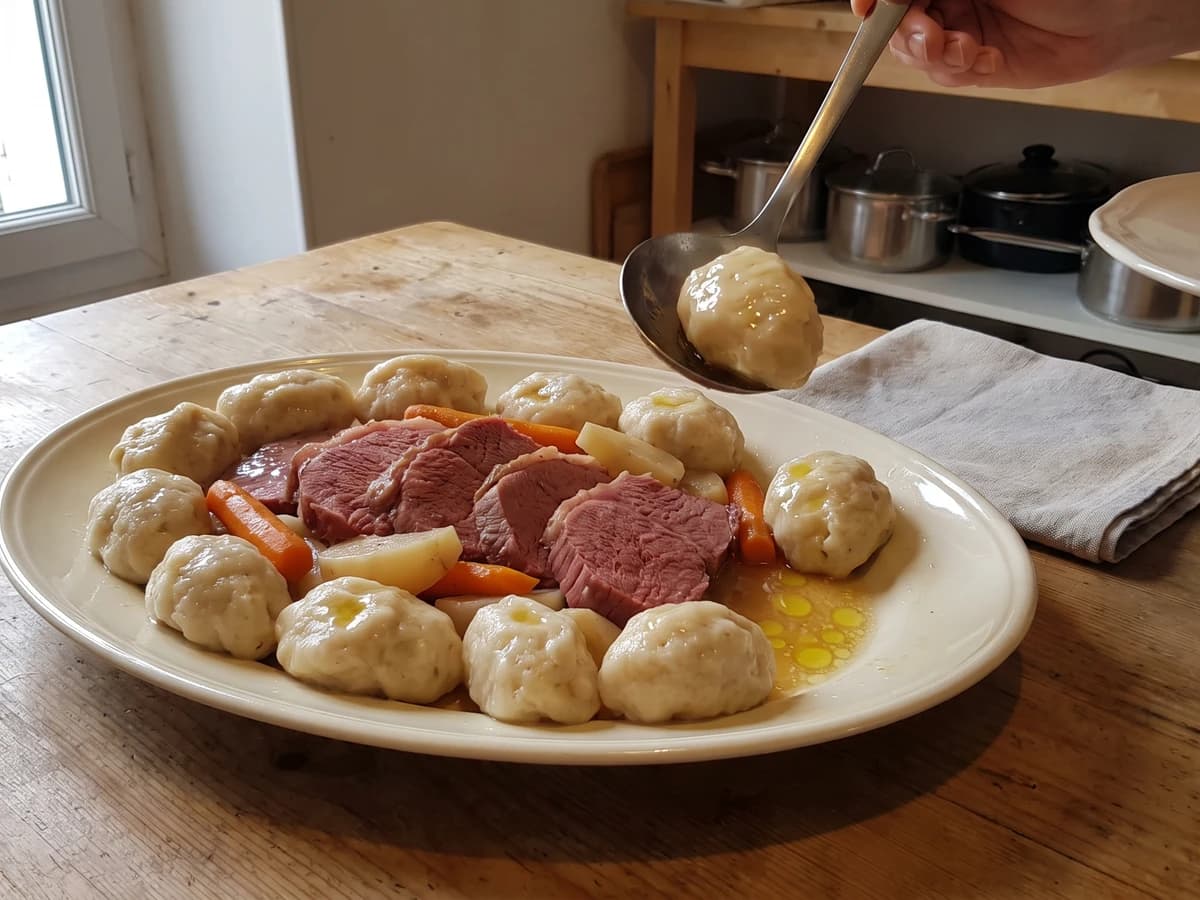
Boulettes au suif, poached beside salt beef, turn equal weights of flour and finely chopped suet into tender, rich dumplings. Keep the beef liquor at a bare tremble and the old garnish works beautifully at home.
A cooking platform built around craft, culture, and the stories behind what we eat.
Created by Chef Juliette
Based on No. 2035, Fonds d’Artichauts aux Pointes d’Asperges, from Le Guide Culinaire (1907) by Auguste Escoffier
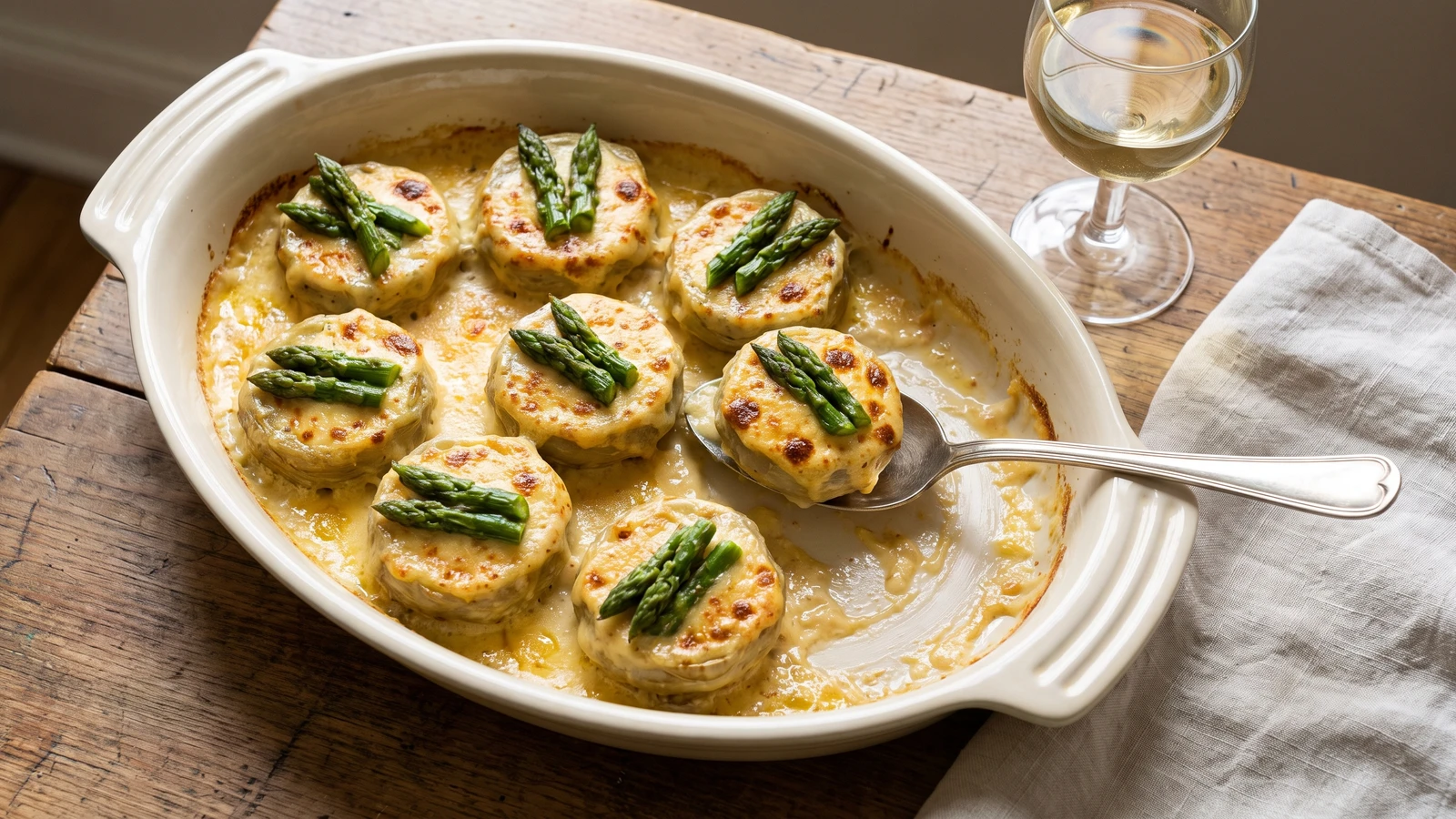
Eight tender artichoke bottoms carry green asparagus tips bound with cream, veiled in Mornay, and flashed under fierce heat until the sauce freckles gold without dulling the spring beneath.
Fonds d’Artichauts aux Pointes d’Asperges (artichoke bottoms with asparagus tips) teaches the difference between cooking and finishing. Everything must be tender and seasoned before it meets fierce heat; the final glaze exists only to bronze the Mornay, not to cook what lies beneath. That is the one true thing to know before touching a pan.
The original entry assumed artichoke bottoms already turned, asparagus tips already blanched, Mornay waiting under a saucier’s eye, and a salamander that browned sauce in moments. A stock never off the fire belonged to that brigade machinery, but it has no business being added here. At home, the concurrent prep is scaffolding we can discard: work in sequence, warm the finished Mornay, and use a fully heated broiler. The butter stew, cream binding, pyramidal garnish, and rapid glaze stay, because they are the dish. Eight bottoms make four generous servings, one cook, one stove, one evening.
When it lands correctly, the artichokes are tender without collapsing, the asparagus remains distinctly green, and the Mornay forms a thin ivory cloak freckled with gold. Preheat the broiler until it is truly fierce. A slow glaze dulls the asparagus before the sauce colours, and that final minute decides the whole plate.
Fonds d’Artichauts aux Pointes d’Asperges belongs to the Parisian classical table, where market-garden vegetables were shaped into individual garnishes and composed side dishes rather than hidden in a casserole. The fonds, the carefully trimmed and cupped bases of the artichokes, became edible pedestals for asparagus tips, while Mornay supplied the rich grand-kitchen finish. Although the dish now resembles a gratin, the canon never intended a long bake: the salamander’s quick glaze coloured the sauce while protecting the spring green beneath.
Quantity
8 medium (about 4 lb / 1.8 kg total)
trimmed into 8 intact bottoms
Quantity
2 qt (1.9 L / 1.9 kg)
for holding the artichokes
Quantity
2 tbsp (30 ml / 30 g)
Quantity
5 tbsp (75 ml / 70 g)
divided
Quantity
1/2 cup (120 ml / 120 g)
for stewing
Quantity
1 tbsp (15 ml / 18 g)
divided
Quantity
1 large bunch (about 1 lb / 450 g), yielding 3 cups (710 ml / 340 g) tips
cut into 2-inch tips, lower stalks reserved for another dish
Quantity
3/4 cup (180 ml / 180 g)
Quantity
1/4 tsp (1.25 ml / 0.5 g)
Quantity
1 1/2 cups (355 ml / 360 g)
warmed until fluid
| Ingredient | Quantity |
|---|---|
| medium globe artichokestrimmed into 8 intact bottoms | 8 medium (about 4 lb / 1.8 kg total) |
| cold waterfor holding the artichokes | 2 qt (1.9 L / 1.9 kg) |
| fresh lemon juice | 2 tbsp (30 ml / 30 g) |
| unsalted butterdivided | 5 tbsp (75 ml / 70 g) |
| waterfor stewing | 1/2 cup (120 ml / 120 g) |
| fine sea saltdivided | 1 tbsp (15 ml / 18 g) |
| thick asparaguscut into 2-inch tips, lower stalks reserved for another dish | 1 large bunch (about 1 lb / 450 g), yielding 3 cups (710 ml / 340 g) tips |
| heavy cream | 3/4 cup (180 ml / 180 g) |
| finely ground white pepper | 1/4 tsp (1.25 ml / 0.5 g) |
| finished Mornay Saucewarmed until fluid | 1 1/2 cups (355 ml / 360 g) |
Combine the cold water and lemon juice in a large bowl. Working with one artichoke at a time on a stable board, cut the stem flush with the base, pull away the leaves, and pare off every tough green leaf base until a neat, pale bottom remains. Scoop out the fibrous choke with a teaspoon or melon baller without piercing the bottom, then round the edges with a paring knife. Drop each finished bottom into the acidulated water immediately; the lemon prevents discolouration, but rinse the bottoms before cooking so it does not become a flavouring.
Étuver means to stew gently under cover, and it is exactly what these bottoms need. Rinse and dry them, then melt 4 tbsp (60 ml / 55 g) of the butter in a wide sauté pan. Set the bottoms cup-side up, add the stewing water and 1/2 tsp (2.5 ml / 3 g) of the salt, and cover tightly. Hold the liquid at the faintest simmer for 15 to 20 minutes, turning the bottoms once, until a small knife slips through the thick edge with almost no resistance. They must remain intact and pale. If the pan dries or the butter begins to colour, add water one tablespoon at a time and lower the heat; browning here would fight the clean Mornay finish. Keep the bottoms covered in their buttery liquor off the heat.
Bring a large saucepan of water to a strong boil and season it with 2 tsp (10 ml / 12 g) of the salt. Add the asparagus tips and blanch for 1 to 2 minutes, depending on thickness, until brilliant green and just tender at the cut end. Transfer them immediately to very cold water, then drain and dry them thoroughly on a clean towel. Water left clinging to the tips thins the cream and makes the pyramids slide. If the tips have softened too far, chill them at once and warm them only briefly in the next step; they cannot be uncooked, but they need not be punished twice.
Pour the cream into a wide pan and bring it to a lively simmer. Reduce it to about 1/3 cup, until the bubbles grow smaller and the cream coats the back of a spoon. Season with the white pepper and the remaining 1/2 tsp (2.5 ml / 3 g) salt, then fold in the asparagus tips for 30 to 60 seconds. The reduced cream should cling lightly and cohere the tips without forming a puddle. If the mixture remains loose, lift out the asparagus and reduce the cream alone for another minute before returning it. Ça se rattrape.
Set an oven rack 4 to 5 inches beneath the broiler and heat the broiler at its highest setting for a full 10 minutes. This is the honest home equivalent of the salamander. Butter a shallow, broiler-safe gratin dish with the remaining 1 tbsp (15 ml / 14 g) butter. Warm the finished Mornay Sauce gently until it falls from a spoon in a broad ribbon, but do not boil it.
Drain the artichoke bottoms thoroughly and arrange them cup-side up in the buttered dish. Divide the cream-bound asparagus among them, setting the tips upright and inward so each portion forms the pyramid specified by the original entry. Spoon the warm Mornay Sauce over every mound, covering the asparagus and letting the sauce run down the artichoke sides. Coat generously, but do not flood the bottom of the dish.
Place the dish beneath the fully heated broiler and watch it without leaving. Glaze for 60 to 120 seconds, only until the Mornay bubbles at the edges and freckles butter-gold across the crowns. If no colour appears within 90 seconds, remove the dish. Ça se rattrape: let the broiler recover or move the rack one notch closer, then return the dish for a brief second pass. Waiting under weak heat turns the asparagus khaki and loosens its cream binding. Carry the gratin straight to the table and serve two bottoms to each guest. À table!
1 serving (about 300g)
Culinary guides, cultural storytelling, and the editorial depth that makes cooking meaningful.
Discover Culinary ExplorerChef Juliette
Boulettes au suif, poached beside salt beef, turn equal weights of flour and finely chopped suet into tender, rich dumplings. Keep the beef liquor at a bare tremble and the old garnish works beautifully at home.

Chef Juliette
Bread, flour, frangipane, and rice become four cool, supple panades for binding forcemeats, each changing body and flavor while preserving tenderness. The finest Mousselines need none, and knowing that distinction is the lesson.

Chef Juliette
Panade au pain is bread, milk, salt, heat, and attention: stir until the paste releases cleanly, butter it against a skin, and you have the quiet binder behind tender French farces.

Chef Juliette
Panade de farine teaches the drying stroke behind pâte à choux: flour meets boiling buttered water, then stays over the fire until the paste gathers, smooths, and quits the pan cleanly.