Culinary Explorer

A cooking platform built around craft, culture, and the stories behind what we eat.
Discover Culinary Explorer
Artichokes with Divers Sauces

Artichokes with Divers Sauces

Created by Chef Juliette

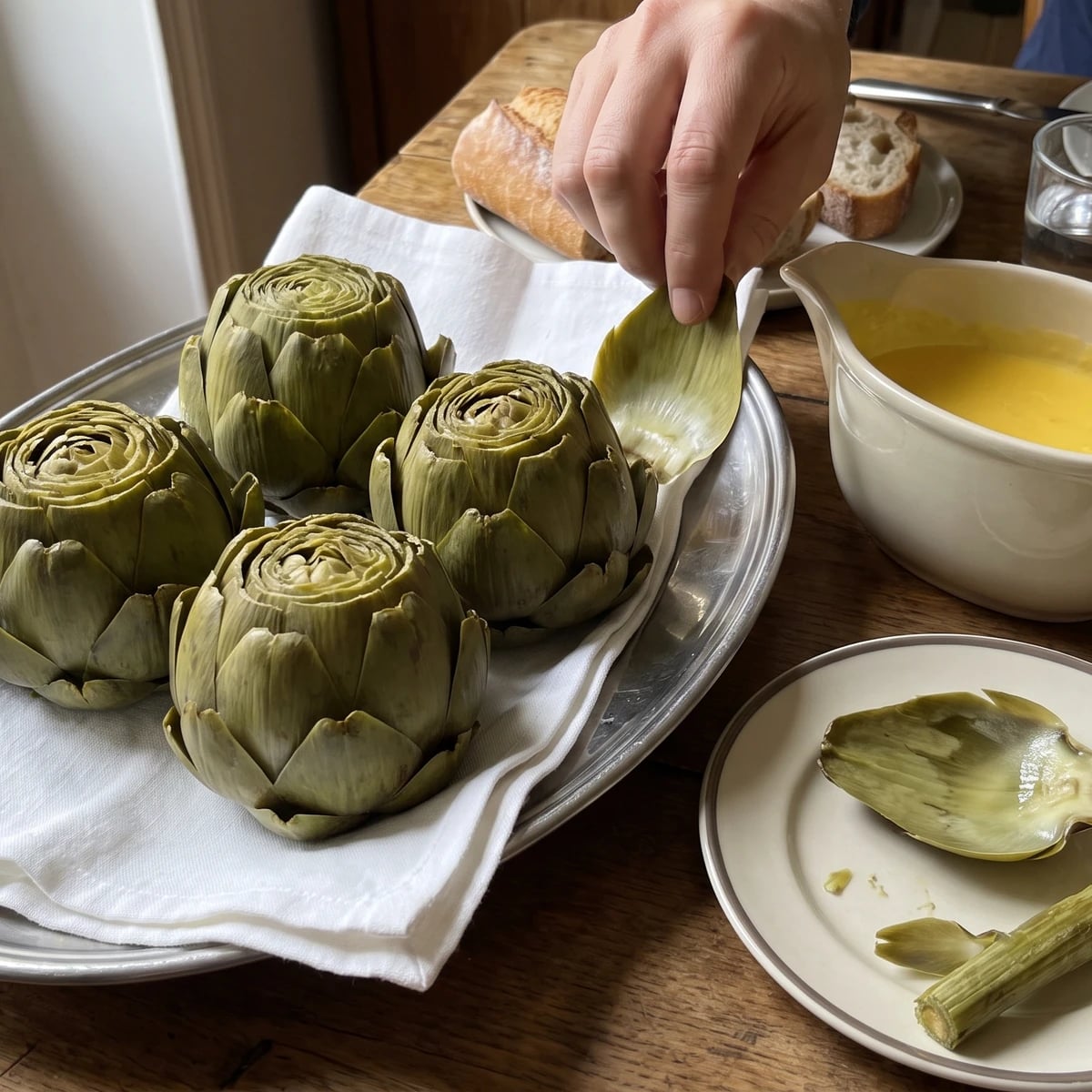
Based on No. 2030, Artichokes with Divers Sauces, from Le Guide Culinaire (1907) by Auguste Escoffier

Artichauts aux sauces diverses bring one generous lesson to the table: tie, boil, and drain the vegetables properly, then let one well-made sauce turn each leaf and heart into supper.

Side Dishes
French
Easter
Weeknight
Budget Friendly
20 min
Active Time
35 min cook1 hr total
Yield4 servings

Artichauts aux sauces diverses (whole artichokes with assorted sauces) teach a clean principle: when a vegetable is cooked plainly, the sauce must be exact. The one true thing to know before you touch the pot is that an artichoke traps water between every leaf. Drain it upside down and thoroughly, or even a beautiful Sauce Hollandaise arrives diluted at the table.

The source entry assumed a vegetable station trimming a service's worth and a saucier ready to send beurre fondu, Sauce Hollandaise, or Sauce Mousseline at precisely the right moment. For one cook, making all three is brigade scaffolding and can go. Choose one sauce, cook four artichokes in one generous pot, and use clean cotton kitchen twine to hold the leaves snugly. This dish needs neither a stock never off the fire nor a salamander, only brisk salted water, a folded napkin to catch the last drops, and one sauce treated with attention. One cook, one stove, one evening.

Keep the tying, the brisk boil, and the last-minute drain. Those steps are the dish. Remove the string only when the platter is ready, and don't let the artichokes lounge in their cooking water after they're tender. The final draining matters most, so give it the patience the boiling did not ask for.

Artichauts aux sauces diverses belong to the Parisian bourgeois and grand table, where large globe artichokes from Brittany entered the national classical repertoire as a vegetable course. The folded napkin was practical, not theater: it caught the water hidden between the leaves while the sauce was sent separately for dipping. Provence's small violet artichokes belong to other preparations; this whole, briskly boiled service calls for the broad, fleshy leaves of a globe artichoke.

The technique, the tradition, and the story behind every dish.

Discover Culinary Explorer

Ingredients

medium globe artichokes

Quantity

4 medium (about 3 lb / 1.35 kg total)

firm, tightly closed, and similar in size

water

Quantity

5 quarts (4.7 L / 4.7 kg)

fine sea salt

Quantity

2 tablespoons (30 ml / 36 g)

prepared beurre fondu, Sauce Hollandaise, or Sauce Mousseline (optional)

Quantity

1 cup (240 ml / about 225 g)

choose one and keep it ready for hot service

prepared Sauce Vinaigrette (optional)

Quantity

1 cup (240 ml / about 230 g)

use instead for cold service

Equipment Needed

  • 8 to 10-quart (7.5 to 9.5 L) deep pot with lid
  • Heavy chef's knife and kitchen shears
  • Unbleached cotton kitchen twine
  • Tongs or a wide wire skimmer
  • Large colander
  • Clean lint-free linen napkin
  • Oval serving platter and sauce boat
  • Teaspoon for removing the cold chokes

Instructions

  1. 1

    Choose the service

    Decide whether the artichokes will be served hot or cold. For hot service, choose one finished sauce: beurre fondu, Sauce Hollandaise, or Sauce Mousseline. For cold service, have Sauce Vinaigrette ready. One sauce is generous; three sauces are a brigade's convenience, not a requirement of the dish.

  2. 2

    Boil the water

    Combine the water and salt in a deep 8 to 10-quart pot, cover, and bring it to a full boil. The artichokes must enter water that is already boiling, exactly as the source directs; starting them cold gives the cut surfaces too much time to darken and draws out their flavour.

  3. 3

    Trim and tie

    Work on one artichoke at a time. Cut the stem flush with the base so the artichoke will stand, pull away the smallest coarse leaves at the bottom, then slice cleanly across the top, removing roughly the upper third and leaving two-thirds of its original height. Snip any remaining thorny tips around the sides. Loop cotton twine twice around the widest part and tie it snugly enough to hold the leaves together without crushing them.

    Have the water boiling before you trim. The source uses salted water without acid, so prompt cooking is what limits discoloration. A little darkening is cosmetic and does not spoil the artichoke.
  4. 4

    Boil them briskly

    Lower the tied artichokes carefully into the boiling water with tongs. Cover just until the boil returns, then cook them at a lively, steady boil for 25 to 35 minutes, turning them once or twice because they float. This is not a gentle poach. The quick cooking keeps the flesh succulent while the string prevents the leaves from spreading and bruising. During the final 10 minutes, bring the chosen hot sauce to serving temperature according to its own preparation.

  5. 5

    Test and drain

    Pull one lower leaf and pierce the stem end with the tip of a thin knife. The leaf should release without a struggle, and the base should feel tender but not collapsing. If the leaf clings or the knife meets a hard core, return the artichokes to the boil for 3 minutes and test again. Ça se rattrape. Lift them out immediately when tender, set them upside down in a colander, and drain for 8 to 10 minutes. Shake each one gently over the sink, then remove the string only when the platter is waiting.

  6. 6

    Serve them hot

    Line a warm oval platter with a clean, thickly folded, lint-free napkin and stand the drained artichokes upright upon it. Send the beurre fondu, Sauce Hollandaise, or Sauce Mousseline separately in a warm sauce boat so each leaf can be dipped and the heart sauced at the table. Never pour the sauce over the whole artichoke; it belongs beside it. À table!

  7. 7

    Or serve cold

    For cold service, let the drained artichokes cool completely and remove the string. Pull out the tight cone of pale central leaves, then scrape away the fuzzy choke with a teaspoon without gouging the tender heart beneath. Chill briefly if desired, stand the artichokes on a napkin-lined platter, and send the Sauce Vinaigrette separately.

Chef Tips

  • Choose globe artichokes that feel heavy for their size, with tightly packed leaves and stems that look freshly cut. Equal size matters more than grandeur because all four must become tender together.
  • Large spring artichokes are the natural Easter choice and usually the best value when the market has them in quantity. Out of season, buy only firm specimens; a light, spreading artichoke has already surrendered much of its moisture.
  • Beurre fondu is the economical weeknight sauce and keeps the artichoke's sweetness in front. Sauce Hollandaise brings a richer lemon-butter emulsion, while Sauce Mousseline, Hollandaise lightened with whipped cream, makes the lightest hot accompaniment. Cold artichokes want Sauce Vinaigrette.
  • The napkin is functional. A whole artichoke can appear dry outside while holding spoonfuls of water inside, and that water ruins a sauce faster than any lack of ceremony.
  • Artichokes contain cynarin, which can make wine taste strangely sweet. If you pour wine, choose a very dry, high-acid white and keep the glass modest; sparkling water is often the happier companion.

Advance Preparation

  • The listed time covers trimming and cooking the artichokes. Prepare the chosen sauce as its own finished component; Sauce Hollandaise and Sauce Mousseline should be made close to serving rather than held for hours.
  • For cold service, cook and drain the artichokes up to 24 hours ahead. Remove the chokes once they are cool, cover tightly, and refrigerate; keep the Sauce Vinaigrette separate until the table.
  • For hot service, set out the twine, platter, napkin, and sauce boat in advance, but trim the artichokes only after the cooking water is heating. Freshly cut artichokes should go promptly into the pot.

Frequently Asked Questions

Nutrition Information

1 serving (about 175g)

Calories
360 calories
Total Fat
32 g
Saturated Fat
18 g
Trans Fat
1 g
Unsaturated Fat
12 g
Cholesterol
165 mg
Sodium
450 mg
Total Carbohydrates
16 g
Dietary Fiber
7 g
Sugars
2 g
Protein
5 g

Note: Chef personas and recipes are created with AI assistance. Cook with care: follow safe food-handling practices, check doneness with a thermometer when needed, and adapt for allergies and your kitchen.

Where cooking meets culture.

Culinary guides, cultural storytelling, and the editorial depth that makes cooking meaningful.

Discover Culinary Explorer

More from Vegetables and Farinaceous Products - Artichokes and Egg-Plant

Browse the full collection