Chef Juliette
Mayonnaise de Volaille
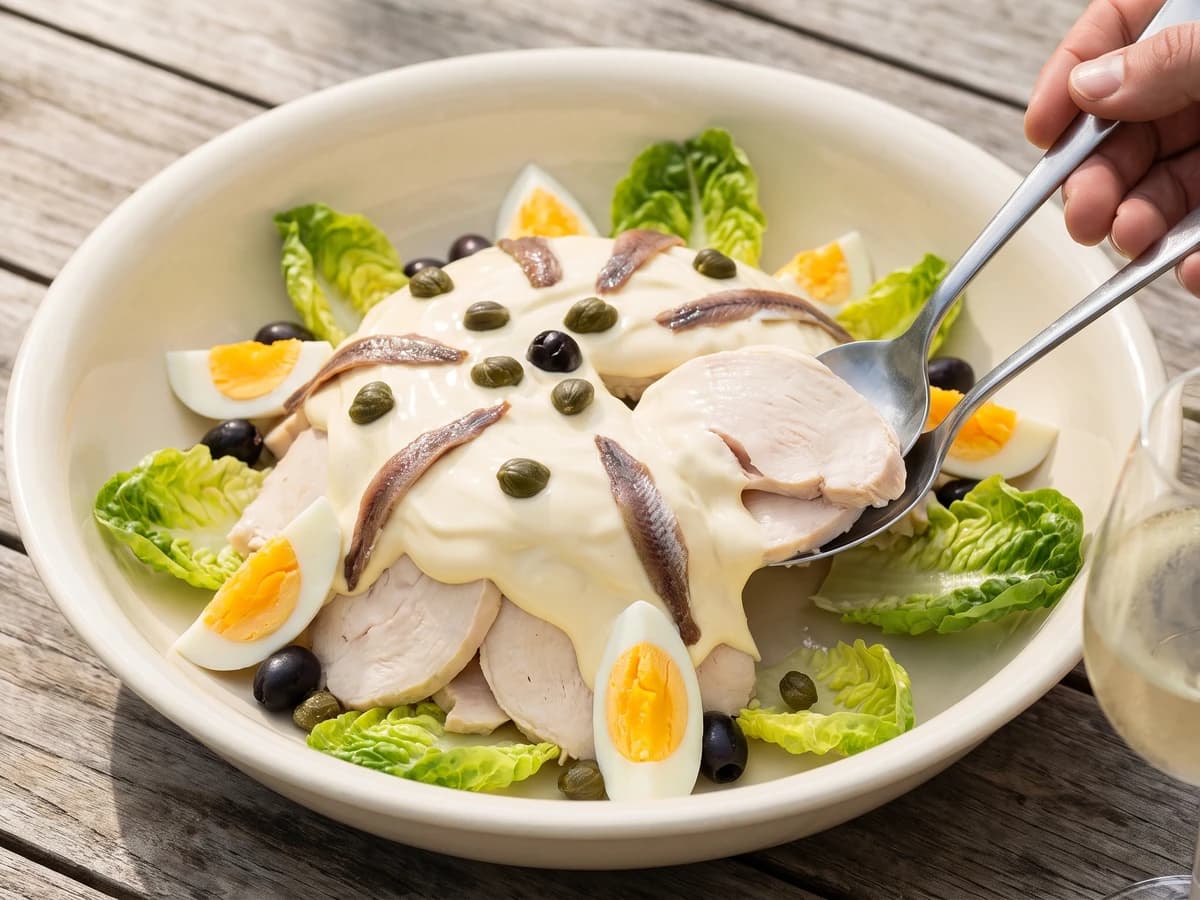
Cold roast chicken, ciseled lettuce, and a shining coat of homemade mayonnaise, arranged with capers, olives, anchovies, eggs, and lettuce hearts, then tossed at the table as the canon intends.
A cooking platform built around craft, culture, and the stories behind what we eat.

Created by Chef Juliette
Based on No. 2009, Jockey-Club Salad, from Le Guide Culinaire (1907) by Auguste Escoffier
Salade Jockey-Club balances tender asparagus tips against fragrant raw truffle, each seasoned on its own and joined at the last moment with just enough sharp mayonnaise to make them hold.
Salade Jockey-Club (asparagus-tip and raw-truffle salad) teaches restraint. The one true thing to know before touching a pan is this: too much mayonnaise and the truffle disappears. The sauce should make the asparagus heads and raw truffle cohere, nothing more. You must still see every green tip and every dark julienne, each carrying its own seasoning beneath the faint gloss of the emulsion.
The original formula assumed a garde-manger station with blanched asparagus, scrubbed truffles, and sauce mayonnaise, the cold yolk-and-oil emulsion, already waiting on ice. At home, blanch one small measure, whisk one yolk, and weigh the two principal ingredients equally after trimming. The ready station was brigade scaffolding and can go. The equal proportion, separate advance seasoning, raw truffle, and scant last-minute binding are the dish itself and must stay. One cook, one stove, one evening.
Give the asparagus and truffle thirty minutes in separate bowls so each absorbs its seasoning without surrendering its character. The decisive step comes at the end: add the mayonnaise one spoonful at a time and stop while the salad still looks like asparagus and truffle, not sauce.
Salade Jockey-Club belongs to the Parisian club and grand-hotel repertoire, where dishes named for fashionable institutions joined luxurious ingredients to disciplined, spare technique. Its name invokes the Jockey Club de Paris, but the salad's identity rests less on ceremony than on the narrow seasonal meeting of tender asparagus and ripe raw black truffle. The common mistake is to treat it as a mayonnaise salad; in the classical formula, the sauce is only a final liaison, while the separately seasoned asparagus and truffle remain distinct.
Quantity
2 quarts (1.9 liters / 1.9 kg)
for blanching
Quantity
1 tablespoon (15 ml / 18 g)
Quantity
¾ cup (180 ml / 90 g)
cut as 1½-inch (4 cm) tips and weighed after trimming
Quantity
¾ cup loosely packed (180 ml / 90 g)
scrubbed, dried, and cut julienne-fashion
Quantity
1 large
Quantity
1 teaspoon (5 ml / 5 g)
Quantity
1 tablespoon (15 ml / 15 g)
divided
Quantity
⅓ cup (80 ml / 74 g)
divided
Quantity
¾ teaspoon (3.75 ml / 4.5 g)
divided
Quantity
¼ teaspoon (1.25 ml / 0.6 g)
divided
Quantity
1 teaspoon (5 ml / 5 g)
| Ingredient | Quantity |
|---|---|
| waterfor blanching | 2 quarts (1.9 liters / 1.9 kg) |
| fine sea salt for blanching | 1 tablespoon (15 ml / 18 g) |
| green asparagus headscut as 1½-inch (4 cm) tips and weighed after trimming | ¾ cup (180 ml / 90 g) |
| fresh black trufflescrubbed, dried, and cut julienne-fashion | ¾ cup loosely packed (180 ml / 90 g) |
| pasteurized egg yolk | 1 large |
| Dijon mustard | 1 teaspoon (5 ml / 5 g) |
| white wine vinegardivided | 1 tablespoon (15 ml / 15 g) |
| neutral oildivided | ⅓ cup (80 ml / 74 g) |
| fine sea salt for seasoningdivided | ¾ teaspoon (3.75 ml / 4.5 g) |
| finely ground white pepperdivided | ¼ teaspoon (1.25 ml / 0.6 g) |
| cold water (optional) | 1 teaspoon (5 ml / 5 g) |
Bring the water and blanching salt to a full boil. Add the asparagus heads and cook for 90 seconds to 3 minutes, depending on thickness, until they are vivid green and a knife enters the cut end with slight resistance. Transfer them immediately to a bowl of ice water. If they have gone softer than intended, chill them at once and handle them as little as possible; they cannot become crisp again, but cold stops further cooking and preserves their shape.
Drain the asparagus and spread it on a clean towel until completely dry. Water clinging to the tips will loosen the mayonnaise later. Cut the scrubbed raw truffle julienne-fashion, first into thin slices and then into slim match-shaped rods about 1½ inches (4 cm) long. Keep the truffle raw. Heat would soften its clean texture and carry away the perfume this salad is built to protect.
Place the asparagus and truffle in separate nonreactive bowls. Season the asparagus with ½ teaspoon (2.5 ml / 2.5 g) vinegar, 1½ teaspoons (7.5 ml / 7 g) oil, ¼ teaspoon (1.25 ml / 1.5 g) seasoning salt, and a small pinch of white pepper. Season the truffle separately with the same amounts of vinegar and oil, ⅛ teaspoon (0.6 ml / 0.75 g) salt, and another small pinch of pepper. Turn each gently, cover, and refrigerate for 30 minutes. This separate rest is not ceremony: it lets both ingredients taste complete before the mayonnaise joins them.
Whisk the egg yolk with the Dijon mustard, the remaining 2 teaspoons (10 ml / 10 g) vinegar, and the remaining salt and white pepper until smooth. Add the remaining oil first drop by drop, then in a thin thread once the emulsion thickens, whisking constantly. The mayonnaise should taste distinctly sharp and well seasoned because very little will reach each bite. If it splits, stop. Ça se rattrape: put the cold water in a clean bowl and whisk the broken mayonnaise into it one teaspoon at a time until smooth. Cover and keep cold.
Drain the asparagus and truffle separately for 1 minute so no loose seasoning follows them into the bowl. Combine them gently, then fold in 2 tablespoons (30 ml / 28 g) mayonnaise. Add the third tablespoon only if dry pieces refuse to hold together. Stop as soon as everything carries a thin sheen. If mayonnaise begins pooling underneath, lift the solids with a slotted spoon into a clean chilled bowl and fold once with 1 teaspoon fresh mayonnaise, leaving the excess sauce behind. Ça se rattrape.
Spoon the Salade Jockey-Club loosely into a chilled shallow serving dish, leaving the asparagus heads whole and the dark truffle julienne visible throughout. Serve at once, cool but not numb from the refrigerator. It needs no decorative garnish and no further sauce. À table!
1 serving (about 75g)
Culinary guides, cultural storytelling, and the editorial depth that makes cooking meaningful.
Discover Culinary ExplorerChef Juliette
Cold roast chicken, ciseled lettuce, and a shining coat of homemade mayonnaise, arranged with capers, olives, anchovies, eggs, and lettuce hearts, then tossed at the table as the canon intends.

Chef Juliette
Cold roast or poached chicken with fine ribbons of lettuce, dressed at the final moment with oil and vinegar: a composed salad whose freshness depends entirely on timing.

Chef Juliette
Five leaves, one living rule: laitue, romaine, chicorée, mâche, or pissenlit must be washed, dried, and dressed only as they go to the table, while every leaf still carries its light vinaigrette.

Chef Juliette
Salade de Betteraves proves that baking, not boiling, is the whole argument: concentrated garnet sweetness, tender baked onion, sharp mustard, and herbs cut into a weeknight salad worth making ahead.