Culinary Explorer

A cooking platform built around craft, culture, and the stories behind what we eat.
Discover Culinary Explorer
Faisan Rôti à la Perigourdine

Faisan Rôti à la Perigourdine

Created by Chef Juliette

Based on No. 1970, Faisan Rôti à la Perigourdine, from Le Guide Culinaire (1907) by Auguste Escoffier

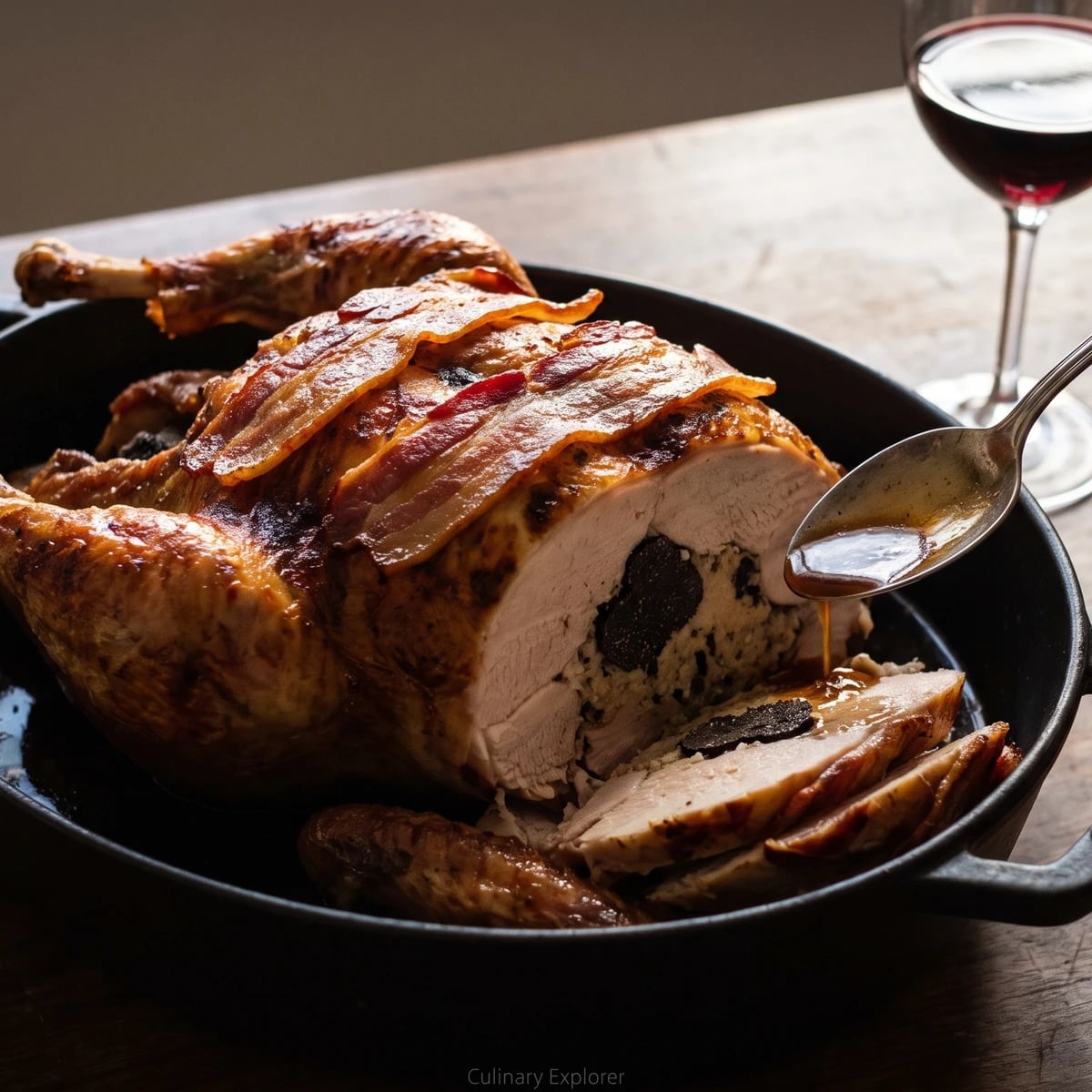
Truffle is not a garnish here: a whole pheasant carries a cold farce of pork fat, foie gras, and large black truffle dice, then roasts under bacon in its cocotte.

Main Dishes
French
Special Occasion
Christmas
Dinner Party
45 min
Active Time
1 hr 15 min cook2 hr 20 min total
Yield4 servings

Faisan Rôti à la Périgourdine (Périgord-style roast pheasant) teaches one extravagant but exact principle: the farce is a setting for truffle, not a way of stretching meat. Pork fat, foie gras, and truffle parings are pounded in equal measure, then four times that weight of raw truffle goes through in large dice. Keep those dice distinct. Their perfume and yielding texture are the whole identity of the dish.

The source entry sends its cook to the separate Truffled Pullet roasting method and assumes a brigade pantry where foie gras trimmings and truffle parings are useful scraps, with hands available to pound each element. At home, a chilled mini processor replaces the mortar, paper-thin bacon replaces formal barding sheets, and a heavy cocotte collects enough fond for its own small jus. No saucier or perpetual stockpot is needed. The quantities are the source's one-bird proportions, retained exactly for a large pheasant serving four with accompaniments. What changed is the equipment and the explanation, not the composition. One cook, one stove, one evening.

The finished bird comes out burnished beneath its bacon, with a glossy roasting jus and a rich farce broken by generous black truffle dice. The step that matters most is temperature: keep the farce cold until stuffing, then roast only until its center and the thickest part of the thigh are safely done. Watch the thermometer, not the clock, and the breast stays succulent.

Périgord, the country of wooded limestone hills around the Dordogne valley, gives this preparation its defining union of black truffle and foie gras, products paired for generations at prosperous winter tables. In the classical canon, à la Périgourdine carried that regional abundance from game estates and bourgeois dining rooms into formal poultry preparations. The term does not mean a token shaving of truffle or a generic rich sauce: here truffle forms the substance of the stuffing, while foie gras and pork fat carry its perfume through the bird.

The technique, the tradition, and the story behind every dish.

Discover Culinary Explorer

Ingredients

large oven-ready pheasant

Quantity

1, 3 to 3½ lb (1.35 to 1.6 kg)

giblets removed

raw pork back fat

Quantity

¼ cup (60 ml / 2 oz / 57 g)

rind removed, cut into small cubes and thoroughly chilled

raw foie gras trimmings

Quantity

¼ cup (60 ml / 2 oz / 57 g)

cut into small cubes and thoroughly chilled

raw fresh black truffle parings

Quantity

⅓ cup (80 ml / 2 oz / 57 g)

roughly chopped and thoroughly chilled

raw fresh black truffle

Quantity

1¼ cups (300 ml / 8 oz / 227 g)

cut into large ⅜-inch (1 cm) dice

unsmoked fatback bacon or unsmoked streaky bacon

Quantity

8 paper-thin slices, about 4¼ oz (120 g)

unsalted butter

Quantity

3 tablespoons (45 ml / 1½ oz / 42 g)

divided

fine sea salt

Quantity

1½ teaspoons (7.5 ml / 9 g)

divided

freshly ground black pepper

Quantity

¾ teaspoon (3.75 ml / 1.5 g)

divided

hot water

Quantity

½ cup (120 ml / 120 g)

plus more only if needed

Equipment Needed

  • 5 to 6-quart (4.7 to 5.7-liter) heavy lidded cocotte
  • 3-cup or larger food processor
  • Instant-read thermometer
  • Kitchen twine and a small metal skewer
  • Small ovenproof ramekin for any excess farce

Instructions

  1. 1

    Chill and season

    Put the food processor bowl and blade in the cold for 15 minutes. Heat the oven to 400°F (200°C) with a rack in the lower-middle position. Pat the pheasant dry inside and out, inspect the cavity for any stray feathers or shot, then season it with 1 teaspoon of the salt and ½ teaspoon of the pepper. Keep the bird chilled while you make the farce. Cold ingredients are not fussiness here; they keep the pork fat and foie gras bound together instead of turning greasy.

    If the pheasant is wild, inspect it closely and remove any damaged flesh around a shot channel. A farm-raised bird gives more predictable roasting time and enough breast meat to serve four with side dishes.
  2. 2

    Pound the farce

    Put the chilled pork fat in the chilled processor and pulse until it becomes tacky and finely pounded. Add the foie gras, truffle parings, remaining ½ teaspoon salt, and remaining ¼ teaspoon pepper. Pulse briefly to make a uniform paste, scraping the bowl once. Do not let the fat warm or liquefy. If the mixture begins to shine and smear around the bowl, stop and chill everything for 10 minutes before continuing. Scrape the paste into a cold bowl and fold in the large diced truffle by hand, keeping every piece intact.

    The processor replaces the brigade's mortar, but not its judgment. Short pulses keep the farce cold and preserve the clean taste of foie gras and truffle.
  3. 3

    Stuff and bard

    Spoon the farce into the pheasant cavity without ramming it tight; heat must be able to reach the center evenly. If the full quantity will not fit comfortably, put the excess in a small buttered ramekin and bake it beside the bird until its center reaches 165°F (74°C). Close the cavity with a small skewer and tie the legs together with kitchen twine. Rub the pheasant with 1 tablespoon of the butter, then lay the bacon slices across the breast and upper legs in overlapping strips. The barding stays. It protects the lean meat and belongs to the source's method.

    Stuff the bird immediately before roasting. Holding raw stuffing inside poultry gives bacteria time to multiply and allows salt to draw moisture from the meat.
  4. 4

    Roast in cocotte

    Melt 1 tablespoon of the butter in a 5 to 6-quart cocotte over medium heat. Set the pheasant breast-side up in the pot, pour 2 tablespoons of the hot water down the side, and cover. Roast for 35 minutes. Remove the lid, baste the bacon with the juices, and continue roasting uncovered for 25 to 35 minutes. The bird is ready when both the center of the stuffing and the thickest part of the thigh, clear of bone, register 165°F (74°C). If the bacon darkens before the bird is ready, cover the breast loosely with parchment. If the thigh reaches temperature while the stuffing still lags, spoon the stuffing into a buttered ramekin and finish it separately while the bird rests; never dry the pheasant merely to satisfy the clock.

    Begin checking early. Pheasant is lean, and its breast passes from succulent to dry much faster than a domestic chicken.
  5. 5

    Rest without drying

    Lift the pheasant onto a carving board and cover it loosely with parchment or foil. Rest for 15 to 20 minutes while you finish the jus. Resting lets the breast retain its juices and gives the farce time to settle. Keep every drop that collects on the board; it belongs back in the cocotte.

  6. 6

    Build the small jus

    Spoon excess fat from the cocotte, leaving about 1 tablespoon and all the browned fond. Set the pot over medium heat, add the remaining hot water, and scrape the floor thoroughly. Add the resting juices and boil gently for 3 to 5 minutes, until the liquid reduces to a small, glossy jus that lightly coats a spoon. Take the cocotte off the heat and whisk in the final cold tablespoon of butter. If the jus separates into greasy beads, ça se rattrape: whisk in 1 teaspoon of cold water until it comes together. Taste before adding salt because the bacon has already spoken.

  7. 7

    Return and serve

    Remove the twine and skewer, then return the whole pheasant to its cocotte with the bacon still in place. Spoon the jus around it rather than over the crisp barding and carry the cocotte directly to the table. Carve each breast into thick slices, divide the legs, and give every plate a generous spoonful of the truffle farce and jus. Cooking well is not cooking fancy. À table!

Chef Tips

  • This recipe requires 10 oz (284 g) of fresh black truffle in total, and that abundance is the dish. Ask a specialist for Tuber melanosporum pieces rather than perfect round specimens; irregular truffles and sound parings cost less and are exactly right for pounding and dicing. Preserved truffle cannot replace this quantity without changing the preparation completely.
  • Foie gras mousse, pâté, and cooked terrine are not substitutes for raw foie gras trimmings. They contain seasoning and binders and will melt differently. Buy a small raw piece from a butcher or foie gras supplier and trim it yourself.
  • Use raw pork back fat, not rendered lard. The chilled fat is pounded into the foie gras and truffle parings to carry their perfume through the bird. Rendered fat cannot form the same farce.
  • Classical barding uses very thin, unsmoked fatty bacon. Smoke would sit heavily over the truffle, so ask the butcher to slice fatback or unsmoked bacon paper-thin.
  • Serve with a quiet accompaniment such as pommes fondantes, buttered celeriac purée, or simply roasted potatoes. The pheasant already contains enough ceremony. A structured red Bergerac or Pécharmant keeps the table in Périgord and has the depth for foie gras and game.
  • Refrigerate leftovers within 2 hours. Keep the carved pheasant, farce, and jus covered for up to 3 days, then reheat gently in the cocotte with a spoonful of water so the lean meat does not dry.

Advance Preparation

  • The pheasant can be patted dry and refrigerated uncovered for up to 24 hours. This dries the surface so the exposed skin and bacon brown cleanly.
  • The pork fat, foie gras, and truffle parings can be cut several hours ahead and kept separately covered in the cold. Dice the larger truffle pieces at the same time, but fold them into the farce only after processing.
  • Do not stuff the pheasant ahead. Make the farce, fill the bird, and put it directly into the heated oven.

Frequently Asked Questions

Nutrition Information

1 serving (about 290g)

Calories
770 calories
Total Fat
56 g
Saturated Fat
20 g
Trans Fat
1 g
Unsaturated Fat
34 g
Cholesterol
205 mg
Sodium
1060 mg
Total Carbohydrates
5 g
Dietary Fiber
3 g
Sugars
1 g
Protein
58 g

Note: Chef personas and recipes are created with AI assistance. Cook with care: follow safe food-handling practices, check doneness with a thermometer when needed, and adapt for allergies and your kitchen.

Where cooking meets culture.

Culinary guides, cultural storytelling, and the editorial depth that makes cooking meaningful.

Discover Culinary Explorer

More from Roasts and Salads

Browse the full collection