
Chef Juliette
John Dory (St. Pierre)
John Dory has the delicacy of sole and the firmness of turbot. A light flouring, a quick butter sauté, and nut-brown beurre noisette show exactly why looks never mattered.
A cooking platform built around craft, culture, and the stories behind what we eat.
Created by Chef Juliette
Based on No. 1938, Pilets (Pintails and Widgeons), from Le Guide Culinaire (1907) by Auguste Escoffier
Pilets teach the wild-duck rule in one fierce roast: butter-burnished skin, rosy breast, and a quick pan jus, with both canonical salmis preparations preserved whole.
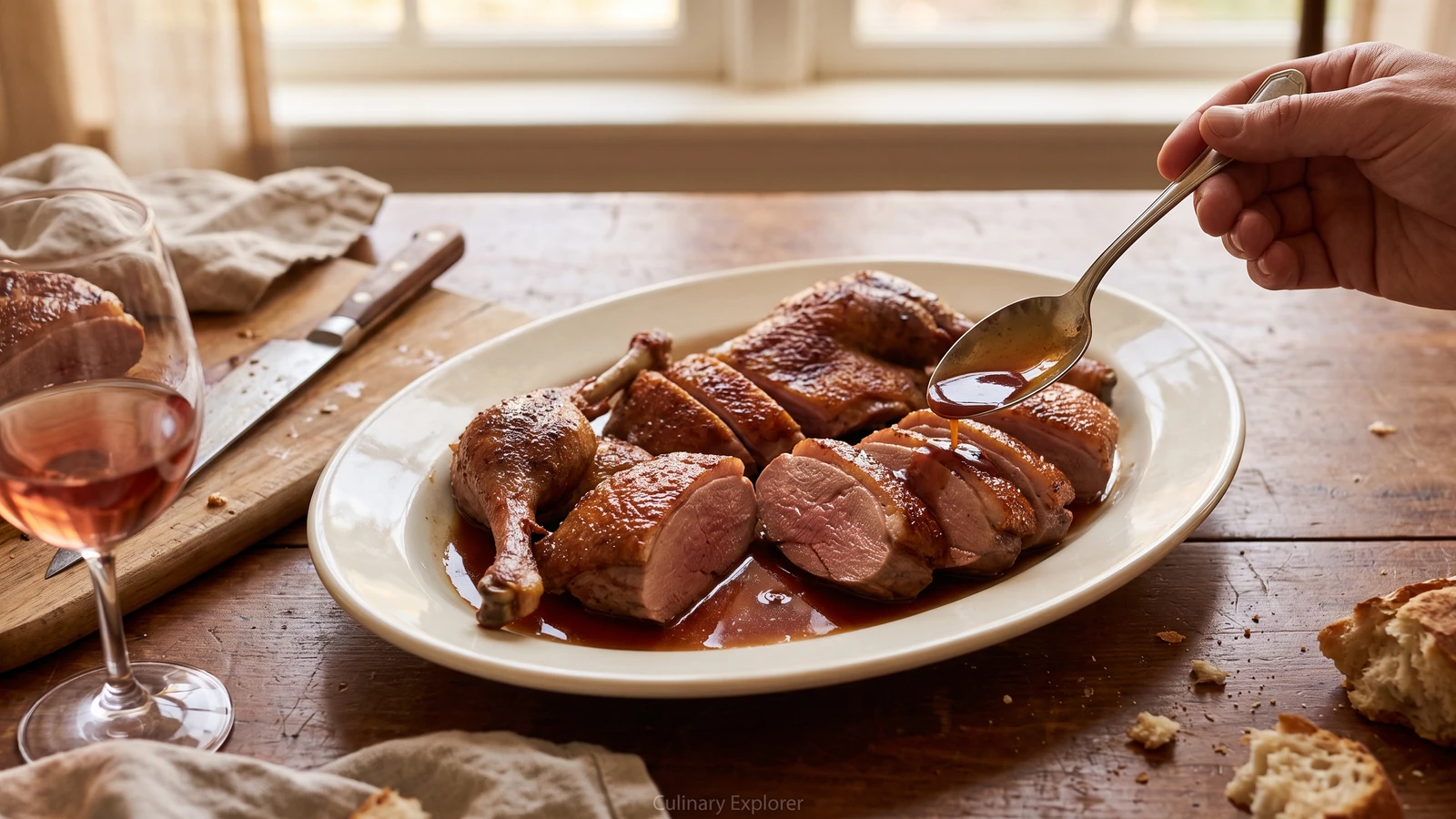
Pilets rôtis teach the one true rule of wild duck: roast fiercely and stop while the breast is still pink. Pintails and widgeons carry far less fat than farmed duck, so the passage from rosy and succulent to gray and dry lasts only a few minutes. The thermometer is not fuss here. It is good judgment made visible.
The book's salmis route assumed a saucier, prepared game sauce, meat glaze, and a stockpot never off the fire; its Rouennaise route assumed a red oven, an experienced carver, and a salamander for instantaneous glazing. Those preparations remain whole as cross-referenced alternatives. For tonight's roast, the honest home equivalents are a thoroughly heated domestic oven, a heavy pan, and a short jus drawn directly from the roasting fond. What changed is the scale and the heat source, not the intent: two large pintails or four small widgeons, one cook, one stove, one evening.
Decorative bread supports and elaborate dishing are brigade scaffolding and can go. Fast roasting, pink flesh, and immediate service are the dish and must stay. The decisive step is the final temperature check, when each bird leaves the oven as soon as its breast is ready, whether its companions are ready or not.
Pilets belong to the table de chasse (hunting table) across France, where lean wild ducks were judged by a fierce roast, a rosy breast, and swift service. The book's grouping is culinary rather than strictly ornithological: pilet properly names the pintail, while widgeon is canard siffleur, but their lean flesh sends both birds toward the same roasting and salmis techniques. Normandy, especially Rouen, gave the family its most elaborate treatment, while salmis carried underdone roast game into the grand kitchen by drawing a concentrated wine sauce from the carcass rather than using sauce to disguise an overcooked bird.
Quantity
2 large pintails or 4 small widgeons (3½ to 4½ lb / 1.6 to 2 kg total)
plucked and drawn
Quantity
3 tablespoons (45 ml / 42 g)
softened and divided
Quantity
1½ teaspoons (7.5 ml / 9 g)
Quantity
1 teaspoon (5 ml / 2 g)
Quantity
⅓ cup (80 ml / 80 g)
Quantity
1 complete preparation Salmis de Faisan (No. 1847)
Quantity
1 complete preparation Salmis De Caneton à la Rouennaise (No. 1763)
| Ingredient | Quantity |
|---|---|
| large oven-ready pintails or small oven-ready widgeonsplucked and drawn | 2 large pintails or 4 small widgeons (3½ to 4½ lb / 1.6 to 2 kg total) |
| unsalted buttersoftened and divided | 3 tablespoons (45 ml / 42 g) |
| fine sea salt | 1½ teaspoons (7.5 ml / 9 g) |
| freshly ground black pepper | 1 teaspoon (5 ml / 2 g) |
| hot water | ⅓ cup (80 ml / 80 g) |
| optional alternate route for the birds (optional) | 1 complete preparation Salmis de Faisan (No. 1847) |
| optional alternate route for the birds (optional) | 1 complete preparation Salmis De Caneton à la Rouennaise (No. 1763) |
Inspect each bird carefully for pinfeathers and shot, then trim away any badly bruised tissue around pellet paths. Wipe the cavities and dry the skin thoroughly. Season inside and out with the salt and pepper, tie the legs loosely, and rub the birds with 2 tablespoons (30 ml / 28 g) of the softened butter. Leave them at cool room temperature for 20 minutes while the oven heats. Dry skin bronzes; damp skin remains pale.
The entry gives three distinct roads, not one preparation piled upon another. Continue below for the roast. For salmis, reach for the complete Salmis de Faisan (No. 1847), substituting these birds for the pheasant and following that preparation whole. For the Rouen treatment, reach for the complete Salmis De Caneton à la Rouennaise (No. 1763), substituting these birds for the duckling and following its separate carving and glazing sequence. Do not combine the two referenced preparations.
Set a rack in the upper third of the oven and heat it to 475°F (245°C). Put the empty heavy roasting pan or ovenproof skillets inside for at least 15 minutes. This fierce, stored heat is the home equivalent of the red oven: it sets the skin quickly before the lean breast has time to dry.
Set the birds on one side in the hot pan and roast for 4 minutes. Turn them onto the other side for 4 minutes, then set them breast-up and spoon the foaming butter from the pan over the skin. Roast widgeons for another 4 to 7 minutes and pintails for another 7 to 11 minutes, checking early with an instant-read thermometer inserted horizontally into the thickest part of each breast without touching bone. Remove each bird separately at 130 to 135°F (54 to 57°C); resting will carry it toward 135 to 140°F (57 to 60°C). If a breast reaches temperature before its legs are tender, remove both breasts and return the legs and carcass to the oven for 5 to 8 minutes. Ça se rattrape. Waiting for every part to finish together does not.
Transfer the birds to a warm board and rest them breast-up for 8 minutes. Leave them uncovered or lay foil over them very loosely. A tight wrapping traps too much heat, drives the breast beyond pink, and softens the burnished skin. Resting is brief here because these small birds cool quickly.
While the birds rest, pour off excess fat from the roasting pan, leaving the bronze fond and about 1 teaspoon of fat behind. Set the pan over medium-high heat, add the hot water, and scrape up the clean browned deposits. Reduce until only 3 to 4 tablespoons remain and the jus looks glossy, then take the pan off the heat and swirl in the remaining 1 tablespoon (15 ml / 14 g) butter. If the pan contains black, bitter patches, leave them untouched and transfer only the clean drippings to a small saucepan. If the jus turns oily, whisk in a teaspoon of hot water off the heat. Ça se rattrape.
Remove the legs at their joints, then lift each breast cleanly from the keel bone. Leave small breasts whole; slice larger pintail breasts across the grain into two or three thick pieces. Arrange everything skin-up on a warm platter and spoon over the roasting jus without drowning the crisp skin. Carry it directly to the table. À table!
1 serving (about 215g)
Culinary guides, cultural storytelling, and the editorial depth that makes cooking meaningful.
Discover Culinary ExplorerChef Juliette
John Dory has the delicacy of sole and the firmness of turbot. A light flouring, a quick butter sauté, and nut-brown beurre noisette show exactly why looks never mattered.

Chef Juliette
Fresh haddock proves its delicacy in the meunière pan: a fine flour crust, moist pearly flakes, and beurre noisette sharpened with lemon and parsley, ready from one skillet in half an hour.

Chef Juliette
Éperlans à l’Anglaise turns small fish into a lesson in disciplined coating: boned smelts under a close, crisp crumb, pan-fried in clarified butter and finished with bright, half-melted maître d’hôtel butter.

Chef Juliette
Tiny smelts, shallot, mushrooms, white wine, gratin sauce, and fine bread raspings meet a fierce oven, where the fish must turn tender in the same breath the buttered crust bronzes.