
Chef Juliette
John Dory (St. Pierre)
John Dory has the delicacy of sole and the firmness of turbot. A light flouring, a quick butter sauté, and nut-brown beurre noisette show exactly why looks never mattered.
A cooking platform built around craft, culture, and the stories behind what we eat.
Created by Chef Juliette
Based on No. 1911, Cailles au Château-Yquem, from Le Guide Culinaire (1907) by Auguste Escoffier
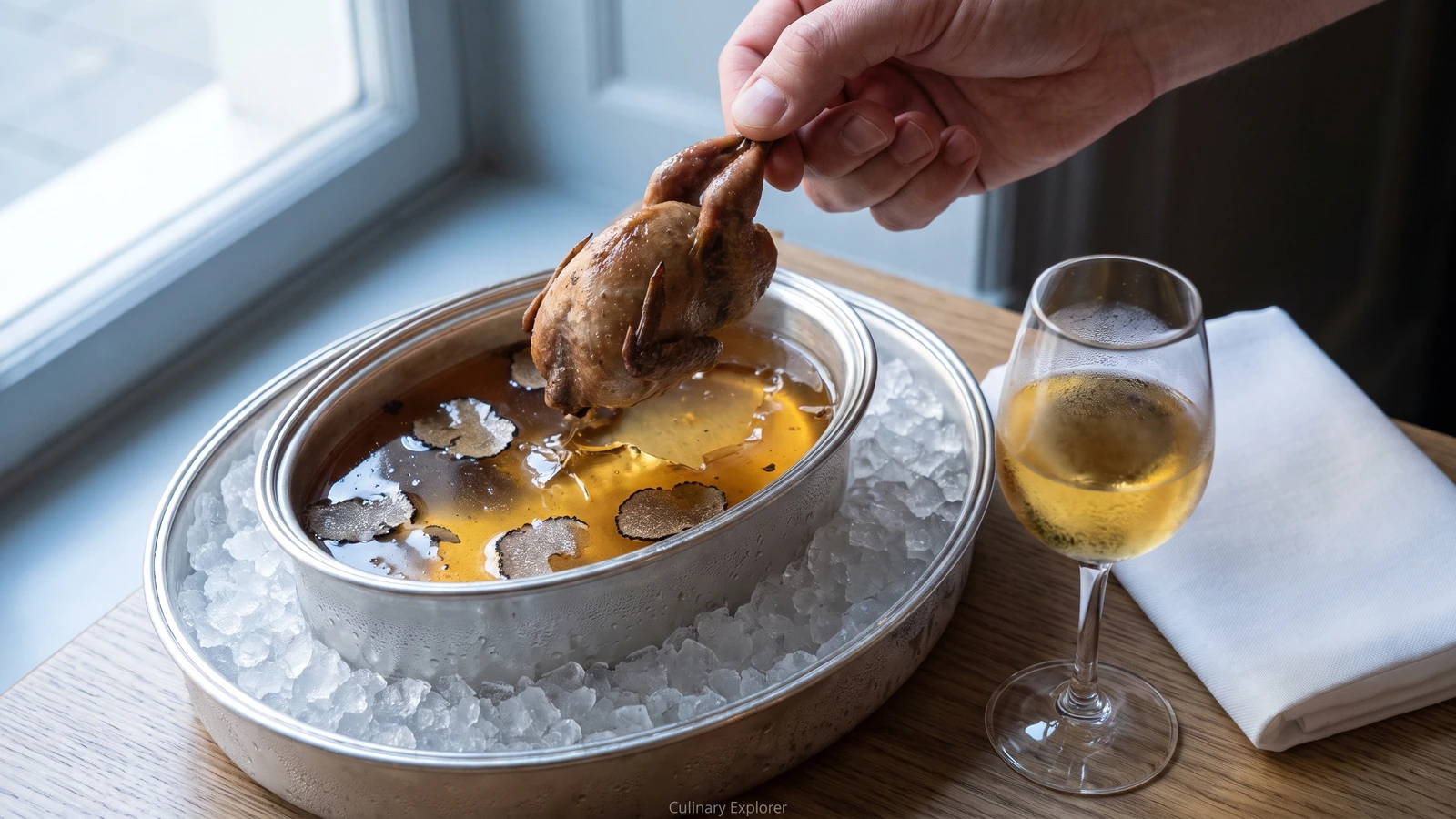
Cailles au Château-Yquem turns one poaching liquor into perfume, preservation, and sauce: four truffled quails scented with Sauternes, strained clear, then chilled in a tender amber jelly for the celebration table.
Cailles au Château-Yquem (quails poached with Château d'Yquem and set in their own jelly) teaches one severe, beautiful principle: the cooking liquor is not beside the dish, it is the dish. The Sauternes must reduce enough to perfume rather than sweeten, and the stock must contain enough gelatin to settle around each bird as a tender, clear sauce.
The working formula assumed Cailles Richelieu (No. 1895) arriving from another station, a saucier on staff, gelatinous amber veal stock never off the fire, muslin at hand, and a carved block of ice for service. A salamander has no work here; cold, not a browned finish, is the point. At home, prepare the referenced component separately, use the refrigerator for the set, and nestle the timbale in crushed ice rather than carving a block. Those are brigade scaffolds we can remove. The quail, vegetable julienne, truffle, Château d'Yquem reduction, grease-free strained liquor, and cold set are the dish and must stay.
The deciding step comes after poaching: remove every trace of fat before the liquor sets. Grease clouds the jelly and turns waxy when cold. If a spoonful fails to firm in a quick test, ça se rattrape; add only enough bloomed gelatin to replace what a home stock lacks. One cook, one stove, one evening of work, then the cold completes it.
Cailles au Château-Yquem belongs to the Parisian grand-kitchen repertoire, while its defining wine comes from Sauternes in Bordeaux, where botrytised grapes produce sweetness held upright by acidity and an apricot-saffron perfume. It is a cold variation on Cailles Richelieu, transforming an already truffled preparation into a timbale set in its clarified cooking liquor. Despite the wine in its title, this is not Bordeaux country cooking; it is a service dish of the grand table, where Château d'Yquem seasons the quail rather than becoming a sweet sauce.
Quantity
1 batch Cailles Richelieu (No. 1895), scaled to 4 quails and stopped just after its coarse vegetable julienne is added, with its prescribed amber veal stock held ready
Quantity
1/2 cup (120 ml / 125 g)
Quantity
40 thin slices (about 1 1/2 oz / 42 g)
cut very thinly
Quantity
1 teaspoon (5 ml / 3 g)
Quantity
8 cups (1.9 L / about 1.1 kg)
divided between chilling and serving
| Ingredient | Quantity |
|---|---|
| prepared Cailles Richelieu component | 1 batch Cailles Richelieu (No. 1895), scaled to 4 quails and stopped just after its coarse vegetable julienne is added, with its prescribed amber veal stock held ready |
| Château d'Yquem Sauternes | 1/2 cup (120 ml / 125 g) |
| fresh black trufflecut very thinly | 40 thin slices (about 1 1/2 oz / 42 g) |
| unflavoured powdered gelatin (optional) | 1 teaspoon (5 ml / 3 g) |
| crushed icedivided between chilling and serving | 8 cups (1.9 L / about 1.1 kg) |
Prepare the Cailles Richelieu (No. 1895) according to its separate formula, scaled to four birds, and stop at the stated handoff point, immediately after its coarse vegetable julienne has been laid over the seasoned quails. Julienne means vegetables cut into match-shaped rods. Keep the prescribed amber veal stock ready beside the stove; the referenced preparation is the foundation, so its stuffing, seasoning, buttered vegetables, and stock proportions remain untouched.
Pour the Château d'Yquem evenly over the vegetable julienne, then add just enough of the amber veal stock prescribed for Cailles Richelieu (No. 1895) to cover the birds. Cover the shallow pan, bring the liquor just to the boil, and immediately lower the heat until it barely trembles. Poach for 10 to 12 minutes, until the thickest thigh reaches about 160°F (71°C). The tightly packed pan and measured liquor concentrate the wine beneath the lid without drying the breasts. If the liquor begins smelling of caramel or falls below halfway up the birds, ça se rattrape: add 2 tablespoons of the reserved stock and lower the heat. A hard boil toughens the quail and turns the sweet wine coarse.
Lift the quails into a second clean saucepan that holds them closely. Cut the truffle into 40 thin slices and place 10 around each bird. Pass the hot cooking liquor through a fine sieve lined with damp muslin, without pressing on the vegetable julienne, and strain it directly over the quails. Return the pan to the gentlest heat and poach for exactly 2 minutes, until the thighs reach 165°F (74°C). Longer cooking drives away the truffle's fragrance and dries the small birds.
Transfer the quails and truffle slices to a chilled 2-quart timbale or deep serving dish. Let the liquor stand for 1 minute, then skim off every visible bead of fat; drawing a clean strip of paper towel lightly across the surface will collect the final film. Pass the liquor through fresh damp muslin once more. Never squeeze the cloth, because pressure forces vegetable particles through and clouds the jelly. If it is already cloudy, don't torment it with elaborate clarification. Strain it once more and serve it confidently; clarity is desirable, not worth overcooking the quails.
Spoon 1 tablespoon of liquor onto a chilled saucer and place it in the freezer for 5 minutes. It should wrinkle softly when pushed and melt readily on the tongue, not bounce like firm jelly. If it remains liquid, cool another tablespoon of liquor, sprinkle the gelatin over it, and leave it for 5 minutes to bloom. Whisk the bloomed gelatin into the hot liquor until completely dissolved, then repeat the test. Add no more than necessary; the natural gelatin from the veal stock should do most of the work.
Arrange the quails snugly in the timbale and distribute 10 truffle slices around each bird. Pour the clear liquor over them until they are covered. Set the timbale in an ice bath made with half the crushed ice and enough cold water to reach halfway up its sides. Cool for about 20 minutes, then refrigerate until the liquor has set completely, at least 6 hours and preferably overnight. Cover once cold so condensation cannot fall onto the surface. The setting is not decoration; it is the sauce.
Make a stable bed with the remaining crushed ice in a shallow tray and nestle the timbale into it. Wipe the rim, then bring the whole vessel to the table with a broad serving spoon. Spoon out one quail per guest with its truffle slices and a generous portion of the delicate amber jelly. Keep the timbale cold throughout service. The carved ice block was ceremony; crushed ice does the same honest work without requiring a mason in the kitchen. À table!
1 serving (about 210g)
Culinary guides, cultural storytelling, and the editorial depth that makes cooking meaningful.
Discover Culinary ExplorerChef Juliette
John Dory has the delicacy of sole and the firmness of turbot. A light flouring, a quick butter sauté, and nut-brown beurre noisette show exactly why looks never mattered.

Chef Juliette
Fresh haddock proves its delicacy in the meunière pan: a fine flour crust, moist pearly flakes, and beurre noisette sharpened with lemon and parsley, ready from one skillet in half an hour.

Chef Juliette
Éperlans à l’Anglaise turns small fish into a lesson in disciplined coating: boned smelts under a close, crisp crumb, pan-fried in clarified butter and finished with bright, half-melted maître d’hôtel butter.

Chef Juliette
Tiny smelts, shallot, mushrooms, white wine, gratin sauce, and fine bread raspings meet a fierce oven, where the fish must turn tender in the same breath the buttered crust bronzes.