
Chef Juliette
John Dory (St. Pierre)
John Dory has the delicacy of sole and the firmness of turbot. A light flouring, a quick butter sauté, and nut-brown beurre noisette show exactly why looks never mattered.
A cooking platform built around craft, culture, and the stories behind what we eat.
Created by Chef Juliette
Based on No. 1882, Bécasses et Bécassines Froides, from Le Guide Culinaire (1907) by Auguste Escoffier
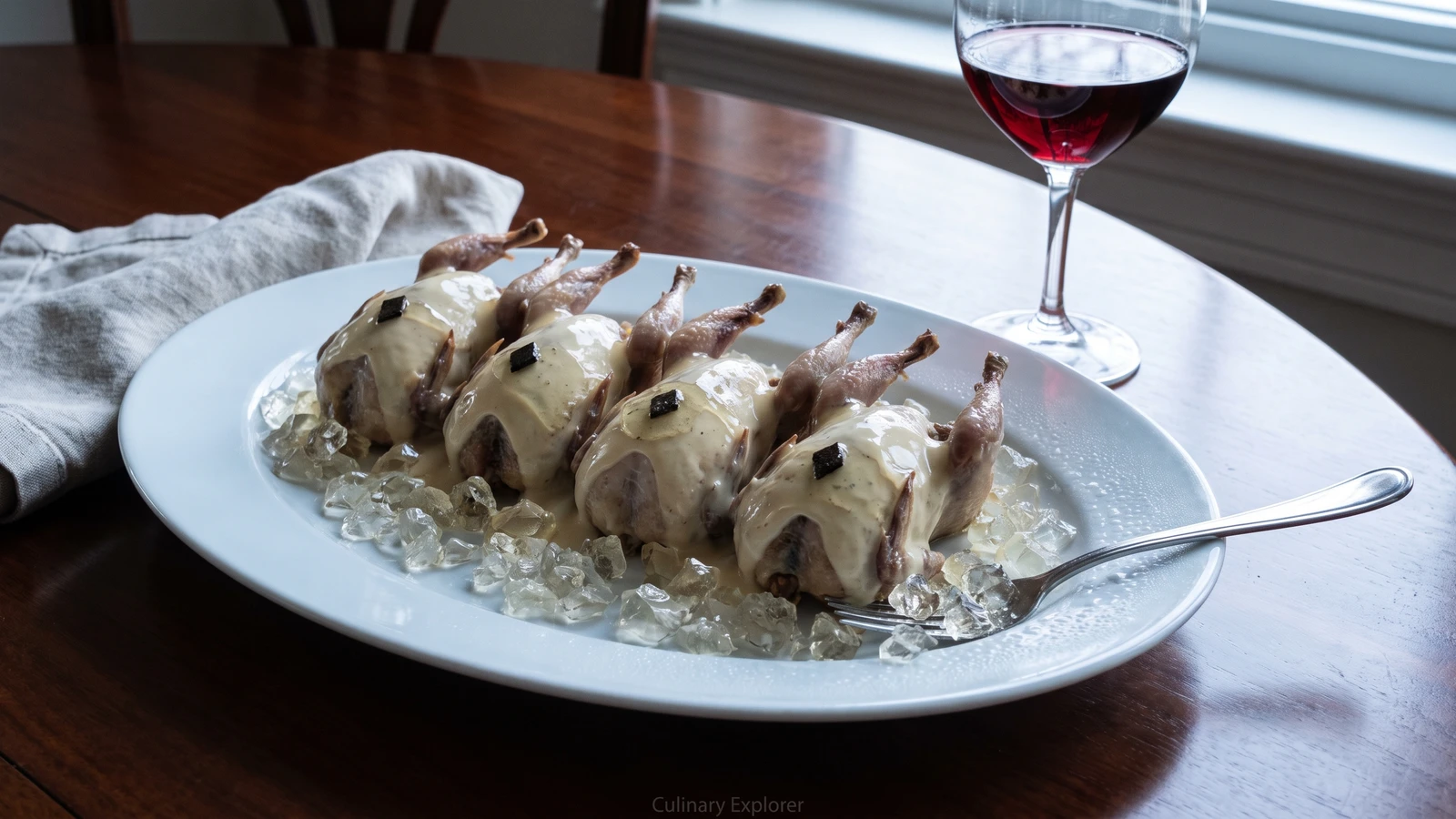
Bécasses et bécassines poached gently, cooled in their own liquor, masked with ivory sauce chaud-froid, and glazed in clear aspic. The art is patience: every cold layer must set before the next touches it.
Bécasses et Bécassines Froides (cold woodcocks and snipes) teach the governing rule of every masked cold dish: the bird must be thoroughly cold and perfectly dry before the first coating touches it. Damp skin makes sauce chaud-froid, a warm-made sauce served cold, slide away in sheets. Temperature and patience do the work here.
The entry gives no independent formula. It sends these birds directly to the cold pheasant and partridge preparations, assuming a saucier with finished sauces at hand, a stockpot never off the fire, and a garde-manger, the cold station, setting one tray while another is coated. For four servings, one aromatic cooking liquor now performs three jobs: it poaches the game, builds the sauce chaud-froid, and becomes the clear aspic. Powdered gelatin supplies the dependable set that a home stock cannot always provide. Separate brigade pots are scaffolding and go; poaching the birds, cooling them in their liquor, and setting every thin layer before the next are the dish and must stay.
When finished, each little bird sits beneath ivory sauce and crystal-clear aspic, with the dark game flavor held inside rather than buried. This is one cook, one stove, one evening's work, followed by an honest rest in the refrigerator. Before you begin, clear space for a rack and shallow chilling tray. The first coat will tell the truth about every preparation that came before it.
Bécasses et Bécassines Froides belong to the French table de chasse, with Sologne especially associated with the woodland and marsh game that supplied both birds. Although woodcock is famously roasted undrawn in another branch of the repertoire, this cold preparation follows the poaching, sauce chaud-froid, and aspic methods used for pheasant and partridge. The entry's cross-reference reveals how the classical kitchen understood game: species altered timing and intensity, but the underlying family of techniques remained the same.
Quantity
4 woodcocks, about 8 to 10 oz (225 to 285 g) each, or 8 snipes, about 3 to 4 oz (85 to 115 g) each
Quantity
2 tsp (10 ml / 12 g), plus more as needed
Quantity
1/2 tsp (2.5 ml / 1 g)
Quantity
4 tbsp (60 ml / 56 g)
divided
Quantity
1 medium (about 5 oz / 150 g)
sliced
Quantity
2 medium (about 5 oz / 150 g)
sliced
Quantity
2 stalks (about 3 1/2 oz / 100 g)
sliced
Quantity
1
Quantity
1 1/2 cups (360 ml / 355 g)
Quantity
6 cups (1.44 L / 1.44 kg)
divided
Quantity
1/4 cup (60 ml / 30 g)
Quantity
3/4 cup (180 ml / 180 g)
Quantity
5 tsp (25 ml / 15 g)
divided
Quantity
1 tbsp (15 ml / 15 g)
Quantity
2 (about 1/4 cup / 60 g)
Quantity
1 small (about 3/4 oz / 20 g)
thinly sliced
| Ingredient | Quantity |
|---|---|
| oven-ready, drawn woodcocks or snipes | 4 woodcocks, about 8 to 10 oz (225 to 285 g) each, or 8 snipes, about 3 to 4 oz (85 to 115 g) each |
| fine sea salt | 2 tsp (10 ml / 12 g), plus more as needed |
| freshly ground white pepper | 1/2 tsp (2.5 ml / 1 g) |
| unsalted butterdivided | 4 tbsp (60 ml / 56 g) |
| yellow onionsliced | 1 medium (about 5 oz / 150 g) |
| carrotssliced | 2 medium (about 5 oz / 150 g) |
| celerysliced | 2 stalks (about 3 1/2 oz / 100 g) |
| bouquet garni of parsley stems, thyme, and bay leaf | 1 |
| dry white wine | 1 1/2 cups (360 ml / 355 g) |
| unsalted chicken or light game stockdivided | 6 cups (1.44 L / 1.44 kg) |
| all-purpose flour | 1/4 cup (60 ml / 30 g) |
| heavy cream | 3/4 cup (180 ml / 180 g) |
| unflavored powdered gelatindivided | 5 tsp (25 ml / 15 g) |
| fresh lemon juice | 1 tbsp (15 ml / 15 g) |
| large egg whites | 2 (about 1/4 cup / 60 g) |
| black truffle (optional)thinly sliced | 1 small (about 3/4 oz / 20 g) |
Inspect the cavities and flesh carefully, removing pinfeathers and every visible shot fragment. Pat the birds dry, then season inside and out with half the salt and the white pepper. Tuck the wings beneath the bodies and tie the legs together loosely so each bird keeps its shape beneath the cold coating. Keep them chilled while you prepare the cuisson, the poaching liquor.
Melt 2 tbsp (30 ml / 28 g) of the butter in a snug, heavy pot over medium-low heat. Add the onion, carrots, and celery, and cook for 8 minutes without browning; the vegetables should soften and smell sweet while remaining pale. Add the bouquet garni, wine, and 5 cups (1.2 L / 1.2 kg) of the stock. Bring to a gentle simmer and cook for 15 minutes, then taste and season lightly. This liquor will be reduced later, so restraint now prevents a salty aspic.
Lower the birds into the cuisson breast-side up. The liquid should nearly cover them; add some of the remaining stock if necessary. Lay a parchment round directly on the surface and hold the liquid between 180 and 190°F (82 and 88°C), with only an occasional tremble. Poach woodcocks for 18 to 25 minutes or snipes for 10 to 15 minutes, turning once, until the thickest part of the thigh reaches 165°F (74°C). If the pot boils, lift it off the heat and add a small splash of cool stock. Ça se rattrape. A hard boil tightens these little birds before you have time to notice.
Transfer the birds to a shallow nonreactive container. Strain the hot cuisson over them, discarding the vegetables and bouquet garni, then set the container in an ice bath. Turn the birds once or twice as the liquor cools so they remain submerged and cool evenly. Refrigerate as soon as the container is no longer hot, keeping the birds in their liquor until cold throughout, at least 3 hours. Do not leave the pot cooling slowly on the counter. This immersion keeps the lean flesh moist and is one of the steps the dish cannot surrender.
Lift the cold birds from the liquor and set them on a rack over a tray. Blot them carefully, then refrigerate uncovered while you make the coatings. Skim every trace of fat from the liquor and boil it in a clean saucepan until 4 cups (960 ml / about 960 g) remain. If it reduces below that point, restore the measure with the reserved stock. Divide the cold liquor into 1 1/2 cups (360 ml / 360 g) for the sauce chaud-froid and 2 1/2 cups (600 ml / 600 g) for the aspic.
Reserve 1/4 cup (60 ml / 60 g) of the aspic liquor and sprinkle 3 tsp (15 ml / 9 g) of the gelatin over it. Leave it to bloom for 5 minutes. Whisk the egg whites into the remaining 2 1/4 cups (540 ml / 540 g) of cold liquor, then heat very slowly, stirring until the whites gather into a pale raft. Stop stirring, open a small hole in the raft, and hold the liquid at the barest simmer for 10 minutes. Ladle it through a fine sieve lined with damp cheesecloth, leaving the raft behind, then dissolve the bloomed gelatin in the hot clarified liquor. If the raft breaks, remove the pan from the heat, let everything settle, and filter twice. The aspic may lose a little brilliance, but it is not lost.
Take 2 tbsp (30 ml / 30 g) from the reserved 1 1/2 cups of cold liquor and bloom the remaining 2 tsp (10 ml / 6 g) gelatin in it. Melt the remaining 2 tbsp (30 ml / 28 g) butter in a small saucepan, stir in the flour, and cook this blond roux for 2 minutes without letting it color. Whisk in the remaining liquor little by little, then simmer for 8 minutes until smooth. Add the cream and cook gently until the sauce coats the back of a spoon in an opaque ivory layer. Remove it from the heat, stir in the bloomed gelatin and lemon juice, then strain. Taste it cold from a chilled spoon and correct the salt, since cold dulls seasoning. Cool the sauce over an ice bath, stirring, until thick but still pourable. If it sets around the edges, warm it briefly over a bain-marie, a warm-water bath, and stir it smooth. We don't apologize for butter or cream; they give the coating its flavor and supple finish.
Blot the birds once more. They must feel dry and cold, not merely cool. Leave them on the rack and spoon a thin, even layer of sauce chaud-froid over each bird, working from the breast downward and letting the excess fall onto the tray. Chill uncovered for 15 minutes, until the coating no longer marks when lightly touched, then apply a second thin coat to cover any shadows. If the sauce slides away, scrape it back into the saucepan, dry the bird again, and cool the sauce until it falls from the spoon in a heavy ribbon. Ça se rattrape. Thick layers crack; two thin layers hold.
Lay the truffle slices on the second coating while it is faintly tacky, then chill for another 10 minutes. Cool the clarified aspic over ice until it becomes lightly syrupy but remains fluid. Spoon or brush on one very thin coat, chill until set, and repeat twice, allowing each layer to firm before the next touches it. If the aspic begins setting in the bowl, stand it briefly in warm water; if it softens the sauce chaud-froid, it was too warm, so stop and rechill the birds before continuing. Pour any remaining aspic into a shallow dish and chill it for serving.
Chill the finished birds uncovered for 4 hours or overnight. Once the final glaze is firm, cover them loosely so condensation cannot fall onto the surface. Chop the reserved aspic into rough, glistening crystals and arrange it around the birds on a cold oval platter. Let the platter stand for 15 minutes before serving, then allow one woodcock or two snipes per guest. The coating should remain cool and set while the game beneath loses its refrigerator chill. À table!
1 serving (about 300g)
Culinary guides, cultural storytelling, and the editorial depth that makes cooking meaningful.
Discover Culinary ExplorerChef Juliette
John Dory has the delicacy of sole and the firmness of turbot. A light flouring, a quick butter sauté, and nut-brown beurre noisette show exactly why looks never mattered.

Chef Juliette
Fresh haddock proves its delicacy in the meunière pan: a fine flour crust, moist pearly flakes, and beurre noisette sharpened with lemon and parsley, ready from one skillet in half an hour.

Chef Juliette
Éperlans à l’Anglaise turns small fish into a lesson in disciplined coating: boned smelts under a close, crisp crumb, pan-fried in clarified butter and finished with bright, half-melted maître d’hôtel butter.

Chef Juliette
Tiny smelts, shallot, mushrooms, white wine, gratin sauce, and fine bread raspings meet a fierce oven, where the fish must turn tender in the same breath the buttered crust bronzes.