Culinary Explorer

A cooking platform built around craft, culture, and the stories behind what we eat.
Discover Culinary Explorer
Perdreau en Demi-Deuil

Perdreau en Demi-Deuil

Created by Chef Juliette

Based on No. 1865, Perdreau en Demi-Deuil, from Le Guide Culinaire (1907) by Auguste Escoffier

Black truffle beneath pale partridge skin, a butter-bound game forcemeat within, and a bare-tremble poach in fumet: half-mourning teaches that gentleness, not ceremony, keeps a grand bird succulent.

Main Dishes
French
Special Occasion
Celebration
Dinner Party
1 hr 15 min
Active Time
55 min cook2 hr 10 min total
Yield4 servings

Perdreau en demi-deuil (partridge in half-mourning) teaches one discipline above all: the fumet must barely tremble. The black truffle beneath the pale skin makes the name, but gentle poaching makes the dish; boil the bird and the lean flesh tightens while the butter forcemeat loses its fine grain.

The book assumed a poulterer to bone each breast, a cold mortar and sieve for the forcemeat, a game fumet never off the fire, and a saucier ready to reduce the poaching liquor while service moved on. Your honest equivalents are four butcher-prepared birds, a chilled food processor, prepared unsalted fumet, and a wide sauté pan that reduces quickly. The separate panada can go because the source permits a butter forcemeat; the truffle under the skin, muslin wrap, thirty-minute poach, and burnt brandy finish stay, because they are the dish. One cook, one stove, one evening.

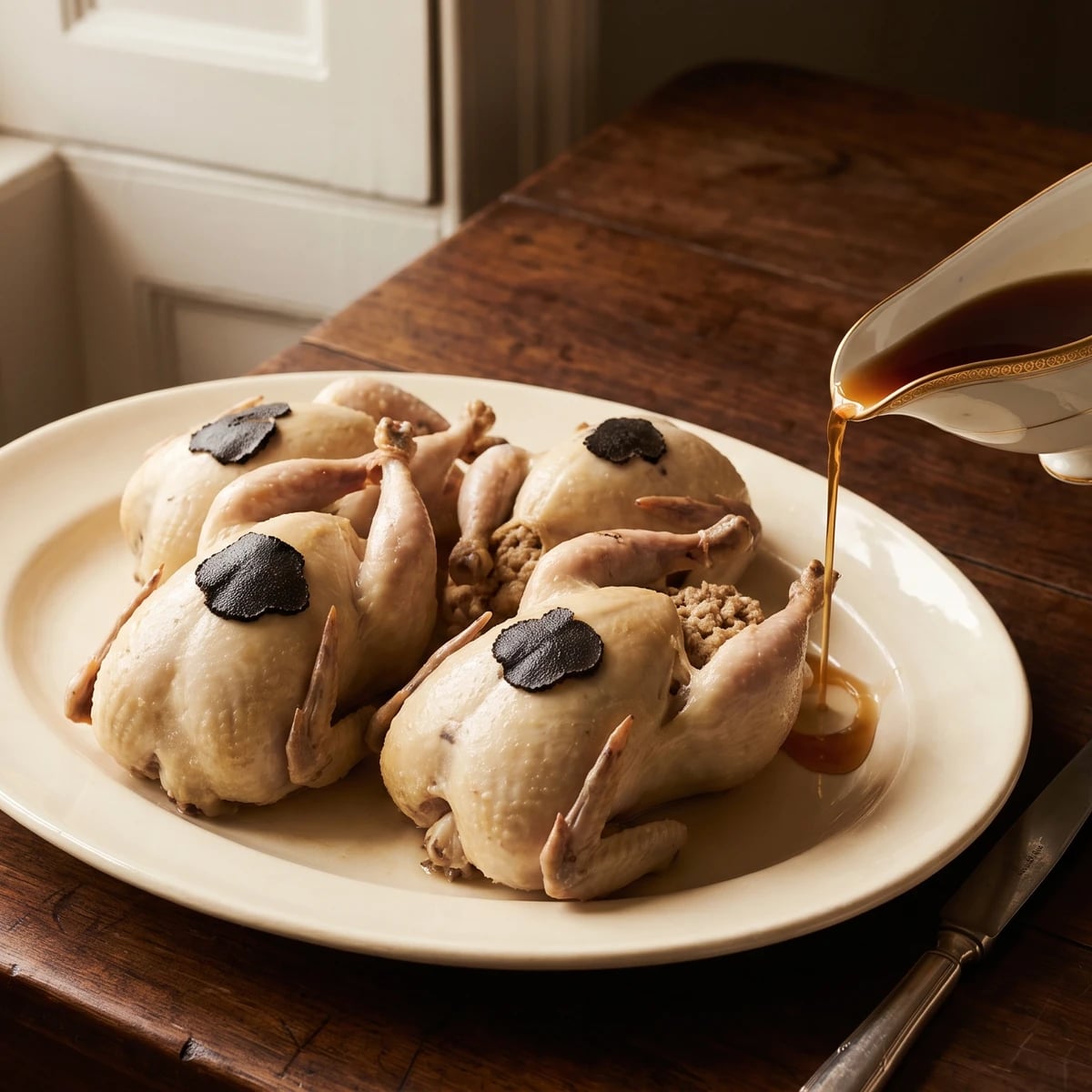
When it is right, each bird arrives pale and plump, its black truffle showing through the skin, with a fine truffled center and a clear, glossy reduction served separately. Keep the forcemeat cold while you make it, then guard that bare tremble when the birds enter the pot. That is the moment that decides everything.

Perdreau en demi-deuil belongs to the Parisian classical game table, while its best-known cousin, poularde de Bresse en demi-deuil, is rooted in Lyon and the cooking of the mères lyonnaises. Demi-deuil means half-mourning: black truffle seen through pale poultry skin suggested black worn with white, rather than full mourning. Game cooks carried the treatment to young partridge, where gentle fumet poaching protected the delicate bird from dryness.

The technique, the tradition, and the story behind every dish.

Discover Culinary Explorer

Ingredients

oven-ready young partridges

Quantity

4 birds, 12 to 14 oz (340 to 400 g) each

breastbones and rib cages removed through the cavity while the breast fillets, skin, legs, and wings remain intact

very cold boneless partridge meat

Quantity

1⅓ cups loosely packed (315 ml / 200 g)

cut into small cubes

cold unsalted butter

Quantity

6 tbsp (90 ml / 85 g)

cut into small cubes

large egg white

Quantity

1 egg white (2 tbsp / 30 ml / 30 g)

very cold

fresh black Périgord truffles

Quantity

2 to 3 truffles (about 60 g total)

scrubbed, with 1½ oz (40 g) sliced paper-thin and ¾ oz (20 g) finely minced

fine salt

Quantity

1½ tsp (7.5 ml / 9 g)

divided

finely ground white pepper

Quantity

½ tsp (2.5 ml / 1 g)

prepared unsalted game fumet

Quantity

7 cups (1.65 L / approximately 1.65 kg)

Cognac or fine French brandy

Quantity

2 tbsp (30 ml / 28 g)

Equipment Needed

  • Food processor, 7-cup or larger, with metal blade
  • 6 to 8-quart (5.7 to 7.6 L) deep oval casserole or stockpot
  • 12-inch (30 cm) wide sauté pan
  • Unbleached muslin, kitchen twine, and trussing needle
  • Fine-mesh sieve
  • Instant-read thermometer

Instructions

  1. 1

    Prepare the partridges

    Ask the game dealer to remove the wishbone, breastbone, and rib cage through each bird's cavity without cutting through the breast skin or removing the fillets. This is the poulterer's brigade labor translated honestly to the home table, not a compromise. Check the birds for bone fragments and pinfeathers, pat them dry inside and out, then keep them cold while you make the forcemeat.

    Use the smallest deep pot that will hold all four birds in one snug layer. A broad, oversized pot demands more fumet and leaves you reducing it long after the partridges should be at the table.
  2. 2

    Make the forcemeat

    Chill the food processor bowl and metal blade for ten minutes. Add the cold partridge meat, 1 teaspoon (5 ml / 6 g) of the salt, and the white pepper, then pulse until the meat forms a fine, sticky paste. Add the egg white and process just until absorbed. With the machine pulsing, add the cold butter one cube at a time, stopping as soon as the forcemeat looks smooth and satiny. Fold in the minced truffle by hand. The processor replaces the mortar and sieve the brigade used; the separate sieving is scaffolding and can go, but the cold emulsion cannot.

    If the butter begins to smear or the paste looks greasy, stop immediately and chill the bowl for ten minutes before continuing. Warm forcemeat separates; cold forcemeat binds.
  3. 3

    Test and chill

    Warm 1 cup (240 ml / approximately 240 g) of the measured fumet to a bare tremble in a small saucepan. Poach a teaspoon of forcemeat for three minutes, then cut and taste it. It should be finely grained, succulent, and gently springy. If it is dense, pulse 1 tablespoon (15 ml / approximately 15 g) of cold fumet into the mixture; if it is loose, chill it for fifteen minutes before testing again. Strain the testing fumet back into the remaining fumet, then refrigerate the finished forcemeat for twenty minutes.

  4. 4

    Slip in truffles

    Working from the neck and cavity openings, slide a finger or the rounded handle of a teaspoon beneath the skin to loosen it from each breast fillet without piercing it. Lay the thin truffle slices flat against the flesh, covering each fillet with a few distinct black pieces and keeping them in a single layer. Smooth the skin back over them. If the skin tears, close the spot with one loose stitch of fine kitchen twine; ça se rattrape, and the muslin will support it during poaching.

  5. 5

    Stuff and wrap

    Divide the cold forcemeat into four equal portions and spoon one portion into each boned breast cavity, filling it evenly without packing it hard. Sprinkle the remaining ½ teaspoon (2.5 ml / 3 g) salt over the birds. Truss each as for an entrée: close the cavity, draw the legs neatly against the body, and tuck the wings beneath. Wrap each bird closely in a single layer of clean, dampened muslin and secure it with two or three loops of twine. The wrapping holds the truffle against the breast and preserves the bird's plump shape, so this step stays.

  6. 6

    Poach at a tremble

    Heat the fumet in the snug deep pot to 180 to 185°F (82 to 85°C), when the surface barely moves and only a few lazy bubbles appear at the edge. Lower in the wrapped partridges, breast-side up; the fumet should cover them. Lay a parchment cartouche directly on the liquid if the upper curves rise slightly above it. Poach for thirty minutes without boiling, turning the birds once only if they are not completely submerged. If the bubbles begin racing, pull the pot off the burner, add a small ladle of cool fumet from the surface, and return it over gentler heat. Cook until the center of the forcemeat reaches 165°F (74°C); if it falls short, continue for three to five minutes.

  7. 7

    Reduce the fumet

    Lift the birds onto a warm tray and leave them wrapped while the sauce is made. Strain the poaching fumet through a fine sieve into the widest sauté pan you own, skim away excess fat, and boil it briskly until about 2 cups (475 ml / approximately 475 g) remain. It should taste concentrated and clean, with enough body to slick a spoon lightly but no syrupy stickiness. If it becomes salty before gaining body, stop reducing and dilute it with a little hot unsalted fumet or water; serving a lighter reduction is better than forcing a harsh one.

  8. 8

    Burn the brandy

    Pour the Cognac into a small pan, never directly from the bottle near a flame. Warm it, pull the pan away from the burner, keep a lid beside you, and ignite the Cognac with a long match. Let the flame die completely, then stir the burnt brandy into the reduced fumet. If an open flame is unsafe in your kitchen, boil the Cognac briskly for one minute instead; removing its raw alcoholic edge is the intent. The 2 tablespoons are the home measure for the book's liqueur-glassful.

  9. 9

    Unwrap and serve

    Remove the muslin and every piece of twine from the partridges, handling the pale skin gently so the truffle pattern stays intact. Arrange the birds on a warmed oval platter and carry the reduced fumet separately in a warm sauceboat, exactly as the source directs. Give each guest a whole partridge and spoon the glossy fumet around it at the table. À table!

Chef Tips

  • Order the partridges and extra boneless partridge meat from a game dealer in advance. Ask for the breastbones and rib cages to be removed through the cavities with the skin left whole; the exact instruction saves an argument at the counter and an hour at the cutting board.
  • Fresh black Périgord truffle gives the clearest perfume and the strongest half-mourning pattern. Outside its season, whole black truffles preserved in their own juice are the classical pantry's honest answer; drain them well and expect a softer aroma. Truffle oil cannot do this work.
  • The fumet must be unsalted or only faintly seasoned because it is reduced after poaching. A salty stock becomes punishing before it develops enough body, and no amount of ceremony rescues that.
  • Keep the forcemeat ingredients and processor cold. Butter, not margarine. The butter carries the partridge flavor and gives the filling its tenderness, while a substitute leaves a greasy paste.
  • Serve a mature red Burgundy with enough delicacy for the partridge and enough earthiness for the truffle. Potatoes cooked simply in butter make a better companion than an elaborate garnish; the bird already has plenty to say.

Advance Preparation

  • Prepare or acquire the unsalted game fumet up to three days ahead and refrigerate it, or freeze it for up to two months. Bring it back to a bare tremble before poaching.
  • The game dealer can bone the birds one day ahead. Keep them well wrapped in the coldest part of the refrigerator and use the bones for another batch of fumet.
  • The forcemeat can be made and the birds truffled, stuffed, trussed, and wrapped up to four hours ahead. Refrigerate them immediately and keep them cold until the fumet is ready.
  • Do not poach the partridges ahead if you can avoid it. Reheating tightens the lean breast and dulls the truffle; this is a dish to assemble early and poach for the table.

Frequently Asked Questions

Nutrition Information

1 serving (about 290g)

Calories
520 calories
Total Fat
28 g
Saturated Fat
14 g
Trans Fat
1 g
Unsaturated Fat
12 g
Cholesterol
220 mg
Sodium
1070 mg
Total Carbohydrates
3 g
Dietary Fiber
1 g
Sugars
0 g
Protein
64 g

Note: Chef personas and recipes are created with AI assistance. Cook with care: follow safe food-handling practices, check doneness with a thermometer when needed, and adapt for allergies and your kitchen.

Where cooking meets culture.

Culinary guides, cultural storytelling, and the editorial depth that makes cooking meaningful.

Discover Culinary Explorer

More from Poultry (Volaille) - Partridge (Perdrix et Perdreaux)

Browse the full collection