Culinary Explorer

A cooking platform built around craft, culture, and the stories behind what we eat.
Discover Culinary Explorer
Terrine de Faisan

Terrine de Faisan

Created by Chef Juliette

Based on No. 1863, Terrine de Faisan, from Le Guide Culinaire (1907) by Auguste Escoffier

Terrine de Faisan follows the hare terrine's grammar with tenderer game: bake it more briefly, trust the clear fat at the surface, then press it cold for generous, clean slices.

Main Dishes
French
Make Ahead
Picnic
Dinner Party
15 min
Active Time
1 hr 15 min cook14 hr total
Yield4 servings

Terrine de Faisan (pheasant pâté baked without a crust) teaches the surest lesson in game cookery: tenderness changes the clock, but doneness still declares itself. Before you touch the oven, know the sign. The fat rising to the surface must be clear. While it remains turbid, raw juices are still leaving the forcemeat and the terrine is not cooked.

The original assumed Terrine de Lièvre (No. 1825) already stood in the cook's repertoire, aspic waited beside a stockpot that never went cold, and an experienced hand could judge the centre with a heated needle. At home, use that referenced preparation as the book intends, exchange pheasant for hare, and scale it evenly into one small lidded terrine. A roasting tin becomes the bain-marie, a thin skewer preserves the old test, and an instant-read thermometer confirms it safely. The greater-pressure unmolding, aspic casing, and jelly croûtons are presentation scaffolding, so they can go. The bacon-lined layers, gentle water bath, clear-fat test, tepid aspic, and slight pressure stay. They are the dish.

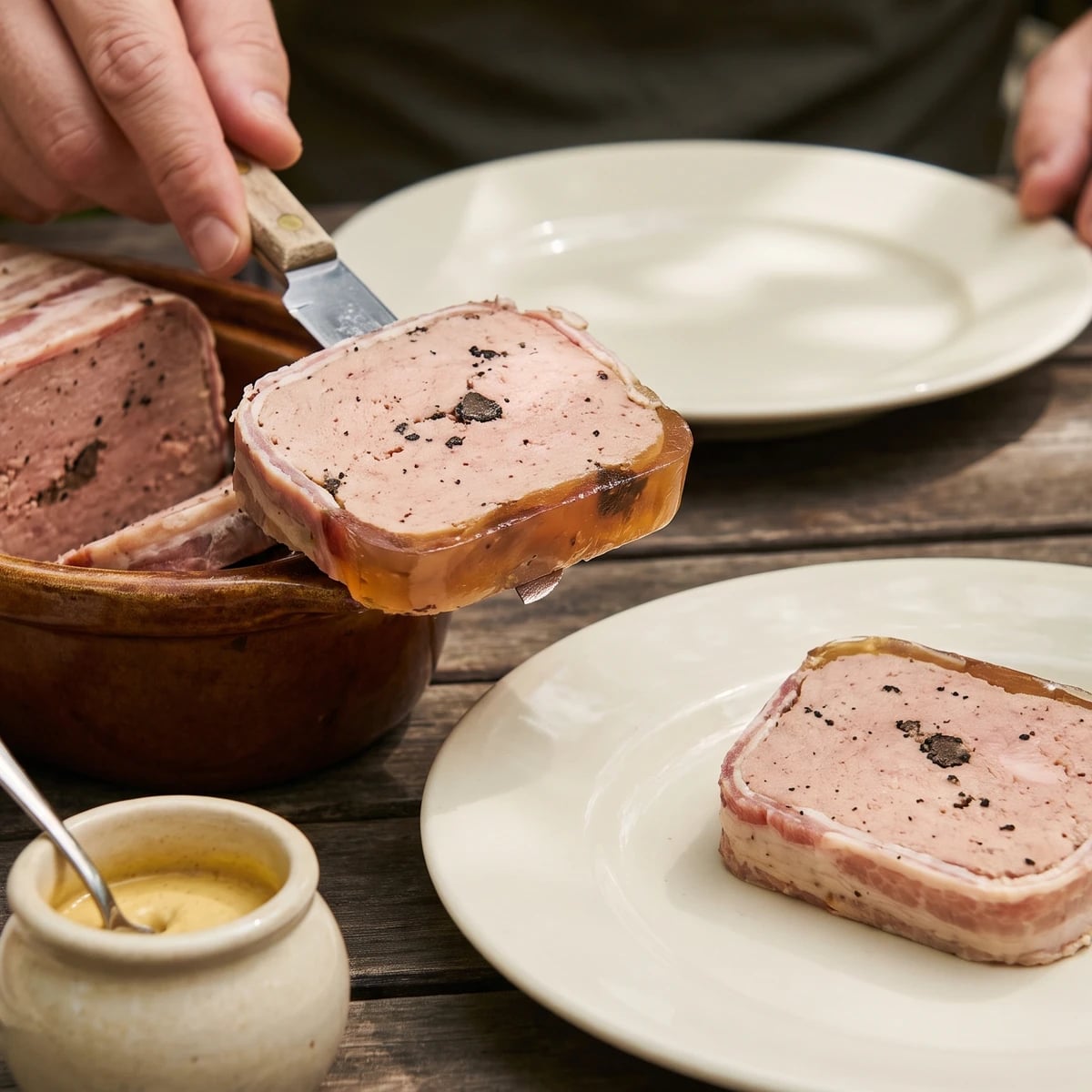
Once cold, the terrine should cut into close, generous slices, tender pheasant held among forcemeat, bacon, and truffle, with clear aspic settling into the small spaces. Watch the fat rather than the clock. That is the one step that decides everything.

Terrines de gibier belong to the game tables of Sologne, Burgundy, and the hunting country around Île-de-France, where hare and pheasant were layered with forcemeat, bacon, and truffles in covered earthenware vessels. The form traveled between estate larders, bourgeois dining rooms, and the grand kitchen; terrine came to mean both the vessel and the crustless preparation cooked inside it. Terrine de Faisan is deliberately tied to Terrine de Lièvre (No. 1825): the classical change is pheasant for hare and a shorter cooking time for the tenderer meat, not a newly invented seasoning.

The technique, the tradition, and the story behind every dish.

Discover Culinary Explorer

Ingredients

Terrine de Lièvre preparation assembled with pheasant

Quantity

1 home-scale batch Terrine de Lièvre (No. 1825)

Scale evenly to an 850 ml / 1½-pint terrine and replace the hare fillets with 1 boned pheasant weighing 2½ to 3 lb (1.1 to 1.4 kg); assemble but do not cook

clear meat aspic jelly

Quantity

½ cup (120 ml / 120 g)

melted and cooled until tepid

Equipment Needed

  • 850 ml / 1½-pint lidded terrine
  • Deep roasting tin for the bain-marie
  • Thin metal skewer
  • Instant-read thermometer
  • Flat board cut to fit inside the terrine, plus a 1 to 1½ lb (500 to 750 g) weight

Instructions

  1. 1

    Make the substitution

    Prepare Terrine de Lièvre (No. 1825) exactly as its own entry directs, scaling every part evenly for an 850 ml / 1½-pint terrine. Replace only the hare fillets with the breast and leg meat from one boned pheasant, cut into even strips; keep the referenced forcemeat, bacon, truffles, seasonings, lining, and layering unchanged. Pheasant is tenderer and leaner than hare, which changes the cooking time but not the method. Pack the layers firmly enough to exclude large air pockets, cover with the final bacon slice, season its centre as directed, and put on the lid.

  2. 2

    Prepare the bain-marie

    Heat the oven to 325°F (160°C). Set the covered terrine in a deep roasting tin and pour recently boiled water around it to come about one-third of the way up the sides. This bain-marie, a gentle water bath, softens the oven's heat so the forcemeat cooks evenly rather than tightening at the edges before the centre is ready. Keep the water below the lid so none can enter the terrine.

  3. 3

    Bake until clear

    Bake for 50 minutes, then uncover and inspect the fat gathered at the surface. Continue cooking in 8 to 10 minute intervals until that fat is clear rather than milky or turbid, a thin skewer inserted into the dense centre withdraws evenly hot along its length, and an instant-read thermometer registers 165°F (74°C). Expect about 60 to 75 minutes altogether, appreciably shorter than the hare preparation. Remove it promptly once all three signs agree; pheasant has no profit in extra cooking.

    If the fat remains turbid, the terrine is simply not there yet. Ça se rattrape: replace the lid, top up the bain-marie with boiling water if needed, and return it for another 8 minutes before testing again. Clear fat, not a hopeful clock, gives the verdict.
  4. 4

    Add the aspic

    Lift the terrine from the water and leave it covered until just tepid, about 30 minutes. Pour the tepid aspic slowly around the inner edges, pausing as it settles into the spaces left by the contracting meat. If the aspic immediately melts into the hot juices, stop and wait another 10 minutes before continuing. Set parchment over the surface, add a flat board cut to fit inside the rim, and weight it lightly with 1 to 1½ lb (500 to 750 g). Heavy pressure belongs to a terrine intended for elaborate unmolding; slight pressure gives clean slices without squeezing out their succulence.

  5. 5

    Chill under pressure

    Refrigerate the weighted terrine for at least 12 hours. Keep it at 40°F (4°C) or colder, and do not leave cooked poultry cooling at room temperature for more than 2 hours in total. The cold sets the aspic and fat, closes the texture, and lets the truffle and game settle into the forcemeat. This waiting is part of the preparation, not an ornament.

  6. 6

    Trim and serve

    Remove the weight and clear away any thick cap of set grease, leaving the bacon lining intact. Serve directly from the terrine, cutting thick slices with a sharp knife dipped in hot water and wiped dry between cuts. The slice should hold cleanly while remaining tender, with clear aspic visible at its edges. Bring good bread, cornichons, and Dijon mustard to the table. À table!

Chef Tips

  • The referenced preparation governs the forcemeat, bacon, truffles, seasonings, and layering. Change only the game and the cooking allowance. C'est la même grammaire, and rewriting the garnish would make a different terrine.
  • For an out-of-season truffle, use the preserved truffle specified by the classical pantry rather than a tired fresh one. Drain it well before it enters the referenced preparation.
  • With a wild pheasant, check every piece carefully for shot and torn bone. Keep the meat and forcemeat cold while assembling; if the fat begins to smear, refrigerate everything for 20 minutes before continuing.
  • The original needle test survives beautifully as a thin metal skewer, but the thermometer removes guesswork. Clear fat and 165°F (74°C) at the centre should agree.
  • The old keeping method sealed the terrine beneath lard. Reliable refrigeration is the honest home equivalent: keep it covered at 40°F (4°C) or colder and eat it within 3 days.
  • A light red Burgundy or a cru Beaujolais suits the pheasant and truffle without flattening them. Serve the terrine cool rather than numb from the refrigerator, allowing it 15 minutes on the table before slicing.

Advance Preparation

  • The time fields begin once the home-scale Terrine de Lièvre (No. 1825) preparation has been assembled with pheasant, since the book keeps that referenced formula in its own entry.
  • Bake and press the terrine 1 or 2 days before serving. Its texture becomes closer and its seasoning more settled after a full night in the refrigerator.
  • For a picnic, leave the terrine whole, transport it below 40°F (4°C) in an insulated cooler, and slice it only when the table is ready.

Frequently Asked Questions

Nutrition Information

1 serving (about 225g)

Calories
545 calories
Total Fat
40 g
Saturated Fat
14 g
Trans Fat
0 g
Unsaturated Fat
24 g
Cholesterol
190 mg
Sodium
1450 mg
Total Carbohydrates
3 g
Dietary Fiber
0 g
Sugars
1 g
Protein
43 g

Note: Chef personas and recipes are created with AI assistance. Cook with care: follow safe food-handling practices, check doneness with a thermometer when needed, and adapt for allergies and your kitchen.

Where cooking meets culture.

Culinary guides, cultural storytelling, and the editorial depth that makes cooking meaningful.

Discover Culinary Explorer

More from Poultry (Volaille) - Venison and Ground Game

Browse the full collection