
Chef Juliette
Selle de Chevreuil et Cuissot
Selle de Chevreuil et Cuissot teaches the discipline of game: strip every tendon, skip marinade for a young, well-hung joint, roast in butter, and stop before leanness turns to dryness.
A cooking platform built around craft, culture, and the stories behind what we eat.
Created by Chef Juliette
Based on No. 1853, Chaud-froid de Faisan, from Le Guide Culinaire (1907) by Auguste Escoffier
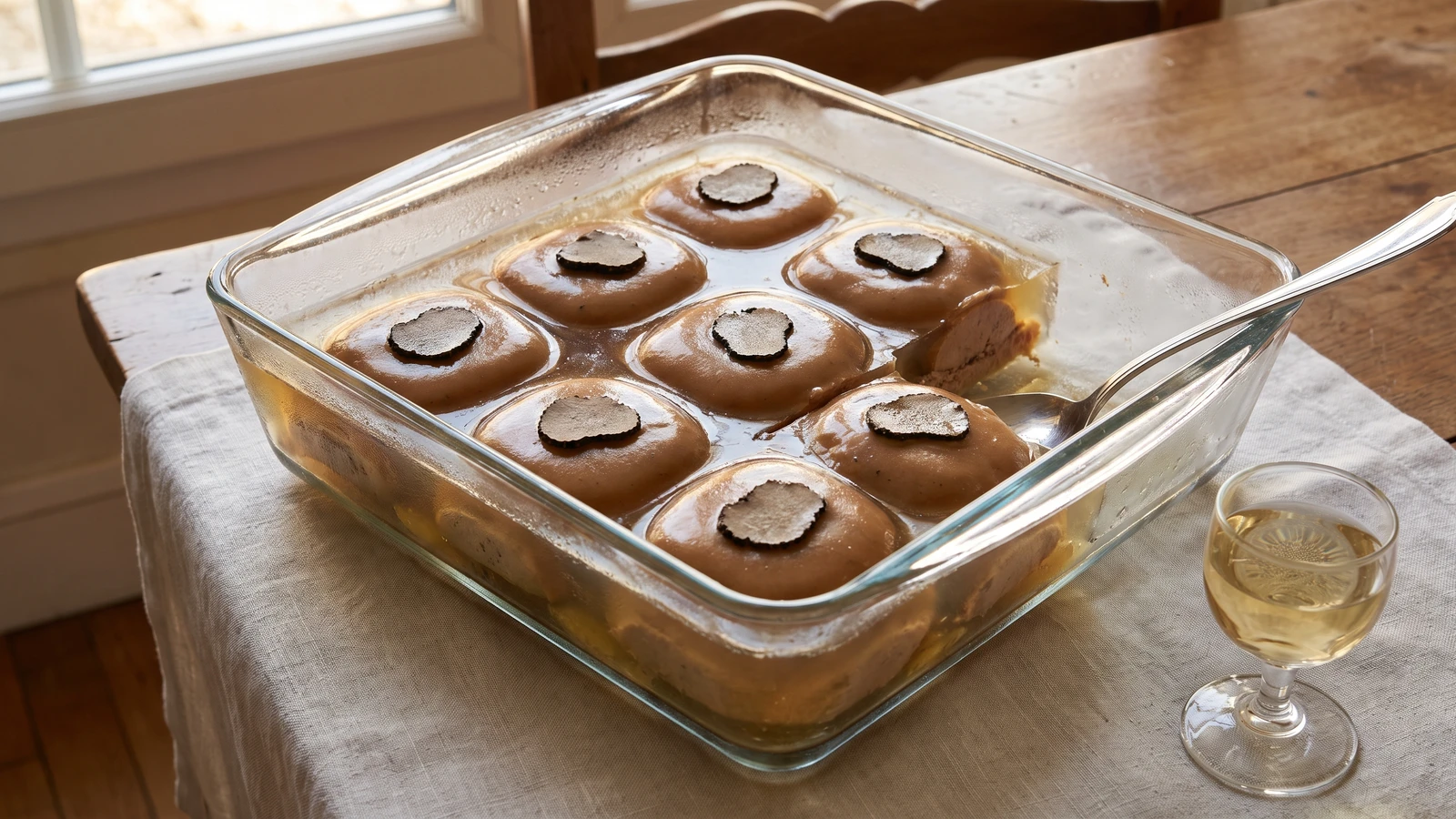
Cold poached pheasant, a brown chaud-froid sauce deepened with its own fumet, black truffle, and trembling aspic: an exacting make-ahead centerpiece whose success rests on coating while the sauce still flows.
Chaud-froid de faisan (cold glazed pheasant) teaches control at the narrow point between liquid and set. The sauce must be cool enough to cling, yet fluid enough to level itself over the cold meat. Coat too soon and it slides off; wait too long and it sets in ridges. That small window is the dish.
The original assumed a saucier on staff, clear aspic ready in the cold room, and a pot of game stock never off the fire. The salamander can stay dark here. At home, the pheasant's poaching liquor supplies the aspic, its browned carcass becomes fumet, the concentrated essence drawn from game, and weighed gelatin gives a tender rather than rubbery set. One cook, one stove, one evening.
Bread cushions, stearine stands, cocks' combs, and blocks of carved ice were service scaffolding, so they go. The poaching, cooling in liquor, skinning, brown sauce scented with the bird, truffle decoration, and delicate aspic must stay because they are the chaud-froid itself. Watch the sauce rather than the clock: coating while it still flows is the step that decides everything.
Chaud-froid belongs to the Parisian grand kitchen's cold buffet, where cooked poultry and game were coated, decorated, and held under clear aspic for formal service. The pheasant version carries the fowl method into game cookery, replacing a pale poultry sauce with a brown chaud-froid scented by fumet drawn from the bird itself; despite the name, it is prepared hot on purpose and served cold, not made from accidental leftovers. Bread or rice cushions, cocks' combs, stearine stands, and carved ice were display engineering, while the poached pheasant, truffle, brown coating, and delicate aspic remain the edible grammar.
Quantity
1 bird (2½ to 3 lb / 1.1 to 1.4 kg)
giblets removed; neck and gizzard reserved if present
Quantity
2 teaspoons (10 ml / 12 g), plus more to season
divided
Quantity
9 cups (2.1 liters / 2.1 kg)
Quantity
1 large (about 1½ cups / 200 g)
quartered and divided
Quantity
2 medium (about 1 cup / 140 g)
cut into chunks and divided
Quantity
2 stalks (about 1 cup / 120 g)
cut into chunks and divided
Quantity
1
Quantity
3 tablespoons (45 ml / 42 g)
divided
Quantity
3 tablespoons (45 ml / 24 g)
Quantity
7 teaspoons (35 ml / 20 g)
divide 5¼ teaspoons (15 g) for the aspic and 1¾ teaspoons (5 g) for the sauce
Quantity
2 (¼ cup / 60 ml / 60 g)
lightly beaten
Quantity
1 small (about ¾ oz / 20 g)
drained and cut into 8 very thin slices
Quantity
¼ teaspoon (1.25 ml / 0.6 g), plus more to season
Quantity
1 method Poularde en Chaud-froid (No. 1689)
used whole, with pheasant and brown chaud-froid sauce
| Ingredient | Quantity |
|---|---|
| oven-ready pheasantgiblets removed; neck and gizzard reserved if present | 1 bird (2½ to 3 lb / 1.1 to 1.4 kg) |
| fine sea saltdivided | 2 teaspoons (10 ml / 12 g), plus more to season |
| cold water | 9 cups (2.1 liters / 2.1 kg) |
| yellow onionquartered and divided | 1 large (about 1½ cups / 200 g) |
| carrotscut into chunks and divided | 2 medium (about 1 cup / 140 g) |
| celerycut into chunks and divided | 2 stalks (about 1 cup / 120 g) |
| bouquet garni of parsley stems, thyme, and bay leaf | 1 |
| unsalted butterdivided | 3 tablespoons (45 ml / 42 g) |
| all-purpose flour | 3 tablespoons (45 ml / 24 g) |
| unflavored powdered gelatindivide 5¼ teaspoons (15 g) for the aspic and 1¾ teaspoons (5 g) for the sauce | 7 teaspoons (35 ml / 20 g) |
| large egg whiteslightly beaten | 2 (¼ cup / 60 ml / 60 g) |
| preserved black truffledrained and cut into 8 very thin slices | 1 small (about ¾ oz / 20 g) |
| ground white pepper | ¼ teaspoon (1.25 ml / 0.6 g), plus more to season |
| coating, decoration, and dishing frameworkused whole, with pheasant and brown chaud-froid sauce | 1 method Poularde en Chaud-froid (No. 1689) |
Season the pheasant inside and out with half the salt. Set it in a snug 5-quart pot with half the onion, carrots, and celery, the bouquet garni, and the cold water; the bird should be just covered. Bring the liquid up slowly, skimming away the grey foam, then hold it at a bare tremble between 180 and 190°F (82 and 88°C). Never let it boil. Poach for 35 to 50 minutes, turning once if the bird floats, until both the thickest breast and inner thigh register 165°F (74°C).
Take the pot off the heat and leave the pheasant in its liquor for 15 minutes. Transfer the bird to a snug shallow container, strain enough liquor over it to cover, and divide the remainder between shallow containers. Set them in ice baths, stir the exposed liquor frequently, and replace the ice as it melts. Chill below 70°F (21°C) within 2 hours and to 40°F (4°C) within another 2 hours, then refrigerate. Cooling in the liquor protects the meat; leaving a deep hot pot on the counter does not.
Lift the cold pheasant from the liquor and dry it. Remove each leg, separate thighs from drumsticks, take off both breasts, and cut each breast across into two neat portions, giving 8 pieces. Strip away every scrap of skin and refrigerate the meat, covered. Chop the wings and carcass into several pieces. Melt 1 tablespoon (15 ml / 14 g) butter in a wide saucepan and brown the bones, wings, neck, and gizzard well; leave out the liver. Add the remaining onion, carrots, and celery and let their edges color. Pour in 3 cups (720 ml / 720 g) strained poaching liquor, scrape up the browned fond, and simmer gently for 30 minutes. Strain, pressing lightly, then reduce to 1¾ cups (420 ml / 420 g). Reserve 2 tablespoons (30 ml / 30 g) in the cold and keep the rest hot. This concentrated liquor is the pheasant fumet.
Measure 4½ cups (1.05 liters / 1.05 kg) cold, defatted poaching liquor into a clean saucepan. Stir in the lightly beaten egg whites, then heat very slowly while scraping the bottom until the whites gather into a raft at the surface. Stop stirring, open a small hole in the raft, and hold the liquor at the faintest simmer for 15 minutes. Ladle it through a damp fine cloth without pressing. Cool ½ cup (120 ml / 120 g) of the clarified liquor, sprinkle over 5¼ teaspoons (26 ml / 15 g) gelatin, and leave it for 5 minutes. Dissolve this bloom in the remaining warm liquor, then season slightly more boldly than seems necessary with salt and white pepper because cold mutes both. Pour 1 cup (240 ml / 240 g) into a deep 8-inch (20 cm) square serving dish and chill until set. Keep the remaining aspic fluid over cool water.
Sprinkle the remaining 1¾ teaspoons (9 ml / 5 g) gelatin over the reserved 2 tablespoons (30 ml / 30 g) cold fumet and leave it to bloom. Melt the remaining 2 tablespoons (30 ml / 28 g) butter in a saucepan, add the flour, and cook this roux over medium-low heat until it reaches a deep hazelnut brown and smells toasted, not burnt. Whisk in the hot fumet a little at a time, keeping the sauce smooth, then simmer gently for 10 to 15 minutes until about 1¼ cups (300 ml / 300 g) remain. It should be nappant, thick enough to coat the back of a spoon. Take it off the heat, whisk in the bloomed gelatin, pass it through a fine sieve, and stir over an ice bath until it cools to about 88 to 92°F (31 to 33°C) and falls from the spoon in a broad, level ribbon.
Use Poularde en Chaud-froid (No. 1689) whole as the coating, truffle decoration, cold-jelly glaze, and deep-dish aspic framework, substituting only the pheasant pieces and the brown chaud-froid sauce. Pat each chilled piece absolutely dry, dip it in the flowing sauce, and lift it onto a rack over a tray. Spoon a little sauce over any bare patch before the coating sets. Place one fine truffle slice on each tacky piece and chill for 10 minutes. Brush each piece lightly with cold but still-fluid aspic, then arrange them side by side on the set aspic base. Bring the remaining aspic to the half-melted stage, fluid but beginning to thicken like loose egg white, and pour it slowly down the side of the dish, around and finally over the pheasant. If the brown coating begins to loosen, the aspic is too warm; stop, chill it for several minutes, and continue only when it thickens.
Chill the dish uncovered for 30 minutes so the surface sets cleanly, then cover without touching the aspic and refrigerate for at least 3 hours. Bring it to the table directly in its deep dish and serve it cool, cutting through the aspic around each portion with a warm, dry knife. A carved ice block adds nothing at home; if the chaud-froid must wait on a buffet, nest the dish in crushed ice and keep it there for no longer than 2 hours. À table!
1 serving (about 350g)
Culinary guides, cultural storytelling, and the editorial depth that makes cooking meaningful.
Discover Culinary ExplorerChef Juliette
Selle de Chevreuil et Cuissot teaches the discipline of game: strip every tendon, skip marinade for a young, well-hung joint, roast in butter, and stop before leanness turns to dryness.

Chef Juliette
A three-day marinade perfumes this lean saddle, but the roast lives or dies by its rosy center; the tray fond, cream, meat glaze, and one juniper berry make the sauce.

Chef Juliette
A butter-poêled venison saddle, carved rosy and flanked by unsweetened pears scented with cinnamon and lemon, with clear game jus and redcurrant jelly at the table.

Chef Juliette
Verjuice perfumes rather than pickles this saddle, while a thermometer protects its rosy centre. Poivrade and red-currant jelly meet in strict equality, with semi-candied cherries folded through for the generous game table.