
Chef Juliette
John Dory (St. Pierre)
John Dory has the delicacy of sole and the firmness of turbot. A light flouring, a quick butter sauté, and nut-brown beurre noisette show exactly why looks never mattered.
A cooking platform built around craft, culture, and the stories behind what we eat.
Created by Chef Juliette
Based on No. 1832, Faisan en Casserole, from Le Guide Culinaire (1907) by Auguste Escoffier
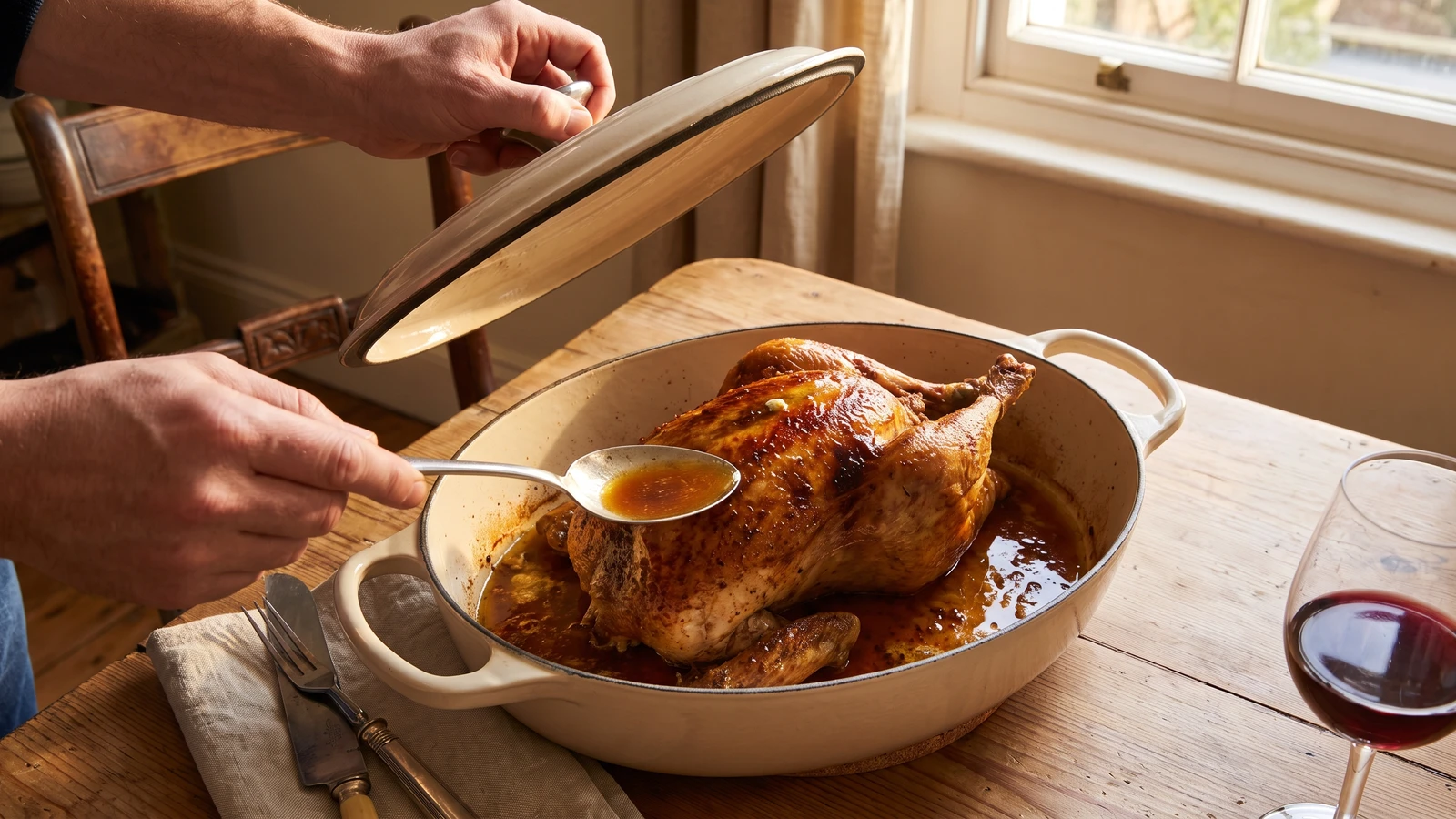
A whole pheasant poêlé gently in butter, bronzed uncovered, and finished with brandy and game gravy: lean game kept succulent by basting, a snug casserole, and exact timing.
Faisan en casserole (pheasant butter-roasted in a covered casserole) teaches the true purpose of poêlé cooking: protect a lean bird with butter and gentle enclosed heat, then give it colour only at the end. The one true thing to know before touching a pan is that pheasant has very little fat and no patience for careless timing. Butter protects it, but cannot rescue it once roasted dry.
The original expected a saucier within calling distance, concentrated game gravy beside a stockpot that never left the fire, and a salamander ready if the colour lagged. At home, one snug flameproof casserole, a measured spoonful of prepared game gravy, an instant-read thermometer, and a final uncovered burst in an ordinary oven do the work. The entry was already built around one bird, so its proper home scale remains one pheasant for four when served with generous accompaniments. One cook, one stove, one evening.
The general Poëlings (No. 250), butter-roasting, could involve matignon, fat wrapping, paper, and a separate sauceboat for larger poultry. In this special en casserole formula, those are brigade scaffolding and come out by design. Cooking in butter alone and swilling the casserole with brandy and game gravy are the dish, so they stay. Watch the thermometer, not the clock. That is the step deciding whether the pheasant reaches the table succulent and burning hot.
Faisan en casserole belongs to the Parisian classical dining room and the bourgeois game table, where a whole pheasant could be cooked and presented in the same handsome vessel. In classical practice, en casserole meant a butter poêling without the vegetable garnish generally associated with en cocotte. Despite its English rendering, this is not a wet stew: the bird roasts without added liquid, and its scant jus is built only after cooking.
Quantity
1 (about 2½ to 3 pounds / 1.1 to 1.4 kg)
Quantity
1 teaspoon (5 ml / 6 g)
Quantity
½ teaspoon (2.5 ml / 1 g)
Quantity
6 tablespoons (90 ml / 85 g), divided, for Poëlings (No. 250)
Quantity
1 teaspoon (5 ml / 5 g)
Quantity
1 tablespoon (15 ml / 15 g), preferably unsalted
Alternatively, reduce ½ cup (120 ml / 120 g) low-sodium chicken stock to 1 tablespoon
| Ingredient | Quantity |
|---|---|
| oven-ready young pheasant | 1 (about 2½ to 3 pounds / 1.1 to 1.4 kg) |
| fine sea salt | 1 teaspoon (5 ml / 6 g) |
| freshly ground black pepper | ½ teaspoon (2.5 ml / 1 g) |
| unsalted butter | 6 tablespoons (90 ml / 85 g), divided, for Poëlings (No. 250) |
| brandy | 1 teaspoon (5 ml / 5 g) |
| concentrated game gravyAlternatively, reduce ½ cup (120 ml / 120 g) low-sodium chicken stock to 1 tablespoon | 1 tablespoon (15 ml / 15 g), preferably unsalted |
Heat the oven to 325°F (165°C), with a rack in the centre. If using the chicken-stock alternative, boil it in a small saucepan until exactly 1 tablespoon remains, then reserve it. Check the pheasant cavity, pat the bird thoroughly dry, tuck the wing tips underneath, and tie the legs together without pulling them tightly against the breast. Season inside and out with the salt and pepper, then rub 1 tablespoon of the butter over the skin.
Melt 4 tablespoons of the butter over gentle heat in a heavy flameproof casserole just large enough to hold the pheasant. Set the bird breast-side up in the butter and spoon the melted butter over it. Cover tightly and place it in the oven for 20 minutes, then uncover briefly, baste every exposed surface, cover again, and cook for another 15 minutes. This is the pheasant's application of Poëlings (No. 250): butter is the cooking medium, and no stock, wine, or vegetables go into the casserole while the bird roasts.
After about 35 minutes, insert an instant-read thermometer into the thickest part of the breast and the inner thigh without touching bone. Once the breast is near 150°F (66°C), baste again, uncover the casserole, and raise the oven to 425°F (220°C). Roast for 8 to 12 minutes, basting once, until the skin is a deep butter-gold and both test points reach 165°F (74°C). Most birds of this size need 45 to 55 minutes in all, but the thermometer governs. If the bird is cooked before it has enough colour, brush it with butter and place it under a fully heated broiler for 30 to 60 seconds, watching without looking away. That is your salamander; don't dry the pheasant merely to improve its complexion.
Lift the pheasant onto a warm plate while you finish the jus. Pour the excess butter into a heatproof bowl, leaving about 1 tablespoon and every browned cooking deposit in the casserole. Take the casserole off the heat before adding the brandy, then return it to medium heat and swill it around the base, scraping gently for 20 to 30 seconds until its sharp alcoholic smell softens. Add brandy from a measured spoon, never directly from the bottle.
Add the concentrated game gravy and swill it through the butter and fond, simmering for only 1 to 2 minutes. This is a short, intense jus, not a moat of sauce. If it looks greasy, tilt the casserole and spoon away the clear butter floating at the edge while preserving the glossy sheen; if it tightens before the fond releases, loosen it with 1 teaspoon of water. Return the pheasant and its resting juices to the casserole, spoon the jus over it, cover, and warm over the lowest heat for 1 minute without boiling. Carry the covered casserole straight to the table. À table!
1 serving (about 150g)
Culinary guides, cultural storytelling, and the editorial depth that makes cooking meaningful.
Discover Culinary ExplorerChef Juliette
John Dory has the delicacy of sole and the firmness of turbot. A light flouring, a quick butter sauté, and nut-brown beurre noisette show exactly why looks never mattered.

Chef Juliette
Fresh haddock proves its delicacy in the meunière pan: a fine flour crust, moist pearly flakes, and beurre noisette sharpened with lemon and parsley, ready from one skillet in half an hour.

Chef Juliette
Éperlans à l’Anglaise turns small fish into a lesson in disciplined coating: boned smelts under a close, crisp crumb, pan-fried in clarified butter and finished with bright, half-melted maître d’hôtel butter.

Chef Juliette
Tiny smelts, shallot, mushrooms, white wine, gratin sauce, and fine bread raspings meet a fierce oven, where the fish must turn tender in the same breath the buttered crust bronzes.