
Chef Juliette
John Dory (St. Pierre)
John Dory has the delicacy of sole and the firmness of turbot. A light flouring, a quick butter sauté, and nut-brown beurre noisette show exactly why looks never mattered.
A cooking platform built around craft, culture, and the stories behind what we eat.
Created by Chef Juliette
Based on No. 1743, Pavé de Foie Gras Lucullus, from Le Guide Culinaire (1907) by Auguste Escoffier
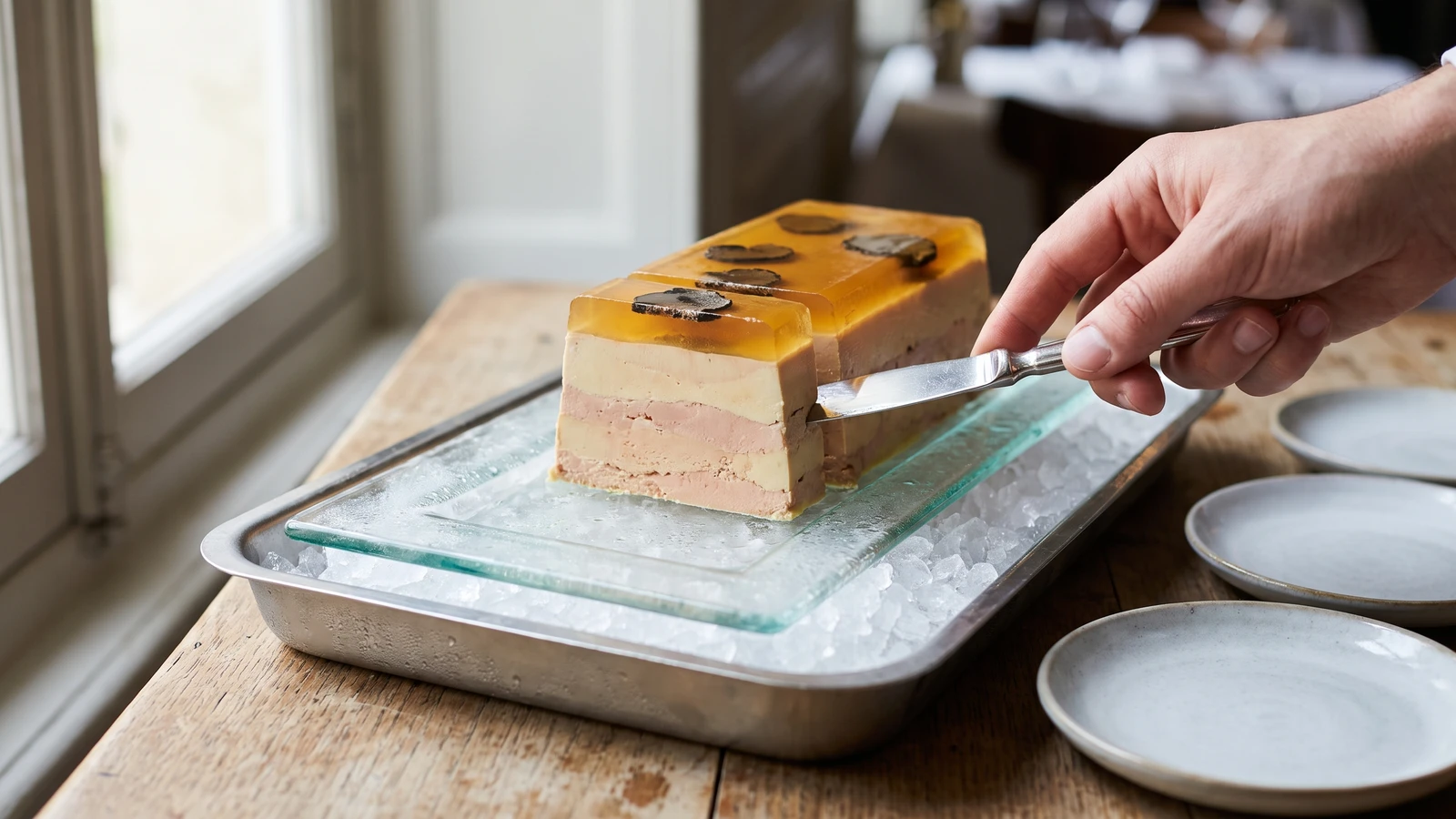
A cold pavé built in clear layers of foie-gras purée, tender collops, black truffle, and aspic, each one set before the next so the square turns out with its lines intact.
Pavé de Foie Gras Lucullus (a square foie-gras timbale) teaches the discipline of cold layering. The one true thing is simple: every layer must become firm enough to carry the next without shifting. Rush that setting and the truffle wanders, the collops float, and the pavé loses the clean lines that make it itself.
The original assumed the cold-kitchen equivalent of a saucier on staff: a garde-manger with finished aspic beside a stockpot never off the fire, brigade quantities of foie gras, a square timbale, and someone willing to carve a block of ice into a flagstone. At home, clear chicken stock reinforced with measured gelatin makes the honest aspic, a one-quart square mold replaces the timbale, and a chilled platter nested over crushed ice does the work of that carved block. The sculpted ice was service scaffolding and can go. The measured layers, the foie-gras purée loosened with melted jelly, and the patient setting between them are the dish and must stay.
This is rich, cold, and splendidly direct: pale foie gras held inside amber-clear jelly, black truffle marking every slice. One cook, one stove, one evening, with the refrigerator doing the brigade's waiting. Before you begin, clear a perfectly level shelf and accept the pace of the dish. Do not add the next layer until the last can bear it without moving.
Pavé de Foie Gras Lucullus belongs to the cold garde-manger table of Parisian grand cuisine, where aspic served as both a gleaming finish and a piece of edible architecture. Lucullus, remembered in European table lore for lavish suppers, became a culinary byword for combinations of foie gras and truffle; pavé names the square flagstone shape, not a cut of liver. Its molded geometry traveled naturally to celebration buffets, but its essential grammar remains modest enough for a home kitchen: cold foie gras, clear jelly, and patience.
Quantity
2 cups (475 ml / 475 g)
chilled
Quantity
1/4 cup (60 ml / 60 g)
Quantity
1 tablespoon plus 2 teaspoons (25 ml / 15 g)
Quantity
Up to 1/4 teaspoon (1.25 ml / 1.5 g)
only if the stock needs it
Quantity
1 terrine, about 1 pound 2 ounces (500 g)
thoroughly chilled; divide 300 g for purée and 200 g for collops
Quantity
1 truffle, about 1 ounce (30 g)
drained if preserved and thinly sliced
Quantity
4 cups (950 ml / 900 g)
for serving
| Ingredient | Quantity |
|---|---|
| clear, well-seasoned chicken stockchilled | 2 cups (475 ml / 475 g) |
| cold water | 1/4 cup (60 ml / 60 g) |
| unflavored powdered gelatin | 1 tablespoon plus 2 teaspoons (25 ml / 15 g) |
| fine salt (optional)only if the stock needs it | Up to 1/4 teaspoon (1.25 ml / 1.5 g) |
| cooked whole foie gras terrinethoroughly chilled; divide 300 g for purée and 200 g for collops | 1 terrine, about 1 pound 2 ounces (500 g) |
| black truffle, fresh or preserveddrained if preserved and thinly sliced | 1 truffle, about 1 ounce (30 g) |
| crushed icefor serving | 4 cups (950 ml / 900 g) |
Clear a level refrigerator shelf. Chill a straight-sided one-quart (1 L) square mold, roughly 4 1/2 inches (11.5 cm) across, along with the flat platter on which you will serve the pavé. Keep the foie gras cold until you cut it; warmth softens its fat, and soft foie gras smears instead of making clean layers.
Sprinkle the gelatin evenly over the cold water and leave it for 5 minutes, until every grain is swollen. Heat half the chicken stock to a bare simmer, remove it from the heat, and whisk in the bloomed gelatin until completely clear. Stir in the remaining cold stock, then strain through a fine sieve. Chill a spoonful for 5 minutes and taste it cold; add only enough salt to give it a quiet savor, because the foie gras and truffle must lead. Let the remaining aspic cool until barely fluid. If it sets in the bowl while the layers chill, stand the bowl in warm water and stir gently until it flows again. Ça se rattrape. Never pour it hot over the foie gras.
Cut 200 g of the chilled foie gras into neat collops, small slices about 1/4 inch (6 mm) thick, and return them to the refrigerator. Cut the remaining 300 g into pieces and press them through a fine-mesh sieve with a firm spatula to make a perfectly smooth purée. Fold in 1/4 cup (60 ml / 60 g) of the barely fluid aspic, a spoonful at a time, until the purée spreads softly but still holds its shape. If it becomes oily, it has grown too warm; set the bowl over ice and fold slowly until it thickens and comes back together.
Pour enough aspic into the chilled mold to make a coat exactly 1/2 inch (1.25 cm) deep. Refrigerate for 25 to 35 minutes, until firm enough to support the truffle but still faintly tacky. Arrange several truffle slices flat against the jelly, remembering that this will become the visible top when the pavé is turned out.
Spoon small mounds of foie-gras purée over the truffles so you do not drag them out of place, then join the mounds gently with a small offset spatula. Build an even layer 2/3 inch (1.7 cm) thick, pressing it into the corners without trapping air. Refrigerate until the surface is firm and does not yield under a light fingertip, about 35 to 45 minutes. This setting is the step that decides the dish; if the surface moves, wait.
Lay half the chilled foie-gras collops over the set purée, leaving narrow channels for the aspic, and place truffle slices between them. Spoon over just enough cool, fluid aspic to anchor everything, then chill for 10 minutes. Once the collops no longer move, add enough aspic to cover them completely and refrigerate until set. If the collops begin to float, stop pouring and set that thin anchoring coat first; the second pour will then stay exactly where it belongs.
Spread the remaining foie-gras purée in an even layer and chill it until firm. Arrange the remaining collops and truffle slices over it, cover them with cool aspic, and let that layer set. Finish by filling the mold to the rim with a final layer of aspic. If the aspic thickens before a pour, warm it only until fluid; hot jelly will soften the layer beneath and blur the lines.
Refrigerate the completed pavé uncovered until the top is set, then cover it without touching the surface. Chill for at least 4 hours, preferably overnight. This final rest binds the layers into one clean, sliceable block. Do not freeze it; frozen aspic releases water as it thaws and loses its clarity.
Pack the crushed ice into a shallow rimmed tray and nest the chilled serving platter securely over it. Dip only the sides and base of the mold in warm water for 5 to 8 seconds, dry the outside, and invert it onto the platter. If the pavé resists, wrap the mold briefly in a warm towel rather than submerging it longer. Should an edge soften, return the unmolded pavé to the refrigerator for 10 minutes. Cut with a thin knife dipped in hot water and wiped completely dry between slices, then serve at once. À table!
1 serving (about 270g)
Culinary guides, cultural storytelling, and the editorial depth that makes cooking meaningful.
Discover Culinary ExplorerChef Juliette
John Dory has the delicacy of sole and the firmness of turbot. A light flouring, a quick butter sauté, and nut-brown beurre noisette show exactly why looks never mattered.

Chef Juliette
Fresh haddock proves its delicacy in the meunière pan: a fine flour crust, moist pearly flakes, and beurre noisette sharpened with lemon and parsley, ready from one skillet in half an hour.

Chef Juliette
Éperlans à l’Anglaise turns small fish into a lesson in disciplined coating: boned smelts under a close, crisp crumb, pan-fried in clarified butter and finished with bright, half-melted maître d’hôtel butter.

Chef Juliette
Tiny smelts, shallot, mushrooms, white wine, gratin sauce, and fine bread raspings meet a fierce oven, where the fish must turn tender in the same breath the buttered crust bronzes.