
Chef Juliette
John Dory (St. Pierre)
John Dory has the delicacy of sole and the firmness of turbot. A light flouring, a quick butter sauté, and nut-brown beurre noisette show exactly why looks never mattered.
A cooking platform built around craft, culture, and the stories behind what we eat.
Created by Chef Juliette
Based on No. 1708, Galantine de Volaille, from Le Guide Culinaire (1907) by Auguste Escoffier
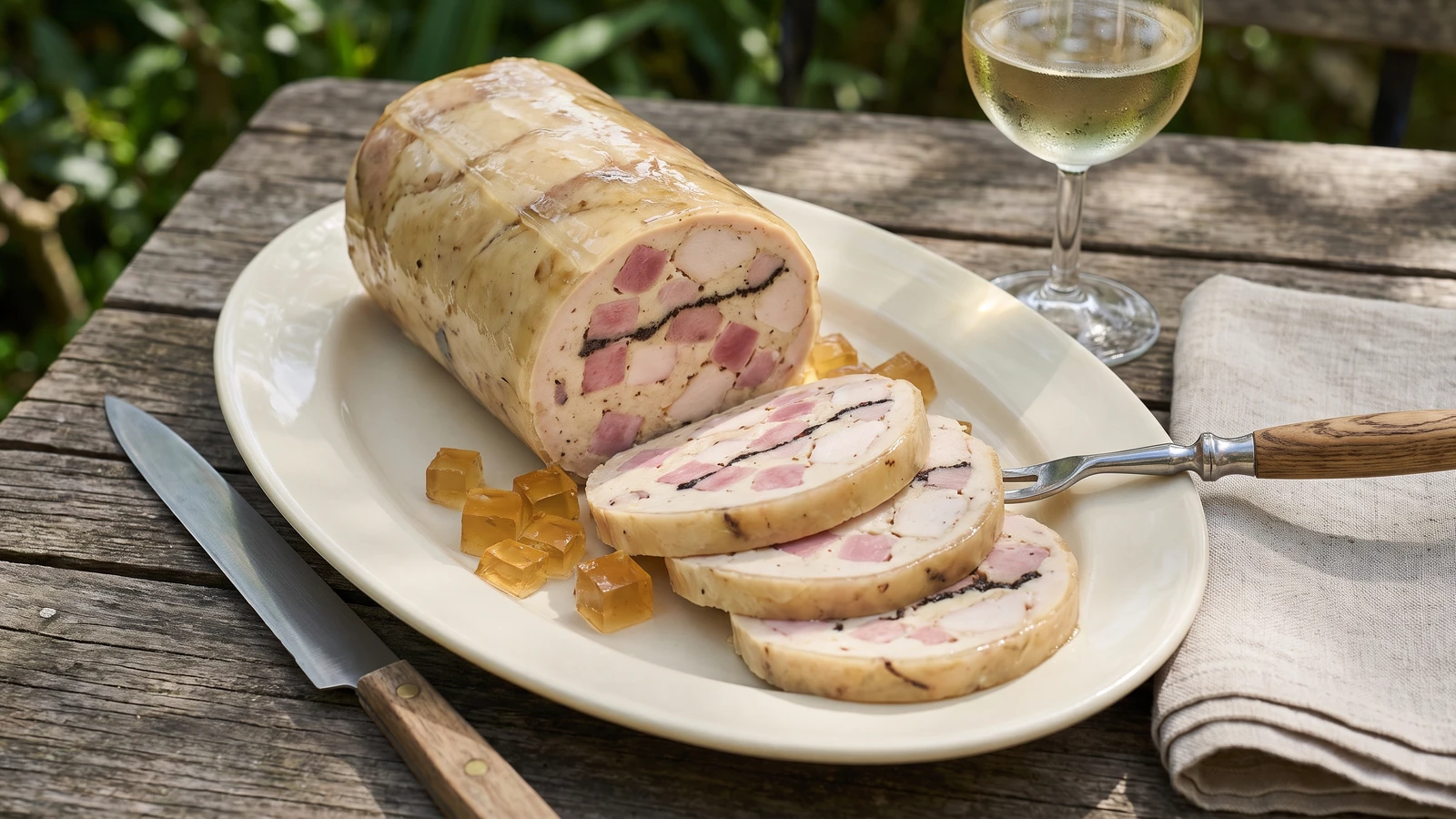
Boned chicken wrapped around a fine cold forcemeat and neat stripes of ham, tongue, salt pork, truffle, and breast, then gently poached, lightly pressed, and sliced beside clear aspic.
Galantine de volaille (boned, stuffed, and pressed chicken) teaches the discipline of cold charcuterie: the filling must remain cold, the stripes must lie in order, and the poach must stay gentler than a simmer. The one true thing to know before touching a knife is that warmth ruins the forcemeat before heat ever cooks it. Keep the meat, bowl, blade, and your own hands cold.
The source entry assumed a saucier on staff, White Veal Stock, and Poultry Stock (No. 10) never far from the fire, and enough hands to pound meat and force it through a sieve. A salamander belonged to that brigade kitchen too, although this cold galantine has no use for one. At home, a food processor supplies the fine texture, finished stock is enriched briefly with the chicken carcass, a probe thermometer guards the poach, and two trays make a proper press. The carved rice cushion and elaborate jelly geometry were service scaffolding, so they go. Boning through the back, the striped filling, gentle poaching, and light pressing are the dish itself, so they stay. One cook, one stove, one evening, followed by a night in the cold.
When sliced, the galantine should reveal a close ivory forcemeat patterned with rosy ham and tongue, white breast, pale salt pork, and black truffle. It is generous picnic food and handsome make-ahead food, but it earns that ease through exact assembly. Before you begin, clear a cold shelf and chill the processor bowl. The temperature of the forcemeat decides everything.
Galantine de volaille belongs to the French garde-manger, particularly the Parisian charcutier-traiteur shop and the formal household buffet, where boned poultry was re-formed, poached, pressed, and glazed for cold service. It traveled naturally from banquet tables to family celebrations and picnics because it slices and carries so well; unlike many ballotines, a galantine is defined by its cold, pressed service and its accompaniment of aspic.
Quantity
1 chicken (about 4 lb / 1.8 kg)
neck and giblets removed, skin unbroken
Quantity
¾ cup loosely packed (180 ml / 120 g)
diced and thoroughly chilled
Quantity
1½ cups loosely packed (360 ml / 240 g)
diced and thoroughly chilled
Quantity
⅓ cup (80 ml / 55 g)
drained if preserved and cut into long batons
Quantity
½ cup loosely packed (120 ml / 85 g)
cut into long batons
Quantity
⅓ cup loosely packed (80 ml / 55 g)
cut into long batons
Quantity
⅓ cup loosely packed (80 ml / 55 g)
cut into long batons
Quantity
1 tablespoon (15 ml / 14 g)
Quantity
1½ teaspoons (7.5 ml / 9 g)
divided
Quantity
¾ teaspoon (3.75 ml / 1.5 g)
divided
Quantity
⅛ teaspoon (0.6 ml / 0.3 g)
Quantity
1 piece (about 2 oz / 55 g), prepared through Blanchings (No. 273)
| Ingredient | Quantity |
|---|---|
| whole eviscerated chickenneck and giblets removed, skin unbroken | 1 chicken (about 4 lb / 1.8 kg) |
| very pale lean vealdiced and thoroughly chilled | ¾ cup loosely packed (180 ml / 120 g) |
| very fatty fresh unsalted pork bellydiced and thoroughly chilled | 1½ cups loosely packed (360 ml / 240 g) |
| fresh or preserved black truffledrained if preserved and cut into long batons | ⅓ cup (80 ml / 55 g) |
| unsmoked salt porkcut into long batons | ½ cup loosely packed (120 ml / 85 g) |
| cooked unsmoked hamcut into long batons | ⅓ cup loosely packed (80 ml / 55 g) |
| salted and cooked ox tonguecut into long batons | ⅓ cup loosely packed (80 ml / 55 g) |
| Cognac or French brandy | 1 tablespoon (15 ml / 14 g) |
| Cooked Marinade for Venisonchilled | 2 teaspoons (10 ml / 10 g) (No. 168) |
| fine sea saltdivided | 1½ teaspoons (7.5 ml / 9 g) |
| finely ground white pepperdivided | ¾ teaspoon (3.75 ml / 1.5 g) |
| freshly grated nutmeg | ⅛ teaspoon (0.6 ml / 0.3 g) |
| White Veal Stock, and Poultry Stockchilled | 12 cups (2.8 L / 2.8 kg) (No. 10) |
| fresh pork rind | 1 piece (about 2 oz / 55 g), prepared through Blanchings (No. 273) |
| Ordinary Aspicsprepared from the galantine poaching liquor | 2 cups (480 ml / 480 g) (No. 158) |
Clear a generous work surface and make room in the refrigerator for two rimmed trays. Chill the processor bowl and blade for at least fifteen minutes, and keep the veal and fresh pork refrigerator-cold. Set out two clean lint-free cotton cloths or lengths of butter muslin. Forcemeat is an emulsion of meat, fat, and moisture, and warmth separates it before it has a chance to set.
Set the chicken breast-side down and cut through the skin along the backbone from the neck end to the tail. Using the point of a small sharp knife, scrape the flesh away from the carcass while keeping the blade against bone. Work evenly toward each breast, disarticulate the wing and leg joints where they meet the trunk, and lift the carcass free without puncturing the breast skin. Strip the remaining meat from the skin and spread that skin exterior-side down on a chilled cloth. Reserve 4 oz (115 g) breast meat for stripes and 4¼ oz (120 g) leg meat and breast trimmings for the forcemeat. Keep every scrap, bone, and remaining piece of chicken for the poaching stock.
Break the carcass into several pieces and place it in a narrow 6 to 8 quart pot with the unused chicken meat, 11 cups of the White Veal Stock, and Poultry Stock (No. 10), and the pork rind already prepared through Blanchings (No. 273). Keep the final cup of stock cold for correcting the poach later. Bring the pot up slowly, skim carefully, and hold it at a bare tremble for forty-five minutes. Strain without pressing the solids, return the liquor to the cleaned pot, and keep it just below a simmer.
Cut the reserved breast into long pieces about one-third inch (8 mm) square. Season them with ⅛ teaspoon of the salt and a small pinch of white pepper, then toss with the Cognac and the chilled Cooked Marinade for Venison (No. 168). Refrigerate for twenty minutes. Cut the truffle, salt pork, ham, and ox tongue into batons of the same thickness and roughly the same length. Regular pieces make a clean mosaic when the galantine is sliced; ragged scraps make a muddy one.
Combine the reserved leg meat and breast trimmings with the chilled veal and fatty fresh pork. Add the remaining salt and white pepper, plus the nutmeg. Pulse in the chilled processor until finely chopped, scrape the bowl, then process only until the mixture becomes smooth and tacky enough to cling to the blade. Add every drop of the Cognac and Cooked Marinade for Venison (No. 168) left around the breast strips and pulse briefly to incorporate. Fry a teaspoonful in a small pan and taste it cold enough not to burn you; correct the seasoning now. If the forcemeat looks greasy or begins smearing around the bowl, stop immediately, spread it on a cold tray, and chill it for fifteen minutes before processing again. Ça se rattrape. Don't add egg or crumbs, which would change the close, fine texture of the dish.
Square the chicken skin gently without cutting away useful edges. Spread one-third of the forcemeat in a band 3 inches (7.5 cm) wide down its center, leaving about 1½ inches (4 cm) clear at both ends. Lay half the salt pork, breast, truffle, ham, and tongue in alternating lengthwise rows. Cover with another third of the forcemeat, repeat the striped rows, and enclose them with the remaining forcemeat. Keep the stripes straight and the layers even. This arrangement is not decoration added afterward; it is the structure of the galantine.
Draw the chicken skin snugly over the filling and overlap its back edges without stretching them thin. Sew the seam with unwaxed cotton thread at intervals of about ½ inch (1 cm), closing the ends securely. Shape the galantine into an even cylinder about 12 inches (30 cm) long. Roll it tightly in the first clean cloth, twist the ends in opposite directions, and tie them firmly with kitchen twine; add three evenly spaced ties around the body. If filling escapes through a weak seam, scrape it back under the skin, add two stitches, and rewrap. The cloth is the second defense.
Bring the strained poaching stock to 180°F (82°C), lower in the wrapped galantine, and use a small heatproof plate to keep it submerged if necessary. Hold the liquor between 176°F and 185°F (80°C and 85°C) for 1 hour 15 minutes, turning the roll once halfway through. It must barely tremble. Cook until the center reaches 165°F (74°C). If the stock begins boiling, lift the pot off the heat and add some of the reserved cold White Veal Stock, and Poultry Stock (No. 10) until the temperature falls back into range. Ça se rattrape, although a prolonged boil will make the forcemeat firmer than intended.
Lift the galantine onto a tray and let it drain for ten minutes. Remove the wet cloth carefully, leaving the stitched skin intact, then roll the galantine in the second clean dry cloth and retie it in the same shape. Set it between two rimmed trays and place a flat weight of 3½ to 4½ lb (1.6 to 2 kg) on top. Never exceed 5 lb (2.3 kg), or the stripes and forcemeat will be squeezed out through the seam. Transfer the whole press to the refrigerator within thirty minutes and chill for at least eight hours, preferably overnight.
Skim the warm poaching liquor, chill it, and lift away the firm cap of fat without disturbing the sediment beneath. Measure the required liquor and complete 2 cups of Ordinary Aspics (No. 158) according to its separate formula. Chill a spoonful for ten minutes to test the set. If it remains liquid, return to Ordinary Aspics (No. 158) and correct the gel strength there; ça se rattrape. Set most of the finished aspic in a shallow dish for cutting into small cubes, and reserve about ½ cup in a container that can be warmed gently for glazing.
Remove the weight, unwrap the galantine, cut away the stitches, and trim both ends cleanly. Warm the reserved Ordinary Aspics (No. 158) only until half-melted and syrupy, then brush a thin coat over the cold galantine. Chill for ten minutes and repeat until the skin carries a clear light glaze. Present it whole on a chilled oval platter with cubes of aspic around it, then cut crosswise into slices about ½ inch (1.5 cm) thick using a long sharp knife. The carved rice pedestal has gone, but the generous slice and its clear jelly remain. À table!
1 serving (about 510g)
Culinary guides, cultural storytelling, and the editorial depth that makes cooking meaningful.
Discover Culinary ExplorerChef Juliette
John Dory has the delicacy of sole and the firmness of turbot. A light flouring, a quick butter sauté, and nut-brown beurre noisette show exactly why looks never mattered.

Chef Juliette
Fresh haddock proves its delicacy in the meunière pan: a fine flour crust, moist pearly flakes, and beurre noisette sharpened with lemon and parsley, ready from one skillet in half an hour.

Chef Juliette
Éperlans à l’Anglaise turns small fish into a lesson in disciplined coating: boned smelts under a close, crisp crumb, pan-fried in clarified butter and finished with bright, half-melted maître d’hôtel butter.

Chef Juliette
Tiny smelts, shallot, mushrooms, white wine, gratin sauce, and fine bread raspings meet a fierce oven, where the fish must turn tender in the same breath the buttered crust bronzes.