
Chef Juliette
John Dory (St. Pierre)
John Dory has the delicacy of sole and the firmness of turbot. A light flouring, a quick butter sauté, and nut-brown beurre noisette show exactly why looks never mattered.
A cooking platform built around craft, culture, and the stories behind what we eat.
Created by Chef Juliette
Based on No. 1701, Poularde En Terrine à la Gelée, from Le Guide Culinaire (1907) by Auguste Escoffier
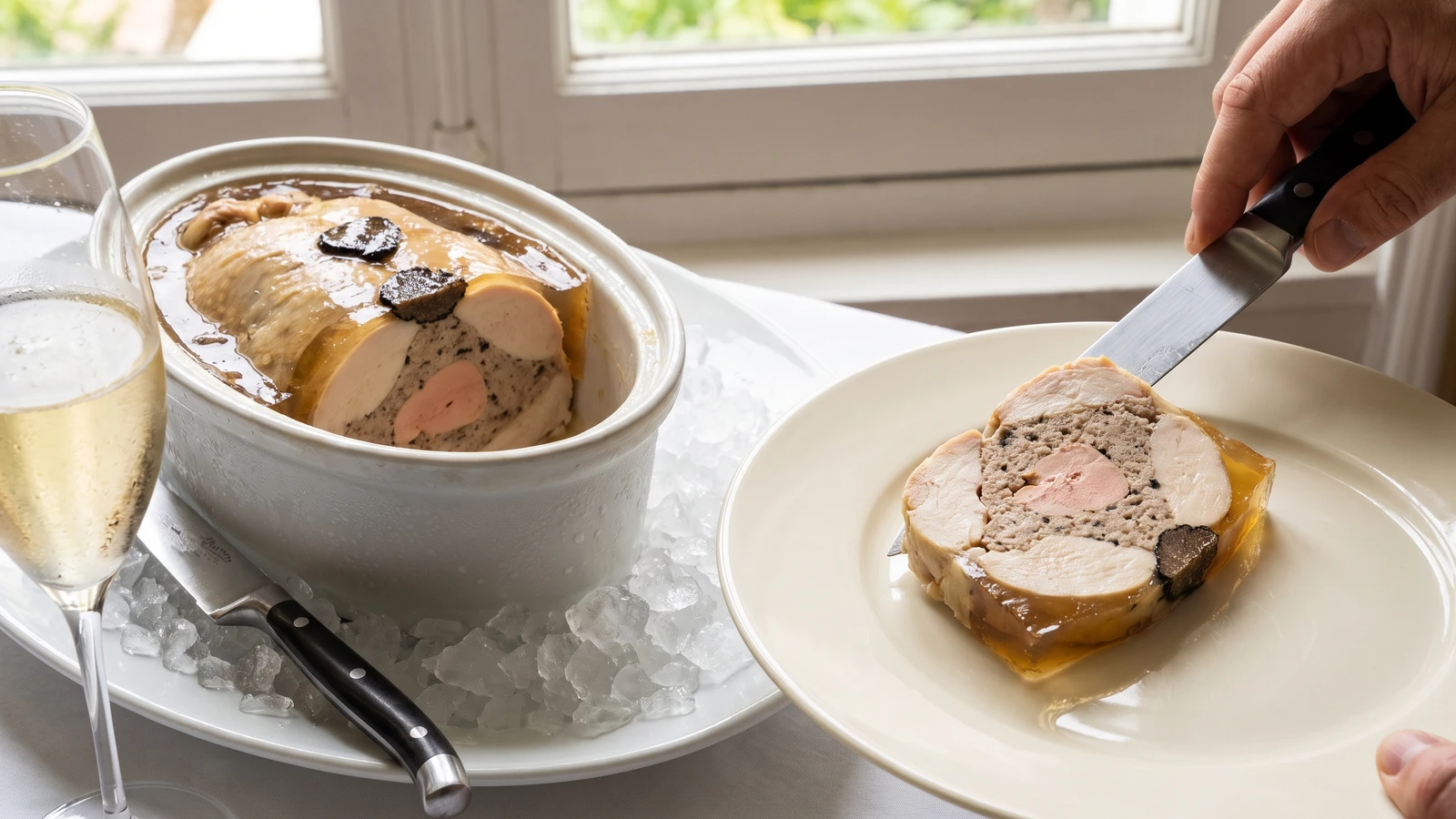
A boned poularde rebuilt around fowl-liver forcemeat, foie gras, and black truffle, gently poêlé with Madeira, then held a full day under its own amber jelly until every cold slice stands richly defined.
Poularde en terrine à la gelée (boned pullet stuffed with foie gras and truffle, set in Madeira jelly) teaches the discipline of cooking for the cold table: every flavor must be built warm, then judged after a full day in the cold. The one true thing to know before touching a pan is this: don't skim the poëling liquor early. Its butter carries the poultry, matignon, Madeira, and truffle into the gelée; the fat comes away only after the jelly has set.
The original kitchen assumed a saucier, a stockpot never off the fire, several hands for boning and trussing, and a cold room large enough for carved blocks of ice. There is no salamander work to preserve here. At home, a boning knife or a willing butcher gives you the intact bird, good chicken stock fortified with the reserved bones and measured gelatin gives you the jelly, and a snug oval terrine replaces the elaborate cold-service apparatus. One cook, one stove, one evening of work, then a full day untouched in the refrigerator.
The block of ice and the extra hands were brigade scaffolding, so they can go. The exact forcemeat proportions, the foie gras and truffle at its center, the butter-rich poëling, the unskimmed cooking liquor, and the full day of setting are the dish itself, so they stay. Build the gelée before you remove its fat, test a spoonful in the cold, and give it the full wait. That is the step that decides everything.
Poularde en terrine à la gelée belongs to the Parisian grand-kitchen and bourgeois cold-table repertoire, where whole boned birds were reconstructed, richly garnished, and presented in aspic for formal suppers and generous buffets. Its practice joins the terrine and galantine work of charcuterie to classical poëling: butter protects the bird, while the Madeira cooking liquor becomes part of its preservation and presentation. Despite the name, this is not a minced pâté; the terrine is the vessel, and the poularde remains recognizably whole beneath its gelée.
Quantity
1 bird, 4 to 4½ pounds (1.8 to 2 kg)
boned from the back with the skin intact and the leg bones left in place; carcass and wing bones reserved
Quantity
3 teaspoons (15 ml / 18 g)
divided
Quantity
1 teaspoon (5 ml / 2 g)
divided
Quantity
3½ ounces (100 g / about ½ packed cup)
finely ground and thoroughly chilled
Quantity
3½ ounces (100 g / about ½ packed cup)
finely ground and thoroughly chilled
Quantity
3½ ounces (100 g / about ½ packed cup) Gratins (No. 268)
prepared according to its own entry and chilled
Quantity
2 tablespoons (30 ml / 28 g)
Quantity
2 tablespoons (30 ml / 30 g)
Quantity
1
Quantity
½ small lobe, about 8 ounces (225 g)
chilled and deveined
Quantity
2 small truffles, about 1 ounce (30 g) total
each quartered
Quantity
10 to 12 slices, about 8 ounces (225 g)
Quantity
1 medium onion, about 5 ounces (150 g)
cut into small dice
Quantity
1 medium carrot, about 3½ ounces (100 g)
cut into small dice
Quantity
1 rib, about 2 ounces (60 g)
cut into small dice
Quantity
4 sprigs
Quantity
1
Quantity
1 cup (240 ml / 240 g)
Quantity
4 cups (950 ml / 950 g)
Quantity
1 tablespoon plus 2 teaspoons (25 ml / 15 g), plus up to 1 teaspoon (5 ml / 3 g) if needed
Quantity
2 cups (475 ml / 475 g), as needed, from Poularde au Champagne (No. 1688)
Quantity
as needed
for rapid chilling and service
| Ingredient | Quantity |
|---|---|
| small poularde or plump air-chilled chickenboned from the back with the skin intact and the leg bones left in place; carcass and wing bones reserved | 1 bird, 4 to 4½ pounds (1.8 to 2 kg) |
| fine sea saltdivided | 3 teaspoons (15 ml / 18 g) |
| freshly ground white pepperdivided | 1 teaspoon (5 ml / 2 g) |
| vealfinely ground and thoroughly chilled | 3½ ounces (100 g / about ½ packed cup) |
| fresh pork back fatfinely ground and thoroughly chilled | 3½ ounces (100 g / about ½ packed cup) |
| fowls' liver gratin forcemeatprepared according to its own entry and chilled | 3½ ounces (100 g / about ½ packed cup) Gratins (No. 268) |
| brandy | 2 tablespoons (30 ml / 28 g) |
| natural black-truffle essence or preserving juice | 2 tablespoons (30 ml / 30 g) |
| large egg yolk | 1 |
| raw foie gras lobechilled and deveined | ½ small lobe, about 8 ounces (225 g) |
| fresh black truffleseach quartered | 2 small truffles, about 1 ounce (30 g) total |
| thinly sliced unsmoked streaky bacon | 10 to 12 slices, about 8 ounces (225 g) |
| yellow onioncut into small dice | 1 medium onion, about 5 ounces (150 g) |
| carrotcut into small dice | 1 medium carrot, about 3½ ounces (100 g) |
| celerycut into small dice | 1 rib, about 2 ounces (60 g) |
| thyme | 4 sprigs |
| bay leaf | 1 |
| unsalted buttermelted | 6 tablespoons (90 ml / 85 g) for Poëlings (No. 250) |
| medium-dry Madeira | 1 cup (240 ml / 240 g) |
| strong unsalted chicken stock | 4 cups (950 ml / 950 g) |
| powdered gelatin | 1 tablespoon plus 2 teaspoons (25 ml / 15 g), plus up to 1 teaspoon (5 ml / 3 g) if needed |
| boiling water for the cold-jelly degreasing finish | 2 cups (475 ml / 475 g), as needed, from Poularde au Champagne (No. 1688) |
| icefor rapid chilling and service | as needed |
If the butcher has not boned the poularde, set it breast-side down and cut through the skin along the backbone from neck to tail. Keeping the knife against bone, scrape the flesh and skin away from the carcass, disjoint the shoulders and hips, and lift out the rib cage, backbone, wishbone, and wing bones without piercing the breast skin. Leave the leg bones in place. Reserve every removed bone for the jelly, refrigerate the opened bird, and keep it cold while you work. If the skin tears, close the nick with cotton kitchen thread or cover it with a bacon slice before trussing. Ça se rattrape.
Put the reserved carcass and wing bones in a saucepan with the chicken stock. Bring it slowly to a bare simmer, skim only the grey surface froth, and cook uncovered for about 45 minutes, until reduced to roughly 3 cups (710 ml). Strain without pressing the bones. Cool ¾ cup (180 ml) quickly over ice and keep the rest warm. This concentrated stock and measured gelatin replace the classical stockpot that never went cold; the flavor still comes from the bird itself.
Combine the chilled veal, pork fat, and prepared fowls' liver Gratins (No. 268) in a cold bowl. Add the brandy, truffle essence, egg yolk, 1 teaspoon (6 g) of the salt, and half the white pepper. Mix firmly until the forcemeat turns cohesive and slightly tacky, but stop before the fat warms and smears. Fry a teaspoonful until completely cooked and taste it cold for a minute; adjust the salt and pepper now. If the mixture becomes soft or greasy, spread the bowl over ice and chill it until firm before continuing.
Lay the cold poularde skin-side down and season its flesh with the remaining salt and pepper. Spread half the forcemeat evenly through the boned cavity, filling the hollows beside the breast without stretching the skin. Place the half lobe of foie gras lengthwise through the center. Arrange the four quarters of one truffle along one side of the foie gras and the four quarters of the second truffle along the other, then cover with the remaining forcemeat. Press gently to remove air pockets. Draw the back edges of skin together, sew them with cotton kitchen thread, and truss the bird into its natural shape with the legs held close. A little forcemeat showing at the seam is harmless; patch it with bacon rather than over-tightening the skin.
Heat the oven to 325°F (165°C). Spread the onion, carrot, celery, thyme, and bay leaf in a heavy lidded casserole just large enough to hold the reconstructed poularde. Set the bird seam-side down on this raw matignon, cover its breast and sides completely with the bacon, and pour over the melted butter. Use the method in Poëlings (No. 250): cover the casserole and cook gently for 60 minutes, spooning the butter over the bacon every 20 minutes. The vegetables should soften and color lightly, never scorch. If their edges begin going black, lower the oven and transfer the bird with the unburned vegetables and butter to a clean casserole.
Uncover the casserole and cook for 10 minutes so the bacon takes a little color. Pour the Madeira down the side of the pan, not directly over the bird, and continue cooking uncovered for about 20 minutes, basting twice, until both the thickest part of the forcemeat and the inner leg register 165°F (74°C). If the bacon colors before the center is ready, cover the bird loosely and continue in 10-minute intervals. Remove the casserole from the oven, cover it, and leave the poularde to half-cool in its Madeira cooking liquor for 25 to 30 minutes, turning it once so the liquor reaches both sides.
Lift the poularde from the casserole, remove every bacon slice, and settle the bird seam-side down in a chilled terrine that holds it closely. Leave the trussing in place. Pour 2¼ cups (530 ml) of the fortified stock into the casserole with the Madeira liquor, vegetables, butter, and poultry juices. Do not skim away the butter. Simmer gently for 10 minutes so the stock recovers the aromas held by the fat, then strain through a damp lint-free kitchen cloth without pressing. Bloom the gelatin in ½ cup (120 ml) of the cold reserved stock for 5 minutes, then dissolve it off the heat in the warm strained liquor. Keep the last ¼ cup (60 ml) of stock for adjustment.
Spoon a teaspoon of the gelée onto a cold saucer and set it over ice for 8 to 10 minutes. It should hold a clean line when pushed but soften readily on the tongue. Taste it cold, since cold mutes seasoning. If it still runs, bloom up to the extra teaspoon of gelatin in a tablespoon of reserved stock and dissolve it into the warm batch. If it sets too firmly, loosen the batch with the remaining warm stock. Ça se rattrape. Pour the gelée over the poularde until completely covered. If the bird rises, hold it down with a small chilled plate laid over parchment until the jelly begins to catch, then remove the plate and top up the surface.
Place the uncovered terrine in a deep tray of ice water, keeping the water below its rim, and cool until the gelée begins to thicken. Cover and refrigerate at or below 40°F (4°C) for a full 24 hours. The wait is not storage added after the cooking; it is the final cooking step. The jelly must firm around the reconstructed bird, and the forcemeat, foie gras, truffle, Madeira, and poultry juices need that cold rest to become one flavor.
After the full day, lift off the solid cap of fat with a cold spoon. Finish the surface as directed for Poularde au Champagne (No. 1688): pass a small ladleful of boiling water briefly over the exposed gelée and drain it away immediately, repeating two or three times only if traces of grease remain. Hold the bird in place while draining. If the surface softens, return it to the refrigerator until firm. Remove the trussing thread, nest the terrine on a rimmed platter with crushed ice around its base, and slice across the breast so each serving shows forcemeat, foie gras, and black truffle; divide the legs separately. The crushed ice is the honest home equivalent of the carved ice block. À table!
1 serving (about 590g)
Culinary guides, cultural storytelling, and the editorial depth that makes cooking meaningful.
Discover Culinary ExplorerChef Juliette
John Dory has the delicacy of sole and the firmness of turbot. A light flouring, a quick butter sauté, and nut-brown beurre noisette show exactly why looks never mattered.

Chef Juliette
Fresh haddock proves its delicacy in the meunière pan: a fine flour crust, moist pearly flakes, and beurre noisette sharpened with lemon and parsley, ready from one skillet in half an hour.

Chef Juliette
Éperlans à l’Anglaise turns small fish into a lesson in disciplined coating: boned smelts under a close, crisp crumb, pan-fried in clarified butter and finished with bright, half-melted maître d’hôtel butter.

Chef Juliette
Tiny smelts, shallot, mushrooms, white wine, gratin sauce, and fine bread raspings meet a fierce oven, where the fish must turn tender in the same breath the buttered crust bronzes.