Culinary Explorer

A cooking platform built around craft, culture, and the stories behind what we eat.
Discover Culinary Explorer
Chaud-froid de Poularde à la Gounod

Chaud-froid de Poularde à la Gounod

Created by Chef Juliette

Based on No. 1692, Chaud-froid de Poularde à la Gounod, from Le Guide Culinaire (1907) by Auguste Escoffier

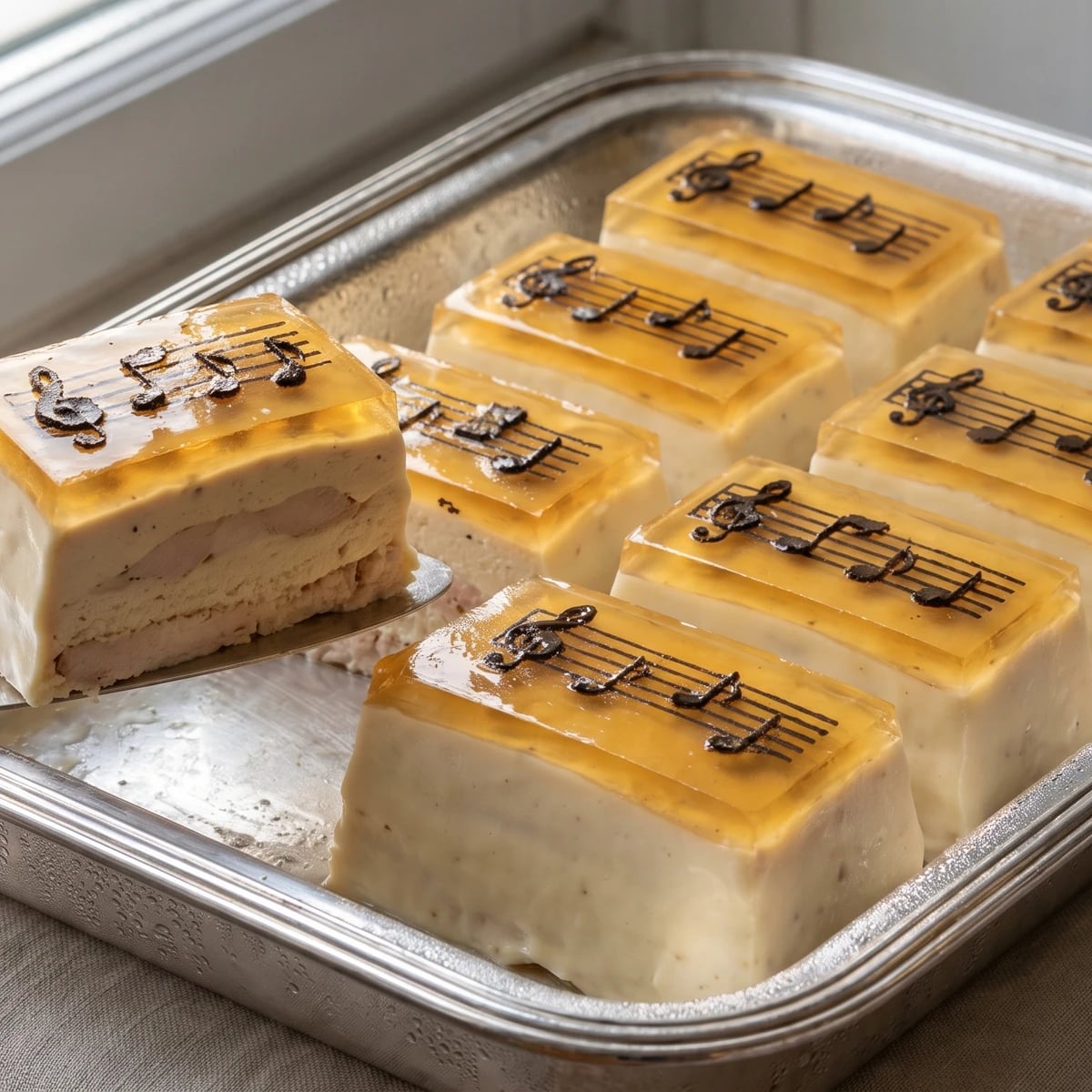
Ivory chaud-froid over pressed suprême and silken leg mousse, black truffle music above, clear chicken aspic below: a cold centerpiece whose clean geometry comes from patience in the refrigerator.

Main Dishes
French
Dinner Party
Special Occasion
1 hr 15 min
Active Time
1 hr 30 min cook5 hr 30 min total
Yield4 servings

Chaud-froid de Poularde à la Gounod (cold glazed pullet with truffle music) teaches that cold cookery is ruled by temperature, not decoration. Its suprême, the breast fillet, must remain moist; its mousse must cut as neatly as the meat above it; and its white chaud-froid must flow without melting either. Chill the mousse hard before the knife touches it. That is the one true thing.

The original recipe assumed a poularde poached beside a stockpot that never went cold, a saucier keeping the white coating at precisely the right flow, a cold larder, a deep silver dish, and enough hands to carve a block of ice for service. Here, one plump market chicken supplies the breast, leg mousse, sauce foundation, and clear jelly; a refrigerator and a brief turn in the freezer supply the cold. The carved ice and banquet architecture are brigade scaffolding and can go. The pressed suprême, leg mousse, white chaud-froid, truffle music, and limpid chicken aspic are the dish, so every one stays.

The finished platter is wonderfully composed: ivory rectangles under trembling amber-clear jelly, each marked with black truffle notes, generous rather than dainty. This is one cook, one stove, one evening, with the refrigerator doing the quiet work. Give the mousse its full cold set before cutting, because every clean edge after that depends upon it.

Chaud-froid belongs to the Parisian grand cold buffet, where poultry cooked hot was cooled, masked with a set sauce, and sealed beneath clear aspic for formal service. The à la Gounod title is a musical compliment to the Parisian composer: black truffle forms a stave and notes, so the name describes the decoration rather than any regional seasoning. The preparation passed into bourgeois special-occasion cooking because its logic is practical as well as handsome: sauce protects the poultry, while aspic keeps its surface moist and glossy.

The technique, the tradition, and the story behind every dish.

Discover Culinary Explorer

Ingredients

plump poularde or whole chicken

Quantity

1, about 4 to 4½ lb (1.8 to 2 kg)

unsalted chicken stock

Quantity

8 cups (1.9 L / 1.9 kg)

cold water

Quantity

2 cups (480 ml / 480 g), plus more only if needed to cover

yellow onion

Quantity

1 medium (5 oz / 150 g)

quartered

carrot

Quantity

1 medium (3½ oz / 100 g)

cut into chunks

leek, white and pale green parts only

Quantity

1 small (4 oz / 120 g)

rinsed and cut into chunks

bouquet garni

Quantity

1

fine sea salt

Quantity

1 tablespoon (15 ml / 18 g), plus more as needed

black peppercorns

Quantity

1 teaspoon (5 ml / 2 g)

unsalted butter

Quantity

3 tablespoons (45 ml / 42 g)

plain flour

Quantity

⅓ cup (80 ml / 40 g)

heavy cream

Quantity

1½ cups (360 ml / 360 g)

divided and chilled

powdered gelatin for the white chaud-froid

Quantity

2 teaspoons (10 ml / 6 g)

powdered gelatin for the chicken aspic

Quantity

1 tablespoon plus 1 teaspoon (20 ml / 10 g)

cold water for blooming the gelatin

Quantity

⅓ cup (80 ml / 80 g)

divided

large egg whites

Quantity

2

lightly beaten

ground white pepper

Quantity

¼ teaspoon (1.25 ml / 0.6 g)

fresh or preserved black truffle

Quantity

1 small, about ½ oz (15 g)

drained if preserved and sliced paper-thin

crushed ice

Quantity

as needed

for serving

Equipment Needed

  • Snug 6 to 8-quart (5.7 to 7.6 L) stockpot
  • Instant-read thermometer
  • Two small rimmed trays and food tins for pressing
  • Fine-mesh sieve and damp muslin or lint-free cloth
  • Food processor or powerful blender
  • 9-inch (23 cm) square pan for the mousse
  • 9-inch (23 cm) square deep serving dish
  • Wire rack and chilled tray
  • Small offset spatula and narrow paring knife

Instructions

  1. 1

    Poach the poularde

    Put the chicken stock, 2 cups (480 ml) cold water, onion, carrot, leek, bouquet garni, salt, and peppercorns in a snug 6 to 8-quart pot. Lower in the poularde, breast upward, adding only enough extra water to cover it. Bring the liquid slowly to a bare tremble, never a rolling boil, then partially cover and poach for 45 to 60 minutes. Turn the bird once and maintain the gentlest movement in the liquid until the breast registers 165°F (74°C) and the thigh at least 175°F (80°C). Boiling tightens the breast and clouds the liquor, while quiet poaching gives you moist suprêmes and the clear foundation the aspic requires.

    Choose a pot that holds the bird closely. A broad stockpot demands more liquid, dilutes the chicken flavour, and leaves you reducing half the night.
  2. 2

    Press the suprêmes

    Lift the poularde onto a tray and rest it for 10 minutes. Remove the skin, raise the two suprêmes cleanly from the breastbone, and place them between sheets of parchment on a small tray. Lay a second tray over them and add two food tins as weights, enough to level the meat without crushing it. Refrigerate for 45 minutes. Strip the meat from the legs and collect the breast trimmings in a shallow container, then chill them promptly. Strain the poaching liquor through a fine sieve and discard the vegetables and bouquet garni.

  3. 3

    Concentrate the liquor

    Skim the fat carefully from the strained liquor. Measure 2 cups (480 ml) into one saucepan and reduce it at a lively simmer to 1½ cups (360 ml) for the white chaud-froid. Measure another 4 cups (960 ml) into a second pan and reduce it to 3½ cups (840 ml) for the aspic. Reserve ½ cup (120 ml) of any remaining liquor for adjustments and chill the rest for another meal. Set the aspic portion in an ice bath until thoroughly cold; clarification begins with cold liquid.

  4. 4

    Make white chaud-froid

    Bloom the 2 teaspoons (6 g) gelatin in 2 tablespoons (30 ml / 30 g) of the measured cold water. Melt the butter over medium-low heat, stir in the flour, and cook this roux for 2 minutes without letting it colour. Whisk in the reduced 1½ cups (360 ml) poaching liquor a little at a time, then simmer for 6 minutes until the velouté coats the back of a spoon. Add 1 cup (240 ml / 240 g) cream and simmer gently until the sauce measures about 2 cups (480 ml) and falls from the spoon in an ivory curtain. Remove it from the heat, stir in the bloomed gelatin, season with white pepper and salt, then pass it through a fine sieve. If the sauce has lumps, don't fight them in the pan. Whisk off the heat and strain it; ça se rattrape. Reserve ⅔ cup (160 ml) for the mousse and cover the remainder directly on its surface.

    Chaud-froid must be fluid enough to coat but firm enough to set. If it gels while you work, warm it over a bowl of lukewarm water. Never boil it after adding gelatin.
  5. 5

    Set the leg mousse

    Uncover the pressed suprêmes. If they remain thicker than ½ inch (12 mm), bisect them horizontally, then trim eight equal rectangles about 3 by 1¾ inches (7.5 by 4.5 cm) and ¼ inch (6 mm) thick. Keep one as the template and add the clean trimmings to the leg meat. Measure 10 oz (285 g) of leg meat and trimmings, then purée it with the reserved ⅔ cup (160 ml) chaud-froid until smooth. Force the purée through a fine sieve. Whip the remaining ½ cup (120 ml / 120 g) cream to soft folds and fold it into the cooled purée. Taste for salt, remembering that cold mutes seasoning. Spread the mousse in a parchment-lined 9-inch (23 cm) square pan, exactly ½ inch (12 mm) thick and level across the top. Chill for 1 hour, or give it 15 minutes in the freezer followed by 30 minutes in the refrigerator. It must feel firm beneath a fingertip, not merely cool.

  6. 6

    Clarify the aspic

    Put the thoroughly cold 3½ cups (840 ml) aspic liquor and the lightly beaten egg whites in a clean saucepan. Warm them slowly, stirring across the bottom until the whites gather into a raft and rise. Stop stirring, make a small opening in the raft, and hold the liquid at the barest simmer for 15 minutes. Ladle it through damp muslin or a damp lint-free cloth without pressing the raft. Bloom the remaining gelatin in the remaining 3 tablespoons plus 1 teaspoon (50 ml / 50 g) cold water, then dissolve it in the hot clarified liquor. Taste and correct the salt while warm, making it a shade more seasoned than seems necessary. If the raft breaks and the liquor clouds, stop stirring, let it settle for 10 minutes, and strain it twice through fresh damp cloth. Ça se rattrape. Cool the finished aspic over ice until fluid but lightly syrupy.

  7. 7

    Cut and join

    Turn the hard-set mousse slab onto a chilled board and remove the parchment. Arrange the eight suprême rectangles over it with room between them, fixing each in place with a thin brush of fluid aspic. With a narrow knife dipped in hot water and wiped completely dry, cut straight down around each suprême so its mousse base matches it exactly. The mousse should be about twice the thickness of the breast. If the knife drags or the corners buckle, the slab is too warm. Return it to the freezer for 10 minutes, wipe the blade after every cut, and begin again.

  8. 8

    Coat and write

    Set the joined pieces on a wire rack over a chilled tray, suprême upward. Warm the remaining white chaud-froid over lukewarm water until it reaches about 88 to 92°F (31 to 33°C) and flows in a thick ribbon. Spoon it once over each piece from the centre outward, allowing it to cover the top and sides without spreading it with a knife. If it ridges, it is too cold; warm it slightly. If it slides away and exposes the meat, it is too warm; chill both pieces and sauce for 5 minutes, then coat again. While the surface remains tacky, cut the black truffle into five hair-thin parallel strips and tiny notes, making a short musical stave on each piece with the point of a paring knife. Chill for 15 minutes until the coating is firm.

  9. 9

    Set beneath aspic

    Pour a thin layer of syrupy aspic into a chilled 9-inch (23 cm) square deep serving dish and refrigerate it until set. Arrange the coated pieces in two precise rows of four. Pour more aspic gently around them until it reaches halfway up their sides, then chill for 15 minutes to anchor them. Add the remaining aspic until the pieces are just covered and the truffle music remains clearly visible beneath the jelly. If the aspic begins setting in its jug, stand the jug briefly in lukewarm water and stir gently. Chill the completed dish for at least 1½ hours, until the jelly trembles when the dish is moved but holds a clean cut.

  10. 10

    Serve properly cold

    Take the chaud-froid from the refrigerator 10 minutes before serving so the aspic loses its hard chill and melts readily on the tongue. Nest the square dish in a larger tray of crushed ice if it will remain on the table, and lift two pieces per person with a broad server, carrying some of the clear jelly with each. Keep the dish cold and return any remainder to the refrigerator within 2 hours. À table!

Chef Tips

  • A true poularde has more fat and a fuller breast than an everyday roasting chicken, but a plump whole chicken works very well. Technique first: quiet poaching protects modest poultry better than an expensive bird treated carelessly.
  • Fresh black truffle is splendid when its season and your purse agree. A small whole preserved black truffle is the classical pantry's honest answer at any other time; drain it well and blot it dry so the strips adhere to the coating.
  • The aspic should tremble, not bounce. The measured gelatin gives enough structure for service while still melting on the tongue. More gelatin makes cutting easier but turns the dish rubbery, which misses the point.
  • Any poached poultry left after measuring the mousse belongs in tomorrow's vol-au-vent, chicken salad, or a little bouchée filling. The broth freezes well once rapidly cooled.
  • Serve a dry Champagne or a mineral white Burgundy. The acidity clears the cream and aspic from the palate without overpowering the truffle.

Advance Preparation

  • The poularde can be poached, pressed, and stripped a day ahead. Chill the meat promptly and refrigerate the strained liquor separately, which also makes its fat easy to lift away.
  • The mousse slab and white chaud-froid can be prepared a day ahead. Keep the mousse covered and cold; warm the coating gently over lukewarm water before assembly.
  • The completed dish may be set beneath aspic up to 24 hours before serving. Cover it once the jelly is firm so the refrigerator does not dull its surface or lend it other aromas.

Frequently Asked Questions

Nutrition Information

1 serving (about 500g)

Calories
945 calories
Total Fat
69 g
Saturated Fat
34 g
Trans Fat
2 g
Unsaturated Fat
30 g
Cholesterol
345 mg
Sodium
900 mg
Total Carbohydrates
13 g
Dietary Fiber
0 g
Sugars
4 g
Protein
64 g

Note: Chef personas and recipes are created with AI assistance. Cook with care: follow safe food-handling practices, check doneness with a thermometer when needed, and adapt for allergies and your kitchen.

Where cooking meets culture.

Culinary guides, cultural storytelling, and the editorial depth that makes cooking meaningful.

Discover Culinary Explorer

More from Poultry (Volaille) - Cold Preparations of Fowl

Browse the full collection