
Chef Juliette
John Dory (St. Pierre)
John Dory has the delicacy of sole and the firmness of turbot. A light flouring, a quick butter sauté, and nut-brown beurre noisette show exactly why looks never mattered.
A cooking platform built around craft, culture, and the stories behind what we eat.
Created by Chef Juliette
Based on No. 1667, Fricassée de Poulet à l’Ancienne, from Le Guide Culinaire (1907) by Auguste Escoffier
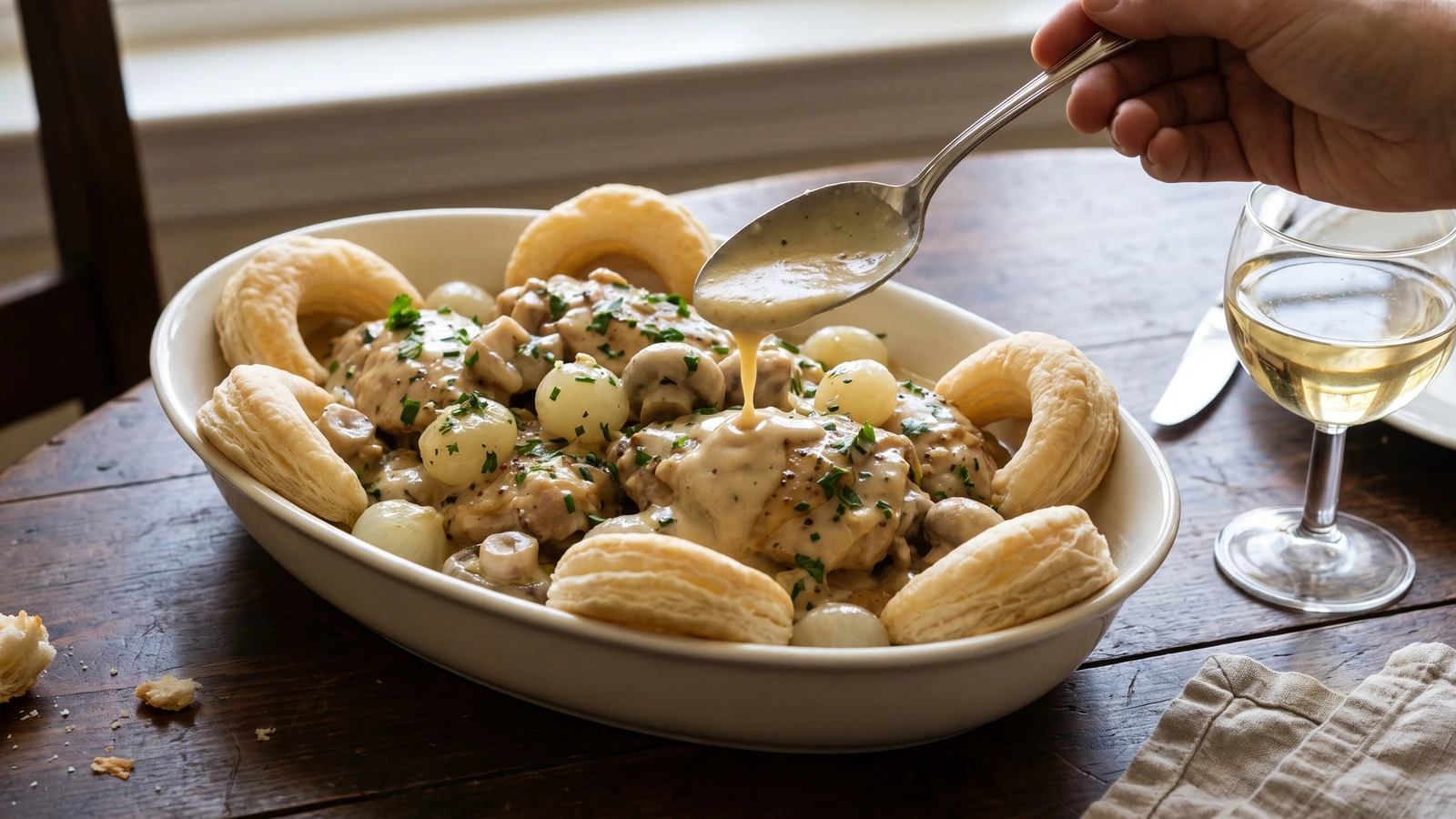
Chicken gently stiffened in butter, never browned, then cooked in its own ivory sauce and finished with pearl onions, mushrooms, cream, yolks, tender herbs, and pale puff-pastry fleurons.
Fricassée de Poulet à l’Ancienne (old-style chicken fricassée) teaches the white braise. Before you touch the pan, know the one true thing: pale is not unfinished. The chicken is raffermi, stiffened in butter without colouring, then flour and white stock turn what is already in the pan into the sauce in which the meat cooks. Brown the butter or the chicken and you may have a pleasant stew, but you no longer have this fricassée.
The book assumed a saucier at the stove, white stock never off the fire, and a pastry station ready to cut delicate fleurons. A salamander has no work here because the finish must remain pale. The home translation is a wide lidded sauté pan, good pale chicken stock, prepared white consommé, and all-butter puff pastry cut with a small cutter. Fluting ten mushroom caps is brigade display and can go; keeping the puff-pastry border, without deep colour, preserves the generous intent of the dish. One cook, one stove, one evening.
What stays untouched is the method: no browning, flour cooked against the chicken, garnishes added near the end, and a final liaison, the yolk-and-cream binding that gives the sauce its satin body. That liaison is the step that matters most. Temper it carefully, take the pan off the heat, and never let the finished sauce boil.
Fricassée de poulet à l’ancienne belongs to the Parisian bourgeois and classical table rather than to a single French province, and its pale sauce reflects a kitchen tradition that prized delicacy without sacrificing richness. Household chicken stew traveled into the grand kitchen, where cooks formalized its flour-bound sauce, pearl-onion and mushroom garnish, yolk-and-cream liaison, and border of pale pastry fleurons. It is often confused with blanquette, but the distinction is practical: fricassée begins by stiffening the raw meat in butter without colour, while blanquette does not.
Quantity
1 whole, 3½ to 4 pounds (1.6 to 1.8 kg), using Fricassée de Veau (No. 1276)
cut into 2 breast halves, 2 wings, 2 thighs, and 2 drumsticks
Quantity
1½ teaspoons (7.5 ml / 9 g), plus more as needed
Quantity
½ teaspoon (2.5 ml / 1 g)
Quantity
6 tablespoons (90 ml / 85 g)
for stiffening the chicken
Quantity
¾ cup plus 1 tablespoon (195 ml / 100 g)
Quantity
5 cups (1.2 L / 1.2 kg)
divided
Quantity
10, about 5 ounces (140 g)
peeled
Quantity
1 cup (240 ml / 240 g)
Quantity
10, about 6 ounces (170 g)
wiped clean, stems trimmed
Quantity
½ standard sheet, about 4½ ounces (125 g)
kept cold
Quantity
2
Quantity
4 tablespoons (60 ml / 60 g)
Quantity
2 tablespoons (30 ml / 28 g)
cut into small cubes
Quantity
2 teaspoons combined (10 ml / 2 g)
finely chopped
| Ingredient | Quantity |
|---|---|
| whole chicken, cut into 8 pieces as for a sautécut into 2 breast halves, 2 wings, 2 thighs, and 2 drumsticks | 1 whole, 3½ to 4 pounds (1.6 to 1.8 kg), using Fricassée de Veau (No. 1276) |
| fine salt | 1½ teaspoons (7.5 ml / 9 g), plus more as needed |
| ground white pepper | ½ teaspoon (2.5 ml / 1 g) |
| unsalted butterfor stiffening the chicken | 6 tablespoons (90 ml / 85 g) |
| all-purpose flour | ¾ cup plus 1 tablespoon (195 ml / 100 g) |
| warm white chicken stockdivided | 5 cups (1.2 L / 1.2 kg) |
| small pearl onionspeeled | 10, about 5 ounces (140 g) |
| prepared white chicken consommé | 1 cup (240 ml / 240 g) |
| small white button mushroom capswiped clean, stems trimmed | 10, about 6 ounces (170 g) |
| all-butter puff pastrykept cold | ½ standard sheet, about 4½ ounces (125 g) |
| large egg yolks | 2 |
| heavy cream | 4 tablespoons (60 ml / 60 g) |
| cold unsalted buttercut into small cubes | 2 tablespoons (30 ml / 28 g) |
| flat-leaf parsley and chivesfinely chopped | 2 teaspoons combined (10 ml / 2 g) |
Heat the oven to 400°F (200°C). Cut the cold puff pastry into 8 to 12 small flowers or fluted rounds, each about 1½ inches (4 cm) wide. Set them on a parchment-lined baking sheet and chill for 10 minutes. Bake until fully risen, dry at the sides, and only faintly blond, 9 to 12 minutes. Lift them out before they bronze; their pale finish belongs to the dish.
Pat the chicken dry and season it with the salt and white pepper. Melt 4 tablespoons of the butter in a wide, heavy sauté pan over medium-low heat. Add the chicken in one uncrowded layer, working in two batches if necessary, and turn the pieces for 5 to 7 minutes, just until every surface turns opaque and firms slightly. This is raffermir: stiffening the flesh without browning it. Add the remaining cooking butter as needed between batches.
Return all the chicken to the pan. Following the procedure of Fricassée de Veau (No. 1276), sprinkle the flour evenly over the pieces and turn them gently until every surface is dusted. Cook for 3 minutes over low heat, moving the chicken and scraping the pan so the flour loses its raw smell without taking colour. Pour in 4½ cups of the warm white stock a little at a time, stirring around and beneath the chicken after each addition. Bring the sauce just to a boil while stirring, then immediately lower it to a bare tremble.
Cover the sauté pan and cook the chicken at the gentlest simmer for 20 minutes, turning the pieces once and scraping the bottom carefully. Meanwhile, put the pearl onions and white consommé in a small saucepan. Cover and poach at a bare tremble for 12 to 18 minutes, until a knife tip enters the onions without resistance but they still hold their shape. Drain them and keep them ready.
Ten minutes before the chicken is finished, add the cooked pearl onions and raw mushroom caps to the fricassée. Cover and simmer gently for 8 to 10 minutes, stirring the sauce around the pieces once. The chicken is ready when the breasts register at least 160°F to 165°F (71°C to 74°C) and the thighs reach 170°F to 175°F (77°C to 79°C). If the breasts finish first, lift them out and keep them covered while the legs complete their cooking.
Whisk the egg yolks and cream together in a heatproof bowl until completely smooth. Lift the cooked chicken, onions, and mushrooms into a warm, deep serving dish and cover them loosely. Skim excess fat from the sauce, then simmer it only until it coats the back of a spoon. If it is too thick, loosen it with some of the reserved stock; if it runs like broth, reduce it briefly before adding the liaison.
Take the pan off the heat. Whisk about 1 cup of hot sauce into the yolk-and-cream liaison, adding it slowly at first, then whisk the tempered liaison back into the pan. Return it to the lowest heat and stir constantly for 1 to 2 minutes, until the sauce turns satin-smooth and lightly thickens. Do not let it simmer. Remove it from the heat and whisk in the cold butter a few cubes at a time.
Taste the sauce for salt and white pepper, then spoon it generously over the chicken, onions, and mushrooms. Scatter the chopped parsley and chives over the surface at the last moment. Arrange the pale puff-pastry fleurons around the fricassée, where they can catch the sauce without losing all their crisp layers. Serve immediately. À table!
1 serving (about 600g)
Culinary guides, cultural storytelling, and the editorial depth that makes cooking meaningful.
Discover Culinary ExplorerChef Juliette
John Dory has the delicacy of sole and the firmness of turbot. A light flouring, a quick butter sauté, and nut-brown beurre noisette show exactly why looks never mattered.

Chef Juliette
Fresh haddock proves its delicacy in the meunière pan: a fine flour crust, moist pearly flakes, and beurre noisette sharpened with lemon and parsley, ready from one skillet in half an hour.

Chef Juliette
Éperlans à l’Anglaise turns small fish into a lesson in disciplined coating: boned smelts under a close, crisp crumb, pan-fried in clarified butter and finished with bright, half-melted maître d’hôtel butter.

Chef Juliette
Tiny smelts, shallot, mushrooms, white wine, gratin sauce, and fine bread raspings meet a fierce oven, where the fish must turn tender in the same breath the buttered crust bronzes.