
Chef Juliette
Smelt (Éperlans)
Tiny éperlans, lightly floured and fried until their tails stand crisp, arrive in a generous heap on a napkin with fried parsley and grooved lemon, a weeknight lesson in heat and restraint.
A cooking platform built around craft, culture, and the stories behind what we eat.
Created by Chef Juliette
Based on No. 1664a, Chicken Croquettes and Cutlets, from Le Guide Culinaire (1907) by Auguste Escoffier
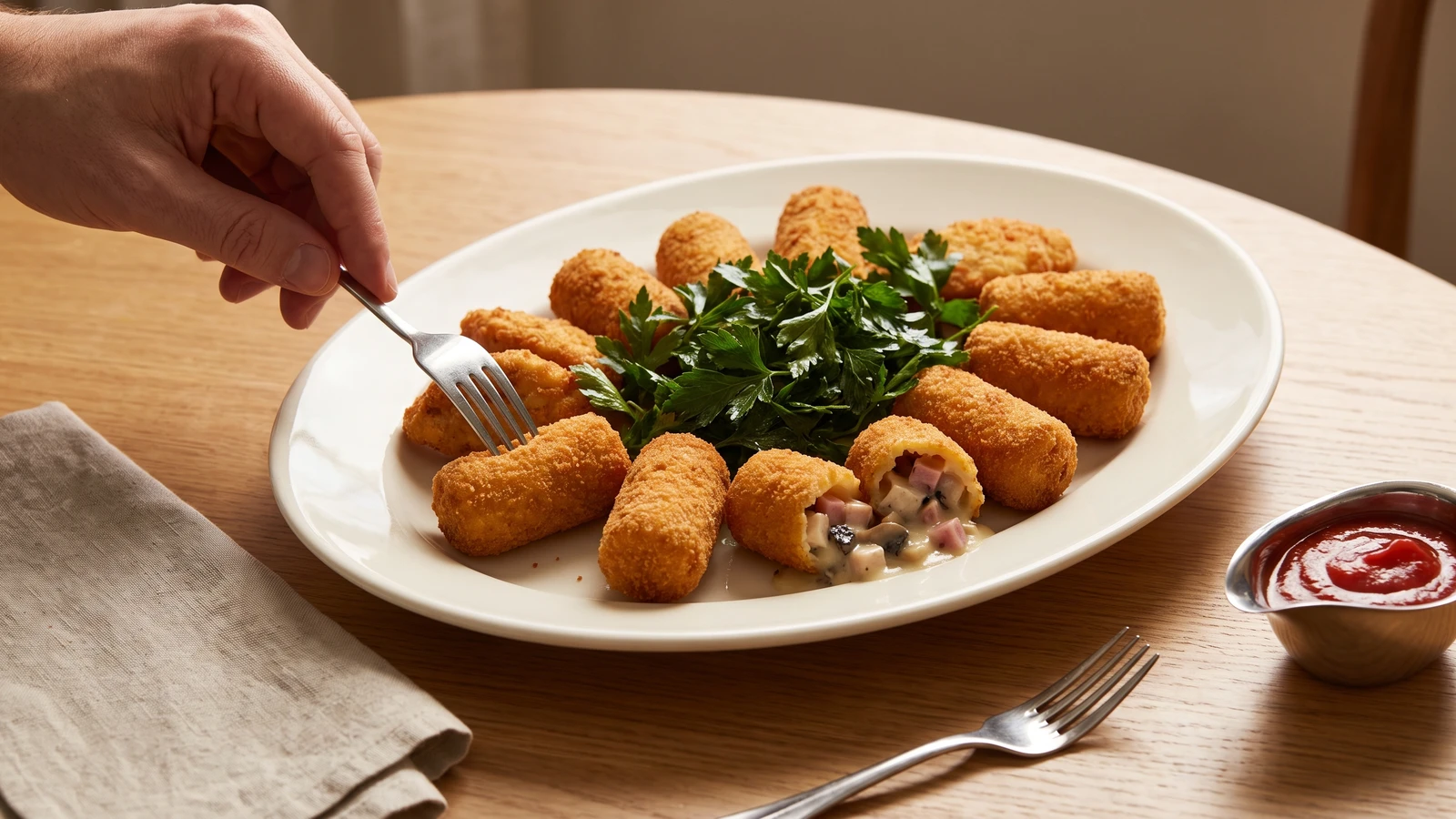
Cold paste is the whole discipline: chicken, mushroom, tongue, and truffle bound in reduced Allemande, shaped two ways, sealed in fine crumbs, and fried until crisp outside and creamy within.
Croquettes et côtelettes de volaille (chicken croquettes and cutlets) teach the discipline of a properly bound filling. The chicken, mushroom, tongue, and truffle must remain distinct inside a reduced Allemande that holds them together without swallowing them. Cold paste is the one true thing to know before you touch the frying pan: if the filling isn't firm, the crumb coat cannot protect it.
The original kitchen assumed a saucier with finished Allemande at hand, a stockpot never cold, another pair of hands for shaping, cutlet moulds, and an open kettle of fat. Here the professional mixture is halved without disturbing its proportions, giving ten proper two-ounce pieces. A small batch of finished Allemande, a broad pan, your hands, and a thermometer are the honest home equivalents. The moulds and napkin under the finished croquettes were service scaffolding and can go; the reduction, yolk binding, hard chilling, fine crumb, and separate sauce are the dish and must stay.
Fried correctly, each piece wears a close golden shell that gives under the teeth to a creamy, finely diced centre. Shape them only when the paste is cold enough to lift cleanly from the tray. If it smears, stop and chill it again. One cook, one stove, one evening.
Croquettes and cutlet-shaped preparations belong to the cuisine classique of Parisian kitchens and bourgeois dining rooms, where cooked poultry could be transformed through sauce work rather than merely reheated. Croquette comes from croquer, to crunch, while the cutlet in this preparation is not a cut of meat at all, only the shape given to the same bound paste. The luxurious tongue and truffle show how a thrifty household method traveled into grand service without losing its original purpose: enclosing tender remnants beneath a crisp coat.
Quantity
1½ cups (360 ml / 225 g)
skin, cartilage, and bones removed; cut into 5 mm dice
Quantity
½ cup (120 ml / 85 g)
cut into 5 mm dice
Quantity
½ cup (120 ml / 85 g)
cut into 5 mm dice
Quantity
⅓ cup (80 ml / 55 g)
drained and cut into 5 mm dice
Quantity
⅔ cup (140 ml / 145 g)
Quantity
2
Quantity
1 tablespoon (15 ml / 14 g)
melted, for the tray and filling surface
Quantity
¼ cup (60 ml / 30 g)
for the shaping board
Quantity
2
for the anglaise
Quantity
1 tablespoon (15 ml / 14 g)
for the anglaise
Quantity
½ teaspoon (2.5 ml / 3 g)
for the anglaise
Quantity
2 cups (480 ml / 180 g)
Quantity
6 cups (1.5 litres / 1.38 kg)
Quantity
1 loosely packed cup (240 ml / 30 g)
large stems removed and leaves thoroughly dried
| Ingredient | Quantity |
|---|---|
| poached or roast chicken meatskin, cartilage, and bones removed; cut into 5 mm dice | 1½ cups (360 ml / 225 g) |
| cooked mushroomscut into 5 mm dice | ½ cup (120 ml / 85 g) |
| cooked salted ox tongue or York hamcut into 5 mm dice | ½ cup (120 ml / 85 g) |
| cooked or preserved black truffledrained and cut into 5 mm dice | ⅓ cup (80 ml / 55 g) |
| very reduced and finished Sauce Allemande | ⅔ cup (140 ml / 145 g) |
| large egg yolks | 2 |
| unsalted buttermelted, for the tray and filling surface | 1 tablespoon (15 ml / 14 g) |
| plain flourfor the shaping board | ¼ cup (60 ml / 30 g) |
| large eggsfor the anglaise | 2 |
| neutral oilfor the anglaise | 1 tablespoon (15 ml / 14 g) |
| fine saltfor the anglaise | ½ teaspoon (2.5 ml / 3 g) |
| fine dry breadcrumbs | 2 cups (480 ml / 180 g) |
| neutral frying oil | 6 cups (1.5 litres / 1.38 kg) |
| flat-leaf parsleylarge stems removed and leaves thoroughly dried | 1 loosely packed cup (240 ml / 30 g) |
Weigh the chicken only after removing every scrap of skin, bone, and cartilage. Cut it, the mushrooms, the tongue or ham, and the truffle into regular 5 mm dice. Keep the pieces distinct rather than mincing them; the finished centre should show each constituent when cut, not collapse into a paste.
Put the diced chicken, mushrooms, tongue or ham, and truffle in a broad sauté pan. Fold in the very reduced and finished Sauce Allemande, then cook over medium heat for 5 to 7 minutes, stirring and turning the mixture so nothing catches. This is the old instruction to dry the preparation over an open fire, translated to a home burner. It is ready when a spatula leaves a clean trail across the pan and the mixture gathers into a mound instead of flowing back.
Remove the pan completely from the heat and wait 30 seconds. Beat the yolks briefly, pour them over the mixture, and stir quickly until the filling thickens and shines. Do not return it to a boil, which would turn the yolks grainy. If the mixture still spreads like sauce, keep stirring off the heat for a minute before judging it; the yolks and the coming chill both add body.
Brush a shallow tray with half the melted butter and spread the filling about 1.5 cm thick. Brush the exposed surface lightly with the remaining butter so no crust forms. Refrigerate uncovered until cold, then cover and continue chilling for at least 3 hours, or overnight, until the paste lifts in firm pieces. If it still bends and smears when fully cold, ça se rattrape: scrape it back into the pan, dry it over the lowest heat until it holds a clean trail, then spread and chill it again. Don't add breadcrumbs to the filling; they would dull the sauce.
Dust the work surface lightly with flour. Divide the cold paste into ten portions of about 2 ounces (55 g) each. Shape five into short corks or neat rectangles for the croquettes, then flatten the other five into oval cutlet shapes with one end slightly narrowed. No mould is required; cupped hands and a bench scraper do the work perfectly well. Return any piece that softens to the refrigerator before coating.
Make the anglaise (beaten egg, oil, and seasoning) by whisking the whole eggs with the neutral oil and salt until completely fluid. Dip each shaped piece into the anglaise, let the excess fall away, then roll it in the fine breadcrumbs. Press gently so the coat meets every edge, and give each piece its final clean shape. Chill the coated pieces for 20 to 30 minutes; this short rest sets the coating and keeps it sealed in the fat.
Pour the frying oil into a deep, heavy saucepan, leaving the pan no more than half full, and heat it to 180°C (355°F). Fry one croquette first. It should bubble briskly, turn evenly golden, and reach a hot centre in 3 to 4 minutes. If it leaks, stop before frying the rest. Recoat any visible seams, chill the pieces hard again, and return the oil to temperature. Ça se rattrape. Warm paste and cool fat are the usual culprits.
Fry the remaining croquettes and cutlets in small batches, allowing the oil to recover to 180°C (355°F) between them. The thinner cutlets may need only 2½ to 3 minutes, while the cork-shaped croquettes need 3 to 4. Lift them when the crumbs are deep butter-gold and crisp, then drain on a wire rack rather than paper, which traps moisture against the underside.
With the parsley completely dry, lower it carefully into the hot oil for 10 to 15 seconds, shielding your hand from any splatter. Lift it as soon as it turns crisp and a shade darker, then drain and salt it lightly. Arrange the croquettes and cutlets in a crown on a warm platter with the fried parsley in the middle. Serve Tomato Sauce or Sauce Périgueux separately in a sauceboat, never poured over the crisp coating. À table!
1 serving (about 215g)
Culinary guides, cultural storytelling, and the editorial depth that makes cooking meaningful.
Discover Culinary ExplorerChef Juliette
Tiny éperlans, lightly floured and fried until their tails stand crisp, arrive in a generous heap on a napkin with fried parsley and grooved lemon, a weeknight lesson in heat and restraint.

Chef Juliette
Brandade de Morue turns salt cod, warm olive oil, and milk into a pale, silky emulsion: keep everything warm and add the oil slowly, then crown the generous dome with butter-fried bread.

Chef Juliette
Salt cod worked warm with cream, one patient spoonful at a time, until the rough flakes become a glossy Nîmes paste, domed generously and ringed with butter-fried croutons for the table.

Chef Juliette
Wine-poached char packed in its earthenware crock beneath butter gold: a make-ahead first course that turns careful cooling, thorough boning, and one unbroken seal into quiet abundance.