
Chef Juliette
Poussins Cendrillon
Butter-browned poussins disappear beneath fine pork forcemeat, melting caul, and a golden crumb jacket, then meet truffle-rich Périgueux sauce at the table: gentle heat is the whole discipline.
A cooking platform built around craft, culture, and the stories behind what we eat.
Created by Chef Juliette
Based on No. 1651, Poussins à la Viennoise, from Le Guide Culinaire (1907) by Auguste Escoffier
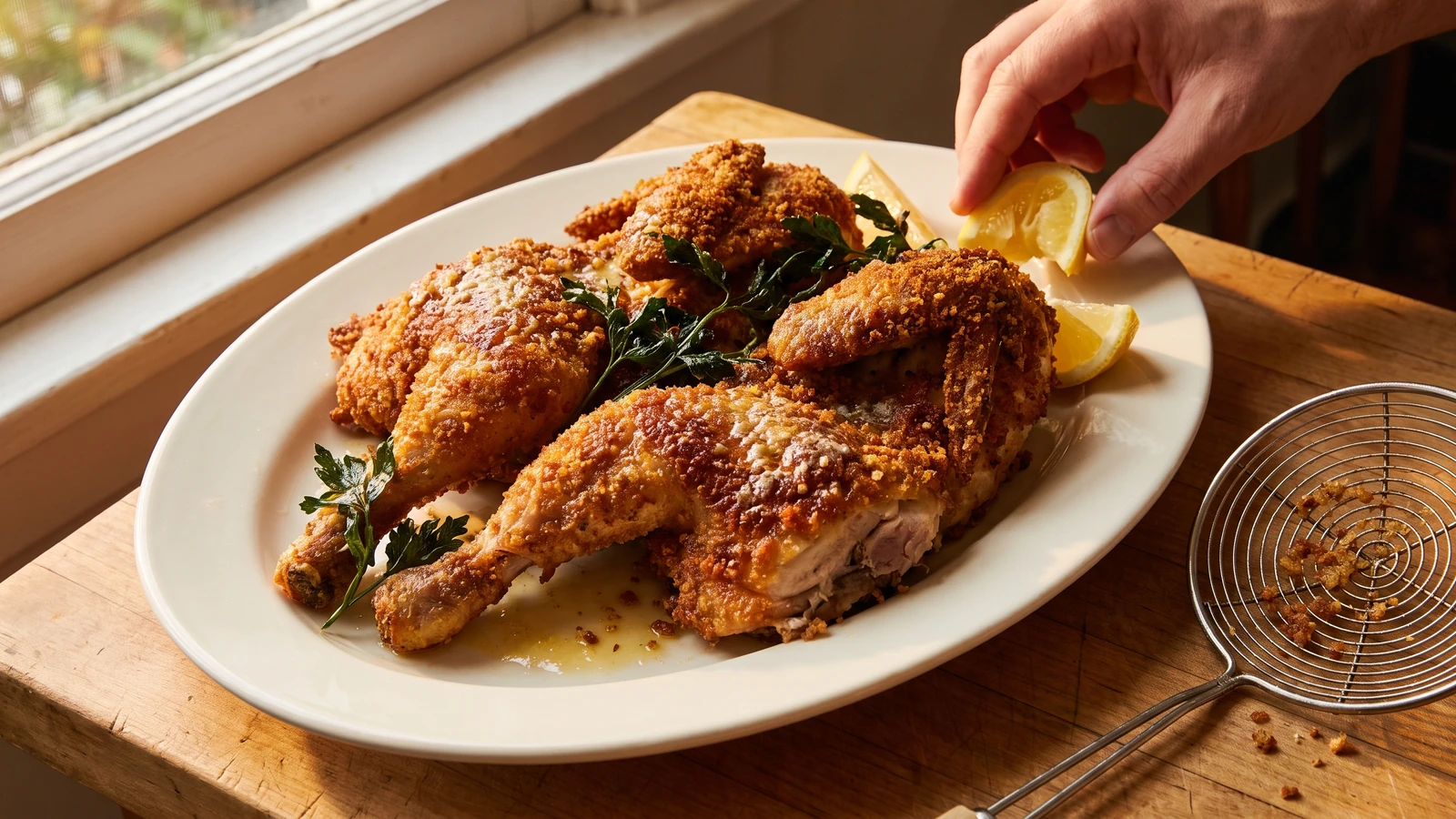
Golden poussin quarters in a close à l'anglaise crumb, fried fast enough to stay juicy, then carried straight to the table beneath crisp parsley with lemon ready at the rim.
Poussins à la Viennoise (quartered young chickens in a flour, egg, and breadcrumb coat, fried crisp) teaches one true thing: frying temperature is an ingredient. The fat must be hot enough to set the à l'anglaise coating at once, before the tender birds surrender their juices, but steady enough that the crumbs bronze before they burn.
The old kitchen needed no saucier, stockpot, or salamander for this dish. It assumed a broad professional fryer, a commis to bread the birds, and enough hands to cook every portion just before service. For one cook, one stove, one evening, two poussins go into a heavy pot in two batches, with a thermometer guarding the heat and a low oven holding the first batch briefly. The folded napkin was service scaffolding and trapped grease, so it gives way to a wire rack and a warm platter; the loose pyramid remains because its generosity belongs at the table. The à l'anglaise coating and last-minute frying are the dish, and they stay.
When it is right, the crust is deep gold and close to the meat, the parsley curls dark green around the heap, and lemon cuts through each rich, crisp bite. Bring the oil fully to 175°C before the first piece enters, then defend that temperature. That is the step that decides everything.
À la Viennoise points toward Vienna, but Poussins à la Viennoise belongs in this form to the French grand-kitchen repertoire, which borrowed the city's breaded-cutlet manner and applied it to quartered young chickens. Its panure à l'anglaise follows the French flour, beaten egg, and breadcrumb sequence, while fried parsley and lemon sharpen the richness of the hot fat. The pyramid on a folded napkin was a formal service custom, not the dish's essential identity; the enduring preparation is breaded poussin fried at the last moment and served very hot.
Quantity
2, about 1 to 1¼ pounds (450 to 550 g) each
quartered
Quantity
1¾ teaspoons (9 ml / 10 g)
Quantity
½ teaspoon (2.5 ml / 1 g)
Quantity
1 cup (240 ml / 120 g)
Quantity
3
beaten until completely blended
Quantity
2½ cups (590 ml / 225 g)
Quantity
8 cups (1.9 liters / 1.75 kg), or enough for a 2-inch (5 cm) depth
Quantity
2 loosely packed cups (475 ml / 50 g)
washed and dried completely
Quantity
2, about 10 ounces (280 g) total
each cut into 4 wedges
| Ingredient | Quantity |
|---|---|
| poussinsquartered | 2, about 1 to 1¼ pounds (450 to 550 g) each |
| fine sea salt | 1¾ teaspoons (9 ml / 10 g) |
| freshly ground black pepper | ½ teaspoon (2.5 ml / 1 g) |
| plain flour | 1 cup (240 ml / 120 g) |
| large eggsbeaten until completely blended | 3 |
| fine dry white breadcrumbs | 2½ cups (590 ml / 225 g) |
| neutral high-heat oil, such as sunflower or grapeseed | 8 cups (1.9 liters / 1.75 kg), or enough for a 2-inch (5 cm) depth |
| flat-leaf parsley leaves and tender sprigswashed and dried completely | 2 loosely packed cups (475 ml / 50 g) |
| medium lemonseach cut into 4 wedges | 2, about 10 ounces (280 g) total |
If the butcher has not quartered the poussins, cut along both sides of each backbone with poultry shears, then divide each bird through the breastbone. Separate each leg quarter from its breast-and-wing quarter at the natural seam, giving you eight pieces. Pat every surface completely dry, then season evenly with all the salt and pepper. Wet poultry weakens the coating and spits in hot fat, so take this drying seriously.
Arrange the flour, beaten eggs, and breadcrumbs in three wide shallow dishes. Dredge each poussin piece lightly in flour and shake off every loose patch, coat it fully in egg, then press it into the breadcrumbs until the surface is evenly covered. Set the pieces on a wire rack for 10 minutes while the oil heats. This short rest binds the panure à l'anglaise to the bird; if a bare patch appears, press on fresh crumbs before frying. Once the piece enters the fat, rebreading is no longer possible.
Set a wire rack over a rimmed tray and heat the oven to 200°F (95°C). Pour the oil into a heavy pot, leaving the vessel no more than half full, and heat it to 350°F (175°C). Fry the completely dry parsley in three small handfuls, lowering each with a spider and covering the pot loosely with a splatter screen. It will bubble fiercely for 10 to 15 seconds, then quiet as the leaves turn crisp and dark green. Lift the parsley to the rack immediately. If the leaves are damp, stop and dry them again; water and hot fat do not negotiate.
Return the oil to 350°F (175°C), then lower the four leg quarters into it one at a time, moving away from yourself. Leave them undisturbed for 2 minutes so the crust can set, then turn occasionally and maintain the oil between 330°F and 345°F (165°C and 175°C). Fry for 10 to 12 minutes, until the coating is a deep, even gold and the thickest part of each thigh reaches at least 165°F (74°C), clear of the bone. If the temperature falls below 310°F (155°C) and the crust looks pale and greasy, lift out two pieces, let the oil recover, and return them. Ça se rattrape. If the crumbs darken before the meat is ready, lower the oil to 315°F (157°C) and finish gently. Drain on the rack and hold in the low oven.
Bring the oil back to 350°F (175°C) and fry the four breast-and-wing quarters by the same method for 7 to 9 minutes. Keep them still until the coating sets, then turn as needed for even colour. Remove each piece as soon as its thickest part reaches 165°F (74°C), measuring away from the bone; these smaller breasts have little patience, and another few minutes trades juice for nothing. Drain everything on the rack for 2 minutes, never directly on paper, which traps oil against the crust.
Arrange the poussin quarters in a loose pyramid on a warm oval platter, placing the leg pieces below and the smaller breast pieces above. Surround the heap generously with fried parsley and tuck the lemon wedges around the rim. Carry it straight to the table while the crust is still crisp and the meat is very hot. À table!
1 serving (about 250g)
Culinary guides, cultural storytelling, and the editorial depth that makes cooking meaningful.
Discover Culinary ExplorerChef Juliette
Butter-browned poussins disappear beneath fine pork forcemeat, melting caul, and a golden crumb jacket, then meet truffle-rich Périgueux sauce at the table: gentle heat is the whole discipline.

Chef Juliette
Two poussins stuffed with white truffle and pork fat, bronzed in butter, nested in Rizotto à la Piémontaise, glazed under Parmesan, and finished with gleaming beurre noisette.

Chef Juliette
Four butter-browned poussins hide a tender gratin forcemeat stuffing, then leave the cocotte under lemon and crisp crumbs fried in beurre noisette: generous classical poultry for one attentive cook.

Chef Juliette
Two little birds, split flat, brushed with Dijon, and crumbed before a gentle grilling. Keep them off the fierce fire and the crust bronzes just as the meat turns succulent.