
Chef Juliette
John Dory (St. Pierre)
John Dory has the delicacy of sole and the firmness of turbot. A light flouring, a quick butter sauté, and nut-brown beurre noisette show exactly why looks never mattered.
A cooking platform built around craft, culture, and the stories behind what we eat.
Created by Chef Juliette
Based on No. 1632, Poulet de Grains Bonne Femme, from Le Guide Culinaire (1907) by Auguste Escoffier
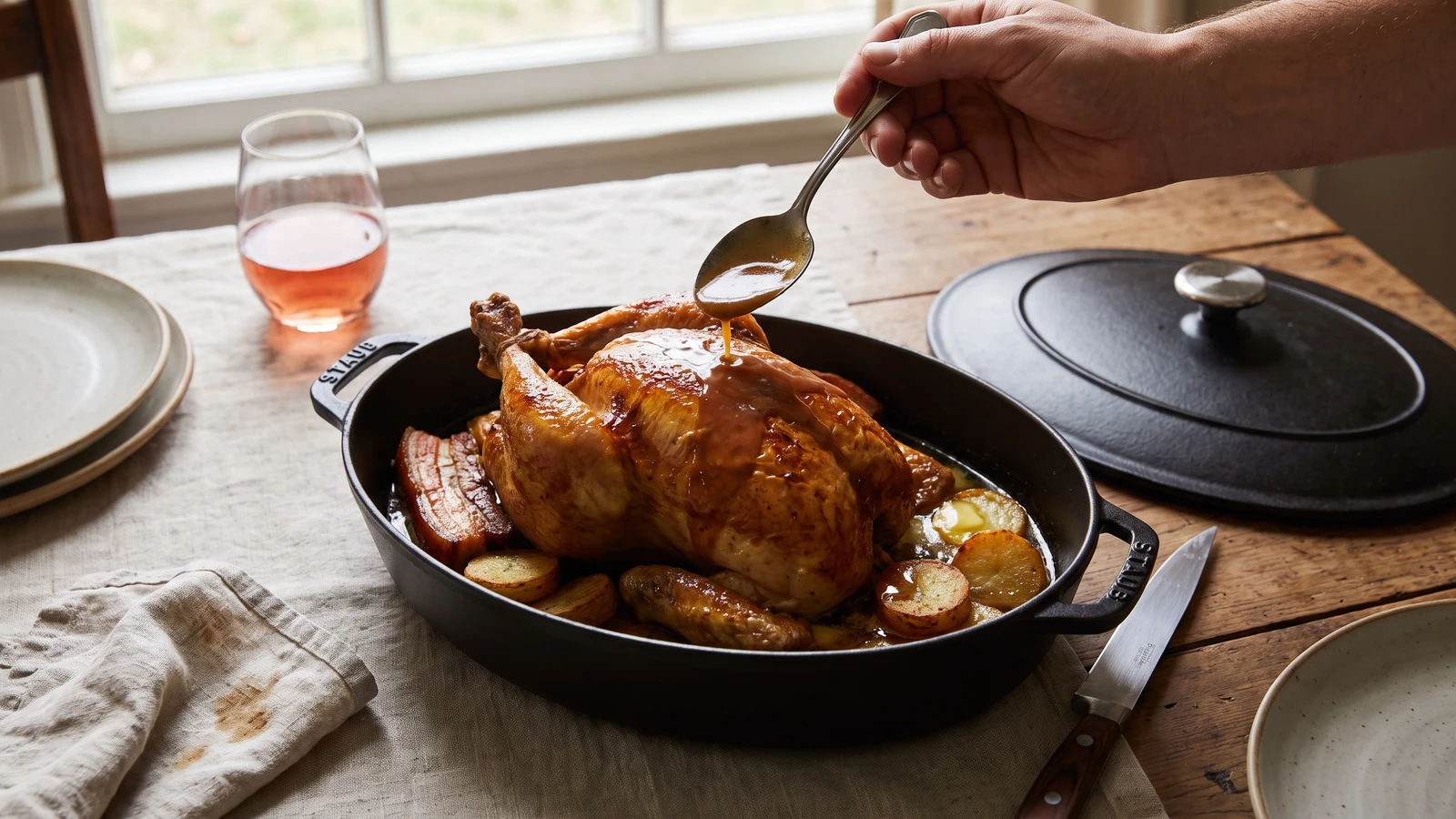
A whole chicken, salt pork, and cork-cut potatoes share one cocotte, taking their bronze from the same fat before a final spooning of veal gravy brings the plain bourgeois dish together.
Poulet de Grains Bonne Femme (grain-fed chicken in the good-wife style) teaches one true thing: every component must take its color from the same fat, in order. Pork first, chicken second, potatoes last. That pork-enriched butter and the fond left behind are the dish's foundation, so don't wipe the cocotte clean between them.
The classical entry assumed a saucier within reach, veal gravy beside a stockpot never off the fire, and enough hands to move food between a frying pan and an oval cocotte. It asks for no salamander finish, and neither do we. A prepared veal gravy, or concentrated veal glaze diluted to a light pouring consistency, is the honest home equivalent; using the same cocotte for the successive browning removes brigade scaffolding without changing the sequence. The original ratio remains intact: four ounces of pork, two-thirds of a pound of potatoes, and only a few spoonfuls of gravy for one small chicken. One cook, one stove, one evening.
Perfectly turned potatoes are service-room polish. Approximate cork-shaped cylinders cut into even roundels will brown and cook just as they should; flawless knife geometry can go, but equal thickness and patient coloring must stay. Before you meet the pan, remember the deciding step: brown the chicken patiently in the pork-enriched butter without letting the fond turn black.
Poulet de Grains Bonne Femme belongs to cuisine bourgeoise, the well-supplied French household table whose practical cocotte dishes were taken up and codified by Parisian classical kitchens. Its path ran from household pot to grand repertoire and back again: a young grain-fed bird, pork, potatoes, and a last spoonful of veal gravy, served without changing vessels. Bonne femme names a domestic register of plain abundance, not a specific province or careless cooking; the ordered use of one fat gives this modest list its stature.
Quantity
1 chicken (3 1/2 to 4 lb / 1.6 to 1.8 kg)
giblets removed
Quantity
4 oz (115 g), prepared by Blanchings (No. 273)
cut into 1/4-inch slices
Quantity
2 tablespoons (30 ml / 28 g)
Quantity
about 2 cups (475 ml / 300 g)
peeled, shaped like stout corks, and cut into 1/2-inch roundels
Quantity
3 tablespoons (45 ml / 45 g)
warmed; alternatively use 1 tablespoon (15 ml / 15 g) concentrated veal glaze mixed with 2 tablespoons (30 ml / 30 g) water
Quantity
1/2 teaspoon (2.5 ml / 3 g), plus only as needed
| Ingredient | Quantity |
|---|---|
| small whole grain-fed chickengiblets removed | 1 chicken (3 1/2 to 4 lb / 1.6 to 1.8 kg) |
| unsmoked fresh pork belly or salt porkcut into 1/4-inch slices | 4 oz (115 g), prepared by Blanchings (No. 273) |
| unsalted butter | 2 tablespoons (30 ml / 28 g) |
| waxy potatoespeeled, shaped like stout corks, and cut into 1/2-inch roundels | about 2 cups (475 ml / 300 g) |
| prepared veal gravywarmed; alternatively use 1 tablespoon (15 ml / 15 g) concentrated veal glaze mixed with 2 tablespoons (30 ml / 30 g) water | 3 tablespoons (45 ml / 45 g) |
| fine sea salt | 1/2 teaspoon (2.5 ml / 3 g), plus only as needed |
Heat the oven to 375°F (190°C). Pat the chicken dry inside and out, then season it lightly with the salt. Use less if the prepared pork is strongly cured, because both the pork and veal gravy will bring salt of their own. Tie the legs together if they splay widely so the bird browns and fits neatly in the cocotte.
Use the pork already prepared by Blanchings (No. 273), leaving that separate operation to its own entry. Melt the butter in a 5 to 6-quart cocotte over medium heat, add the pork slices, and fry them until their edges color and their fat begins to render, about 5 minutes. Lift the slices out and let them drain. Keep every clear spoonful of fat and every brown mark in the cocotte.
Set the chicken breast-side down in the pork-enriched butter. Brown it patiently over medium heat, turning with tongs so the breast, legs, and both sides become a deep, even gold, 12 to 15 minutes in all. If the skin clings, wait another minute before turning; properly browned skin releases more willingly. Lift the bird onto a plate once colored.
Trim the peeled potatoes into approximate stout cylinders, then cut them crosswise into even 1/2-inch roundels. Perfect tourning is brigade scaffolding; matching thickness is the part that matters. Fry the roundels in the same fat for 6 to 8 minutes, turning until both flat faces show patches of gold. Return the chicken to the cocotte, arrange the pork slices against it, and tuck the potatoes closely around the bird.
Cover the cocotte and bake for 50 to 65 minutes, until the potato roundels yield cleanly to a knife and the chicken reaches at least 165°F (74°C) at the thickest part without touching bone, with the thigh nearer 170°F (77°C). If the chicken is ready before the potatoes, lift it out and rest it loosely covered while the potatoes cook for another 10 minutes. If the potatoes soften first, remove them with the pork and let the bird finish alone. Either way, the dish stays whole.
Rest the chicken in the covered cocotte for 10 minutes. Warm the prepared veal gravy until fluid; if using the home equivalent, stir the concentrated veal glaze and water together until smooth. Spoon the three tablespoons over the bird only when you are ready to serve, letting a little run among the pork and potatoes. Taste one potato before adding any further salt, then carry the cocotte directly to the table. À table!
1 serving (about 300g)
Culinary guides, cultural storytelling, and the editorial depth that makes cooking meaningful.
Discover Culinary ExplorerChef Juliette
John Dory has the delicacy of sole and the firmness of turbot. A light flouring, a quick butter sauté, and nut-brown beurre noisette show exactly why looks never mattered.

Chef Juliette
Fresh haddock proves its delicacy in the meunière pan: a fine flour crust, moist pearly flakes, and beurre noisette sharpened with lemon and parsley, ready from one skillet in half an hour.

Chef Juliette
Éperlans à l’Anglaise turns small fish into a lesson in disciplined coating: boned smelts under a close, crisp crumb, pan-fried in clarified butter and finished with bright, half-melted maître d’hôtel butter.

Chef Juliette
Tiny smelts, shallot, mushrooms, white wine, gratin sauce, and fine bread raspings meet a fierce oven, where the fish must turn tender in the same breath the buttered crust bronzes.