
Chef Juliette
Filets
Filets de volaille sautés teach the discipline of even cutting and last-minute cooking: flour lightly, gild quickly in clarified butter, and serve before a tender chicken breast has time to harden.
A cooking platform built around craft, culture, and the stories behind what we eat.
Created by Chef Juliette
Based on No. 1621, Suprêmes de Volaille Verneuil, from Le Guide Culinaire (1907) by Auguste Escoffier
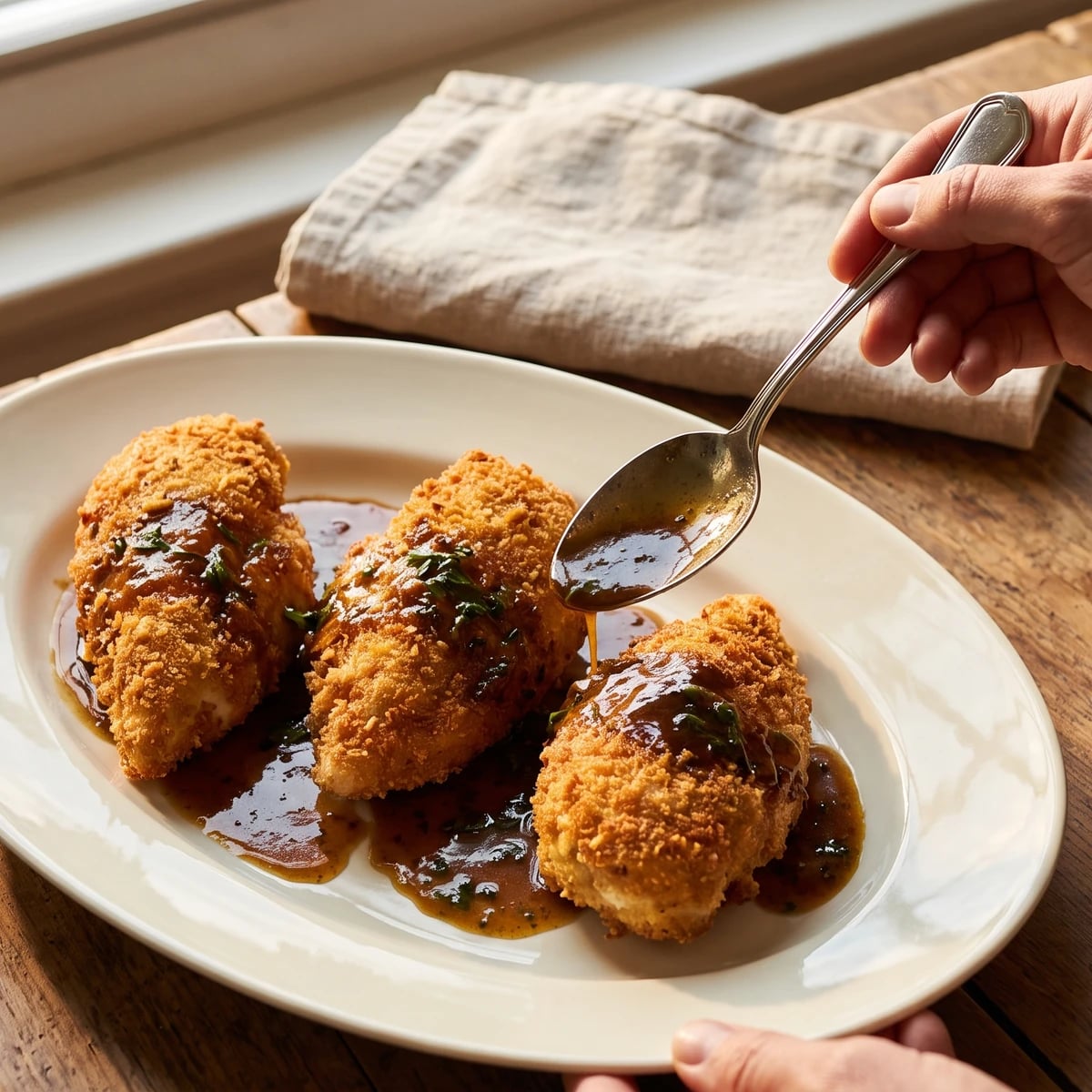
Crisp, butter-gold chicken under glossy Sauce Colbert, with truffle-flecked artichoke purée beside it: a lesson in keeping breading dry, fat hot, and the final sauce perfectly timed.
Suprêmes de Volaille Verneuil (crumbed chicken breast fillets with Sauce Colbert and truffled artichoke purée) teaches one exact thing: a breaded crust is only as good as the dry surface beneath it. The crust is pané à l’anglaise (floured, egged, and breadcrumbed), then cooked in clarified butter until butter-gold. Sauce Colbert brings gloss and savor; the artichoke purée brings quiet sweetness and black truffle.
The book assumed a saucier on staff, stock never off the fire, enough hands to crumb a full service at once, and a salamander close by, although this crust belongs in the sauté pan, not under overhead heat. At home, a concentrated stock reduction stands in for the permanent meat glaze, a rack replaces the waiting station, and unseasoned frozen artichoke hearts spare one cook the pile of turned fresh bottoms. The batch is four. The intent is untouched: Orly marination, Anglaise, clarified butter, Colbert, and truffle. One cook, one stove, one evening.
The queue of brigade pans is scaffolding and can go; the dry chicken, tight crumb, hot butter, and last-minute emulsion are the dish and must stay. Before touching the flour, press every suprême completely dry. That one small severity decides whether the coating clings or slides into the pan.
Suprêmes de Volaille Verneuil belongs to the Parisian classical repertoire, where named preparations organized service across sauces, garnishes, and prized cuts. Despite the place-name, the formula is not presented as a Norman regional chicken dish: Verneuil identifies this composed service of crumbed suprêmes, Sauce Colbert, and artichoke purée with truffle. Its cross-references show the canon working as a living grammar, with separately mastered marinades and anglaise breading brought together for a formal table.
Quantity
4 (about 1½ lb / 680 g total), for the marinating stage of Suprêmes de Volaille Orly (No. 1609)
evened to ⅝ inch / 1.5 cm thick
Quantity
½ cup (120 ml / 120 g) Cooked Marinade for Venison (No. 168)
fully cooled
Quantity
2 teaspoons (10 ml / 12 g)
divided
Quantity
½ teaspoon (2.5 ml / 1 g)
divided
Quantity
¾ cup (180 ml / 90 g)
Quantity
½ cup (120 ml / 120 g) Anglaise (for Egg-and-bread-crumbing) (No. 174)
Quantity
2 cups (480 ml / 140 g)
Quantity
¾ cup (180 ml / 165 g)
Quantity
3 cups (720 ml / 720 g)
Quantity
1 teaspoon (5 ml / 3 g)
Quantity
7 tablespoons (105 ml / 98 g)
divided
Quantity
1 tablespoon (15 ml / 15 g)
Quantity
2 teaspoons (10 ml / 2 g)
finely chopped
Quantity
2 teaspoons (10 ml / 3 g)
finely chopped
Quantity
⅛ teaspoon (0.6 ml / 0.2 g)
Quantity
About 4 cups (960 ml / 510 g)
thawed and drained
Quantity
½ cup (120 ml / 122 g)
divided
Quantity
2 tablespoons (30 ml / 15 g)
finely minced
Quantity
1 tablespoon (15 ml / 15 g)
| Ingredient | Quantity |
|---|---|
| skinless, boneless chicken breast suprêmesevened to ⅝ inch / 1.5 cm thick | 4 (about 1½ lb / 680 g total), for the marinating stage of Suprêmes de Volaille Orly (No. 1609) |
| Cooked Marinade for Venisonfully cooled | ½ cup (120 ml / 120 g) Cooked Marinade for Venison (No. 168) |
| fine sea saltdivided | 2 teaspoons (10 ml / 12 g) |
| ground white pepperdivided | ½ teaspoon (2.5 ml / 1 g) |
| all-purpose flour | ¾ cup (180 ml / 90 g) |
| Anglaise for egg-and-bread-crumbing | ½ cup (120 ml / 120 g) Anglaise (for Egg-and-bread-crumbing) (No. 174) |
| fine fresh white breadcrumbs | 2 cups (480 ml / 140 g) |
| clarified butter | ¾ cup (180 ml / 165 g) |
| unsalted brown chicken stock | 3 cups (720 ml / 720 g) |
| unflavored powdered gelatin (optional) | 1 teaspoon (5 ml / 3 g) |
| cold unsalted butterdivided | 7 tablespoons (105 ml / 98 g) |
| fresh lemon juice | 1 tablespoon (15 ml / 15 g) |
| fresh tarragonfinely chopped | 2 teaspoons (10 ml / 2 g) |
| flat-leaf parsleyfinely chopped | 2 teaspoons (10 ml / 3 g) |
| cayenne pepper | ⅛ teaspoon (0.6 ml / 0.2 g) |
| unseasoned frozen artichoke heartsthawed and drained | About 4 cups (960 ml / 510 g) |
| heavy creamdivided | ½ cup (120 ml / 122 g) |
| black trufflefinely minced | 2 tablespoons (30 ml / 15 g) |
| preserved truffle juice (optional) | 1 tablespoon (15 ml / 15 g) |
Set the suprêmes in a shallow nonreactive dish with the fully cooled Cooked Marinade for Venison (No. 168), applying the one-hour marinating treatment prescribed by Suprêmes de Volaille Orly (No. 1609). Turn them once, then drain and discard the used marinade. Press every surface dry with clean towels and season with half the salt and white pepper. Wet chicken sheds its coating, so be severe here; if the surface still glistens, leave it uncovered in the refrigerator for five minutes before proceeding.
If using gelatin, bloom it in 1 tablespoon of the cold stock. Pour the remaining stock into a wide saucepan and reduce it briskly to 1 cup (240 ml), about 25 to 35 minutes. Whisk in the bloomed gelatin, if needed, and hold the reduction off the heat. This concentrated foundation is the home answer to the permanent stockpot and prepared meat glaze. It should taste deep and lightly coat a spoon, not become salty syrup; if the salt runs ahead of the body, dilute it with unsalted stock and reduce more gently.
Reserve 2 tablespoons of the cream. Put the drained artichoke hearts in a saucepan with the remaining cream, 3 tablespoons of the butter, ½ teaspoon of salt, and a pinch of white pepper. Cover and cook over low heat for 10 minutes, then uncover and cook until little free liquid remains. Blend to a smooth, dense purée and pass it through a fine sieve if the hearts were fibrous. Keep it covered and warm, without adding the truffle yet.
Arrange the flour, Anglaise (for Egg-and-bread-crumbing) (No. 174), and breadcrumbs in three shallow dishes. Coat each dry suprême lightly in flour and shake off the excess, immerse it completely in the Anglaise, then press it into the breadcrumbs until every surface wears a close, even coat. Set the pieces on a wire rack for 10 minutes so the coating settles. If a bare patch appears, dab it with a little Anglaise and press on fresh crumbs. Ça se rattrape.
Heat half the clarified butter in a heavy 12-inch / 30 cm skillet to about 330°F / 165°C. A pinch of breadcrumbs should sizzle at once and turn gold in about 20 seconds. Fry two suprêmes at a time without crowding, 3 to 4 minutes per side, until the crust is deep butter-gold and the center reaches 165°F / 74°C. Drain on a wire rack and repeat with clean clarified butter, straining out dark crumbs between batches. If the crust colors before the center is ready, lower the heat and turn the chicken every minute; finish it in a 350°F / 180°C oven if necessary. The crust can be rescued, scorched crumbs cannot.
Return the stock reduction to a bare simmer, then remove it from the heat. Whisk in the remaining 4 tablespoons of cold butter, one small piece at a time, until Sauce Colbert is glossy and nappant, meaning it coats the back of a spoon in a thin, even veil. Stir in the lemon juice, tarragon, parsley, cayenne, and enough of the remaining salt and white pepper to bring it into focus. Do not boil it after the butter goes in. If oily beads appear at the edge, whisk in a teaspoon of cold stock away from the heat. Ça se rattrape.
Rewarm the artichoke purée over the gentlest heat and fold in the minced truffle and optional truffle juice. If it stands too stiffly, loosen it with the reserved cream, a spoonful at a time; if it is loose, reduce it before the truffle goes in so its perfume is not cooked away. Taste once more for salt. The purée should hold a soft mound while remaining supple enough for the serving spoon.
Arrange the four suprêmes in a loose crown on a warmed oval platter, their narrow ends pointing inward. Spoon the Sauce Colbert over them at the last possible moment, coating the tops while leaving the golden edges visible. Carry the truffled artichoke purée separately in a warmed bowl, exactly as the entry directs. Sauce over crumb has no waiting time. À table!
1 serving (about 405g)
Culinary guides, cultural storytelling, and the editorial depth that makes cooking meaningful.
Discover Culinary Explorer
Chef Juliette
Filets de volaille sautés teach the discipline of even cutting and last-minute cooking: flour lightly, gild quickly in clarified butter, and serve before a tender chicken breast has time to harden.

Chef Juliette
Suprêmes de volaille sautés teach the Paris rule of tender breast meat: flour lightly, gild quickly in clarified butter, add no liquid, and carry the plates straight from skillet to table.

Chef Juliette
Small chicken suprêmes, wing bone attached, take a veil of flour and a swift bath in clarified butter, turning golden at the exact moment their flesh becomes tender.

Chef Juliette
Ailerons de poulet teach the discipline of fast sautéing: small skinless breasts, wing bone attached, floured lightly and gilded in clarified butter, then carried straight from pan to warm platter before tenderness has time to leave.