
Chef Juliette
John Dory (St. Pierre)
John Dory has the delicacy of sole and the firmness of turbot. A light flouring, a quick butter sauté, and nut-brown beurre noisette show exactly why looks never mattered.
A cooking platform built around craft, culture, and the stories behind what we eat.
Created by Chef Juliette
Based on No. 1617, Suprêmes de Volaille Rossini, from Le Guide Culinaire (1907) by Auguste Escoffier
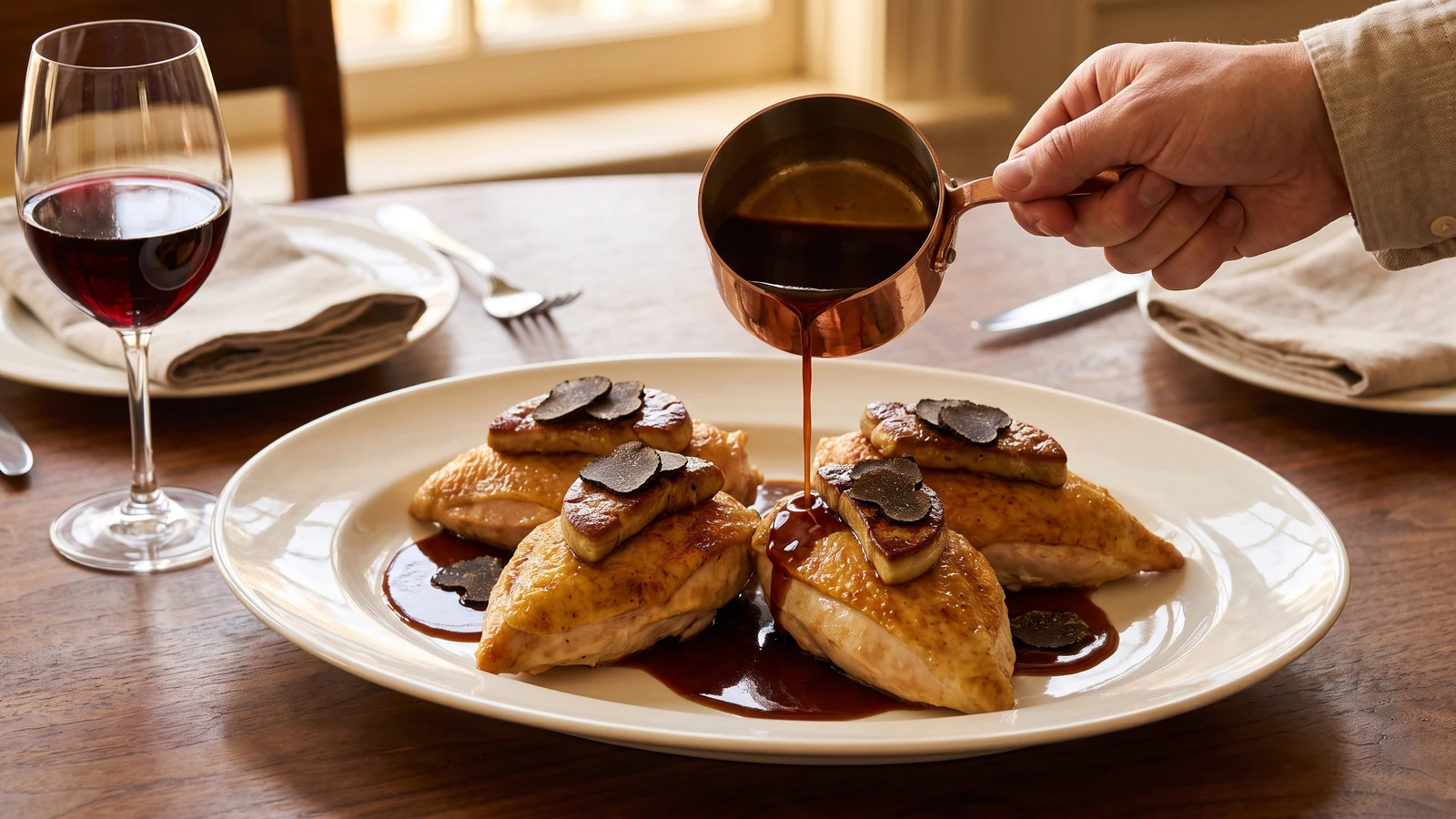
Butter-sautéed suprêmes over warm foie gras, crowned with a glossy Madeira sauce and black truffle: a grand Parisian composition translated faithfully for four, with timing doing the work.
Suprêmes de Volaille Rossini (chicken breast fillets with foie gras, Madeira, and truffle) teaches the discipline of sequence. A suprême is the breast fillet of the bird, and sauté means it cooks briskly in a shallow film of butter. The one true thing to know before touching the pan is simple: the sauce must be ready, the platter warm, and the chicken rested before the foie gras meets the butter. Foie gras waits for no one.
The old formula could fit in one sentence because its kitchen supplied a saucier, a stockpot never off the fire, and a salamander, the overhead grill, keeping the serving platter ready. At home, reduce gelatin-rich brown stock in one saucepan and warm the platter with hot water. Four suprêmes and four foie gras collops make the crown for four. The separate sauce station and hot holding are brigade scaffolding, so they go; the butter sauté, foie gras beneath the chicken, crown arrangement, strong Madeira sauce, and sliced truffle are the dish itself, so every one stays. One cook, one stove, one evening.
When it lands correctly, the chicken is butter-gold and juicy, the foie gras has just softened beneath it, and the mahogany sauce coats rather than floods, carrying black truffle over the whole crown. Make the sauce first. That single decision turns a frantic final five minutes into a composed service.
Suprêmes de Volaille Rossini belongs to the Parisian grand-kitchen repertoire, where the name Rossini signals the lavish garniture associated with the composer: foie gras, black truffle, and a strong Madeira sauce. Its larder points toward Périgord, but the composition is not a Périgord household dish; it is that region's truffle and foie gras set down with Parisian formality. The better-known tournedos wears the same garnish, yet classical kitchens also placed it under poultry suprêmes, carrying a named composition from one suitable cut to another.
Quantity
4, about 6 oz / 170 g each (1½ lb / 680 g total)
Quantity
4, each 2 oz / 55 g and ½ inch / 1.25 cm thick (8 oz / 220 g total)
well chilled
Quantity
3 cups (720 ml / 720 g)
Quantity
1 teaspoon (5 ml / 3 g)
Quantity
½ cup (120 ml / 120 g)
Quantity
1 small truffle (1 oz / 28 g)
thinly sliced
Quantity
1 tablespoon (15 ml / 15 g)
Quantity
½ cup (120 ml / 113 g)
divided
Quantity
1½ teaspoons (7.5 ml / 9 g)
divided
Quantity
½ teaspoon (2.5 ml / 1 g)
divided
| Ingredient | Quantity |
|---|---|
| boneless, skinless chicken suprêmes (breast fillets) | 4, about 6 oz / 170 g each (1½ lb / 680 g total) |
| raw whole-lobe foie gras collopswell chilled | 4, each 2 oz / 55 g and ½ inch / 1.25 cm thick (8 oz / 220 g total) |
| strong unsalted brown veal stock | 3 cups (720 ml / 720 g) |
| unflavored powdered gelatin (optional) | 1 teaspoon (5 ml / 3 g) |
| medium-dry Madeira | ½ cup (120 ml / 120 g) |
| black Périgord trufflethinly sliced | 1 small truffle (1 oz / 28 g) |
| truffle packing liquid (optional) | 1 tablespoon (15 ml / 15 g) |
| unsalted butterdivided | ½ cup (120 ml / 113 g) |
| fine sea saltdivided | 1½ teaspoons (7.5 ml / 9 g) |
| finely ground white pepperdivided | ½ teaspoon (2.5 ml / 1 g) |
Keep the foie gras in the refrigerator until the chicken has finished resting. Pat the suprêmes dry and gently press the thickest part of each breast to an even ¾ inch / 2 cm thickness without flattening it into an escalope. Slice the truffle, cover it, and place the serving platter near the stove. This dish finishes quickly, so every component must already know where it is going.
If the cold stock does not set like soft jelly, reserve 1 tablespoon (15 ml / 15 g) and sprinkle the gelatin over it; leave it for 5 minutes. Bring the remaining stock to a brisk simmer in a wide saucepan and reduce it to about 1 cup (240 ml / 240 g), skimming when needed, about 20 to 25 minutes. Stir in the bloomed gelatin, if using, then add the Madeira and simmer for 4 to 6 minutes, until about 1¼ cups (300 ml / 300 g) remain and the sauce lightly naps the back of a spoon. If it turns sticky or salty before reaching that volume, loosen it with hot water a tablespoon at a time; if it remains thin, keep reducing. Ça se rattrape. Hold it below a simmer.
Set aside 1 tablespoon (15 ml / 14 g) butter for the foie gras and cut 2 tablespoons (30 ml / 28 g) into cold cubes for the sauce. Melt the remaining butter gently until it separates, skim away the surface foam, and pour the clear golden fat into a cup, leaving the pale milk solids behind. Clarified butter is still real butter, but it tolerates the heat of the sauté without scorching.
Season the suprêmes with 1 teaspoon (5 ml / 6 g) salt and most of the white pepper. Heat 3 tablespoons (45 ml / 40 g) clarified butter in a heavy sauté pan over medium-high heat. Lay in the chicken with its smooth presentation side down and leave it undisturbed until evenly butter-gold, 4 to 5 minutes. Turn, lower the heat to medium, and baste with the butter as the second side cooks, another 4 to 6 minutes. The thickest part should reach 160 to 162°F / 71 to 72°C, then rise to 165°F / 74°C while resting. If the outside colors before the center is ready, lower the heat and cover the pan for 1 to 2 minutes; if it remains below 165°F / 74°C after resting, return it to the gentle pan. Transfer the suprêmes to a plate and cover loosely for 5 minutes.
Fill the heatproof serving platter with hot water and leave it for several minutes, then empty and dry it thoroughly. Bring the sauce back to a bare simmer and remove it from the heat. Monter au beurre, whisk in the 2 tablespoons (30 ml / 28 g) cold butter a cube at a time, until the sauce is glossy and cohesive. Fold in the truffle slices and the optional packing liquid, taste carefully, then adjust with the remaining salt and pepper. If the sauce separates into oily beads, whisk 1 teaspoon (5 ml / 5 g) cold water in vigorously off the heat. Cover and keep it beside the stove, never simmering after the truffle enters.
Wipe the sauté pan clean and set it over medium heat. Take the foie gras directly from the refrigerator, pat it dry, and season it lightly with the remaining salt and pepper. Add the reserved 1 tablespoon (15 ml / 14 g) butter; when it foams, lay in the collops and sauté for 30 to 45 seconds per side, spooning the butter over them once. They should take a light golden color and soften while still holding their shape. If a collop begins releasing fat rapidly or slumping, lift it out immediately and drain it briefly. More cooking will not put it back together. The sauce is ready, the platter is warm, and the chicken has rested before this moment because foie gras waits for no one.
Arrange the four foie gras collops in a loose ring on the warm platter. Set one suprême over each collop, angling the tapered ends toward the center to form the crown specified by the original formula. Spoon the strong Madeira sauce over the chicken and around the base, distributing the truffle slices across all four portions while leaving some golden surface visible. Carry it straight to the table. À table!
1 serving (about 270g)
Culinary guides, cultural storytelling, and the editorial depth that makes cooking meaningful.
Discover Culinary ExplorerChef Juliette
John Dory has the delicacy of sole and the firmness of turbot. A light flouring, a quick butter sauté, and nut-brown beurre noisette show exactly why looks never mattered.

Chef Juliette
Fresh haddock proves its delicacy in the meunière pan: a fine flour crust, moist pearly flakes, and beurre noisette sharpened with lemon and parsley, ready from one skillet in half an hour.

Chef Juliette
Éperlans à l’Anglaise turns small fish into a lesson in disciplined coating: boned smelts under a close, crisp crumb, pan-fried in clarified butter and finished with bright, half-melted maître d’hôtel butter.

Chef Juliette
Tiny smelts, shallot, mushrooms, white wine, gratin sauce, and fine bread raspings meet a fierce oven, where the fish must turn tender in the same breath the buttered crust bronzes.