
Chef Juliette
Ordinary Aspics
Clear amber gelée ordinaire carries the classical cold table on natural gelatin from veal, calf's feet, beef, and pork rind, then a patient clarification that leaves flavour intact and every suspended morsel visible.
A cooking platform built around craft, culture, and the stories behind what we eat.
Created by Chef Juliette
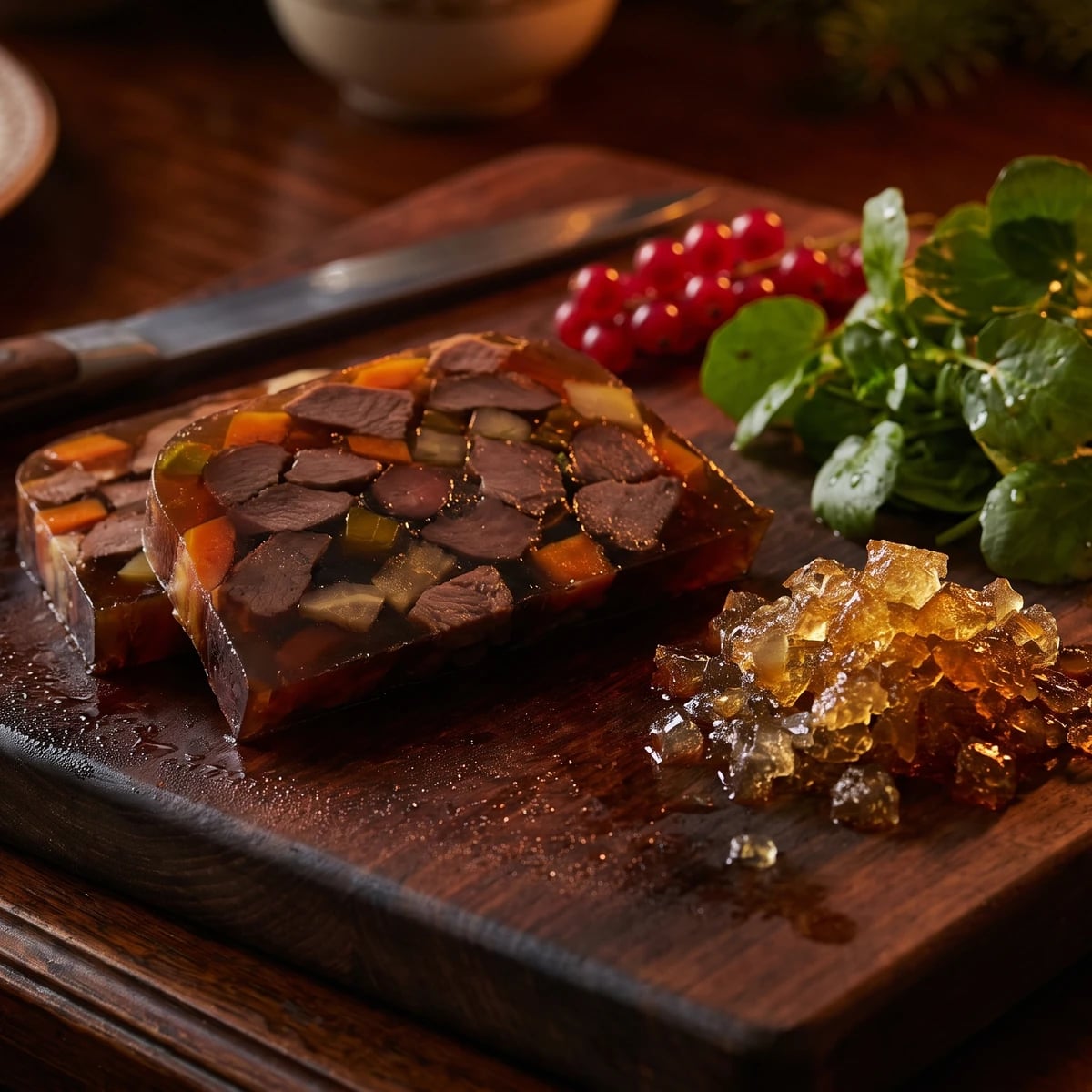
A clear amber game jelly built from browned venison or hare, tough partridge, and patient clarification, firm enough to slice yet delicate on the tongue, with fine brandy only if the bottle deserves it.
Aspic de gibier (game aspic) teaches the cold side of stock making: a broth must grow strong enough to stand while remaining clear enough to shine. That is the one true thing to know before touching the pan. Gelatin can reinforce a weak set, but it cannot give clarity to a stock boiled cloudy or squeezed through the strainer.
The original entry assumed a saucier on staff, game carcasses arriving from service, and stock never off the fire. A salamander has no work here; this is cold larder cookery, and the necessary browning happens on a roasting tray. At home, one deep stockpot, a fat separator, an ice bath, and an egg-white clarification do the work. The brigade's overnight settling and repeated transfers were scaffolding, so they go. The oven-browned game, tough feathered bird, natural gelatin, game-meat clarification, and careful reduction are the dish, so they stay. One cook, one stove, one evening, then the refrigerator sets it overnight.
Clarification is the step that matters most. Begin with cold stock, stir only until the raft forms, and never let the pot boil once it has risen. If the raft breaks and the liquid clouds, don't discard it. Ça se rattrape: cool the strained stock and clarify it again with the reserved egg whites. Fine brandy may lift the finished aspic, but a poor bottle spoils the whole pot, so omission is the better seasoning.
Aspic de gibier belongs to the French garde-manger and to hunting tables in game country such as Sologne and the forested parts of Burgundy, where deer, hare, partridge, and pheasant supplied both roasts and the bones for the cold larder. The preparation traveled from hunting-house kitchens into Parisian cold buffets and bourgeois holiday tables, glazing terrines and protecting sliced game beneath a clear savory jelly. Its defining distinction from ordinary aspic is that game replaces beef in the browned stock and returns in the clarification, while old feathered game contributes a depth too valuable to waste.
Quantity
2½ pounds (1.13 kg)
cut into 2-inch pieces
Quantity
2 pounds (900 g)
Quantity
2 partridges or 1 pheasant, about 2 pounds (900 g) total
cleaned and quartered
Quantity
1 carcass, about 8 ounces (225 g)
chopped for the clarification
Quantity
3 tablespoons (45 ml / 42 g)
softened
Quantity
5 quarts (4.75 L / 4.75 kg)
Quantity
2, about 1 pound (450 g)
quartered
Quantity
3, about 10 ounces (285 g)
cut into large pieces
Quantity
2, about 5 ounces (140 g)
cut into large pieces
Quantity
1
Quantity
1 teaspoon (5 ml / 3 g)
lightly crushed
Quantity
1 pound (450 g)
matching the principal game used in the stock
Quantity
1, about 4 ounces (115 g)
very finely diced
Quantity
1, about 4 ounces (115 g)
very finely diced and thoroughly washed
Quantity
8
6 for the clarification and 2 reserved for rescue
Quantity
Up to 2 teaspoons (10 ml / 12 g)
added after reduction
Quantity
¼ teaspoon (1.25 ml / 0.6 g)
Quantity
1 tablespoon (15 ml / 14 g)
Quantity
Up to 4½ tablespoons (68 ml / 42 g)
used only if the set test requires it
| Ingredient | Quantity |
|---|---|
| bone-in venison neck or shank, hare, or wild rabbitcut into 2-inch pieces | 2½ pounds (1.13 kg) |
| split veal knuckle or calves' feet | 2 pounds (900 g) |
| old partridges or mature pheasantcleaned and quartered | 2 partridges or 1 pheasant, about 2 pounds (900 g) total |
| partridge or pheasant carcasschopped for the clarification | 1 carcass, about 8 ounces (225 g) |
| unsalted buttersoftened | 3 tablespoons (45 ml / 42 g) |
| cold water | 5 quarts (4.75 L / 4.75 kg) |
| yellow onionsquartered | 2, about 1 pound (450 g) |
| carrots for the stockcut into large pieces | 3, about 10 ounces (285 g) |
| celery stalkscut into large pieces | 2, about 5 ounces (140 g) |
| bouquet garni of parsley stems, thyme, and bay leaf | 1 |
| black peppercornslightly crushed | 1 teaspoon (5 ml / 3 g) |
| lean ground venison, hare, or wild rabbitmatching the principal game used in the stock | 1 pound (450 g) |
| carrot for the clarificationvery finely diced | 1, about 4 ounces (115 g) |
| small leek, white part onlyvery finely diced and thoroughly washed | 1, about 4 ounces (115 g) |
| large egg whites6 for the clarification and 2 reserved for rescue | 8 |
| fine sea saltadded after reduction | Up to 2 teaspoons (10 ml / 12 g) |
| ground white pepper | ¼ teaspoon (1.25 ml / 0.6 g) |
| fine aged brandy (optional) | 1 tablespoon (15 ml / 14 g) |
| unflavored powdered gelatin (optional)used only if the set test requires it | Up to 4½ tablespoons (68 ml / 42 g) |
Heat the oven to 425°F (220°C). Dry the game pieces, veal bones, and quartered partridges or pheasant thoroughly, then rub them with the softened butter and spread them across a heavy roasting pan without crowding. Roast for 45 to 55 minutes, turning twice, until the meat and bones are deeply browned but nowhere black. Put the chopped clarification carcass in one corner of the pan for the final 20 minutes, then reserve it separately. Browning in the oven is explicit to the dish: pale game makes a pale, timid aspic, while burnt drippings make it bitter.
Transfer the browned game, veal bones, and quartered feathered game to a 10 to 12-quart stockpot, leaving the reserved clarification carcass aside. Pour about 2 cups of the measured cold water into the roasting pan, scrape up every mahogany-colored trace, and add it to the pot with the remaining water. Bring up very slowly, skimming the grey foam as it gathers. Once the surface is clean, add the quartered onions, large carrot pieces, celery, bouquet garni, and peppercorns. Hold the stock at the barest tremble for 4 hours with the lid slightly ajar. Never allow a rolling boil: it beats fat and impurities into the liquid, and no clarification works as cleanly after that.
Ladle the stock through a fine sieve into a clean heatproof bowl, then pour the final liquid gently through without pressing the meat or vegetables. Pressing buys a few spoonfuls and costs you clarity. Let the stock stand for 20 minutes, remove the fat with a separator or shallow ladle, and draw a folded piece of paper towel lightly across any remaining sheen. Set the bowl in an ice bath and stir occasionally until the stock falls below 60°F (16°C). This rapid cooling replaces the brigade's overnight settling and gives the egg whites the cold start they need.
In the cleaned stockpot, combine the ground game, reserved roasted carcass, finely diced carrot, leek, and 6 egg whites. Work them together until evenly mixed, then stir in about 2 cups of the cold stock to loosen the mass. Add the remaining cold stock. Set the pot over medium-low heat and stir slowly across the bottom as the liquid warms, preventing the proteins from catching. Stop stirring the moment the egg whites coagulate and rise into a solid raft. Open a small chimney in its center with the handle of a spoon so the stock can circulate through it.
Lower the heat until the liquid barely quivers beneath the raft. For 45 to 60 minutes, ladle a little clear stock through the chimney and over the raft every 10 minutes, disturbing it as little as possible. A hard bubble can split the raft and scatter its trapped impurities. If that happens, take the pot off the heat and leave it undisturbed for 10 minutes. If the stock remains cloudy, strain it, cool it again below 60°F (16°C), whisk the 2 reserved whites with 1 cup of the liquid, return everything to the pot, and repeat the slow clarification. Ça se rattrape.
Wet a double layer of fine muslin or cheesecloth with cold water and lay it in a clean sieve over a bowl. Ladle the clear stock from the chimney first, then tip the pot only far enough to recover the liquid around the raft. Let it pass under its own weight. Do not squeeze, scrape, or chase the last cloudy cup at the bottom. The finished stock should be clear amber rather than colorless, with the aroma of roasted game and no greasy film.
Measure the clarified stock and return it to a clean saucepan. Simmer gently until reduced to about 2 quarts, skimming any surface trace. Spoon 1 tablespoon into a small metal dish set over ice and wait 5 minutes. It should form a tender jelly that parts cleanly under a fingertip. If it is only slightly weak, reduce a little further. If the flavor is already concentrated but the stock will not set, don't boil it into bitterness. Cool 1 cup of stock, bloom 2 tablespoons (about 14 g) gelatin in it for 5 minutes, then whisk it into the hot stock off the heat and retest. Add more only as needed, up to 42 g total if the bones supplied almost no gelatin.
Season the hot aspic with the salt and white pepper. Taste it over a chip of ice or from a chilled spoon, because cold dulls seasoning; it should taste a shade more assertive warm than you want it cold. Take it off the heat and add the brandy only if it is fine enough to drink with pleasure. Otherwise leave it out entirely. Pass the aspic once more through damp muslin into shallow containers or a rinsed mold, cool the containers in an ice bath, then cover and refrigerate for 8 to 12 hours until fully set.
For a molded aspic, dip the mold in warm water for 5 seconds, dry it, and invert it onto a cold platter. If it clings, wrap the outside briefly in a warm towel rather than soaking it until the edges melt. Cut the aspic into clear cubes for cold roast game and terrines, or melt it over the gentlest heat and brush it onto chilled preparations in several thin layers. Never boil it after setting, particularly if supplemental gelatin was used. À table!
1 serving (about 240g)
Culinary guides, cultural storytelling, and the editorial depth that makes cooking meaningful.
Discover Culinary Explorer
Chef Juliette
Clear amber gelée ordinaire carries the classical cold table on natural gelatin from veal, calf's feet, beef, and pork rind, then a patient clarification that leaves flavour intact and every suspended morsel visible.

Chef Juliette
Clear amber aspic, built on an oven-browned hen and brightened through roasted-carcass clarification, with just enough gelatin to tremble on the plate and disappear on the tongue.

Chef Juliette
A clear, tender fish aspic perfumed with dry Champagne at the last cold moment, built on sole fumet and clarified with caviar so the jelly gleams rather than bounces.

Chef Juliette
The spent red-wine court-bouillon becomes a tender, lucid aspic for salmon or trout, clarified with egg white and coloured no deeper than somber pink. The cold test, not bravado, decides the gelatin.