
Chef Juliette
John Dory (St. Pierre)
John Dory has the delicacy of sole and the firmness of turbot. A light flouring, a quick butter sauté, and nut-brown beurre noisette show exactly why looks never mattered.
A cooking platform built around craft, culture, and the stories behind what we eat.
Created by Chef Juliette
Based on No. 1512, Poularde Reine Marguerite, from Le Guide Culinaire (1907) by Auguste Escoffier
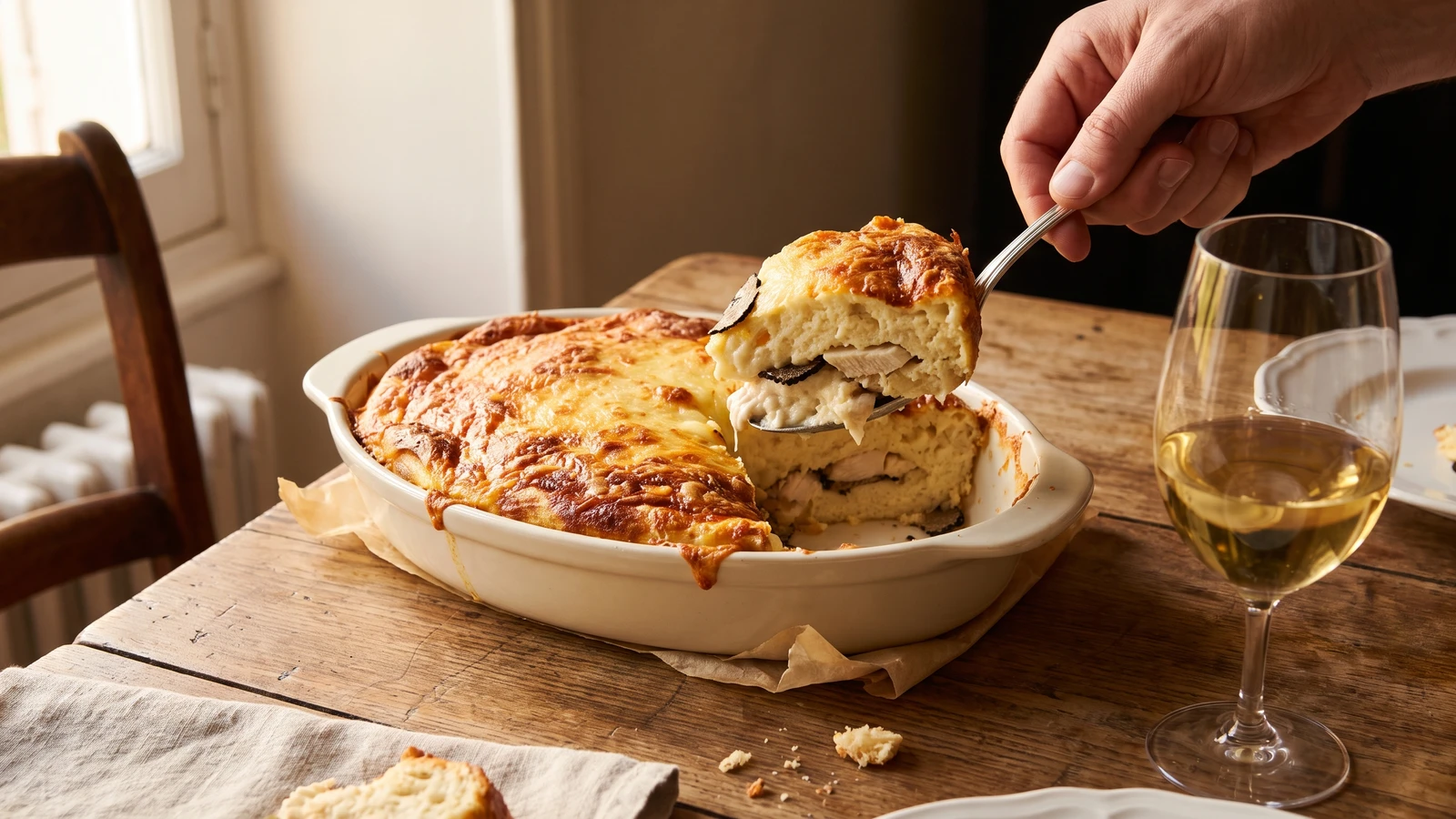
Poached poultry becomes its own serving vessel: sliced suprêmes and black truffle held in a firm Parmesan soufflé, rebuilt on the bird, collared in paper, and baked beneath Gruyère.
Poularde Reine Marguerite (poached pullet rebuilt with truffled Parmesan soufflé) teaches structure. Its suprêmes, the breast fillets, return to the bird inside a risen egg preparation that must support chicken and truffle without becoming heavy. The one true thing to know before touching a pan is this: the soufflé must mound before it can rise.
The original entry assumed a poularde at market, white poultry stock never off the fire, spare hands to bone the warm bird, and an ovenproof serving dish shaped for the job. It didn't need a saucier or a salamander; the moderate oven completed the dish. The home equivalent is a small whole chicken poached in its own aromatic liquor, a firm bread cushion on a shallow ovenproof platter, and doubled buttered parchment tied with kitchen string. The brigade stockpot and silver-service scale can go. The poaching, intact wings and legs, one truffle slice for every collop of suprême, substantial Parmesan soufflé, paper band, and Gruyère crown must stay. One cook, one stove, one evening.
When it is right, the attached wings and legs frame a burnished oval of Gruyère, while the cut centre shows ivory chicken, dark truffle, and a soufflé tender enough to spoon. The step that decides everything is the roux-thickened base before the whites meet it: it must mound, not pour.
Poularde Reine Marguerite belongs to Parisian grand cuisine, where whole poultry was often poached, dismantled, and reconstructed as a named presentation dish for the formal table. Its royal title is less certain than its method: the canon does not securely identify which Queen Marguerite it honors, but it preserves the precise service logic of breast suprêmes paired one-for-one with truffle and returned to the bird in Parmesan soufflé. What appears decorative is also structural, because the carcass, bread cushion, and paper band turn a delicate mixture into a centerpiece that can travel from oven to table.
Quantity
1, weighing 3½ to 4 lb (1.6 to 1.8 kg)
Quantity
3 quarts (2.8 L / 2.8 kg), or enough to cover
Quantity
1 medium (about 7 oz / 200 g)
quartered
Quantity
1 medium (about 4 oz / 115 g)
cut into large pieces
Quantity
1 rib (about 2 oz / 55 g)
cut into large pieces
Quantity
1
Quantity
1 tablespoon (15 ml / 18 g)
Quantity
1 thick oval slab (about 6 oz / 170 g)
crust removed
Quantity
5 tablespoons (75 ml / 70 g)
softened and divided
Quantity
⅓ cup (80 ml / 40 g)
Quantity
1¼ cups (300 ml / 305 g)
Quantity
4
separated
Quantity
¾ cup (180 ml / 65 g)
finely grated
Quantity
¾ teaspoon (3.75 ml / 4.5 g)
Quantity
¼ teaspoon (1.25 ml / 0.6 g)
Quantity
1 small (1 oz / 28 g)
cut into 12 thin slices
Quantity
10 to 12 paper-thin slices (4 oz / 115 g)
| Ingredient | Quantity |
|---|---|
| small whole young chicken or poularde | 1, weighing 3½ to 4 lb (1.6 to 1.8 kg) |
| cold water | 3 quarts (2.8 L / 2.8 kg), or enough to cover |
| yellow onionquartered | 1 medium (about 7 oz / 200 g) |
| carrotcut into large pieces | 1 medium (about 4 oz / 115 g) |
| celerycut into large pieces | 1 rib (about 2 oz / 55 g) |
| bouquet garni of parsley stems, thyme, and bay leaf | 1 |
| fine sea salt for poaching | 1 tablespoon (15 ml / 18 g) |
| firm white country breadcrust removed | 1 thick oval slab (about 6 oz / 170 g) |
| unsalted buttersoftened and divided | 5 tablespoons (75 ml / 70 g) |
| all-purpose flour | ⅓ cup (80 ml / 40 g) |
| whole milk | 1¼ cups (300 ml / 305 g) |
| large eggsseparated | 4 |
| Parmesanfinely grated | ¾ cup (180 ml / 65 g) |
| fine sea salt for the soufflé | ¾ teaspoon (3.75 ml / 4.5 g) |
| finely ground white pepper | ¼ teaspoon (1.25 ml / 0.6 g) |
| fresh or whole preserved black trufflecut into 12 thin slices | 1 small (1 oz / 28 g) |
| Gruyère | 10 to 12 paper-thin slices (4 oz / 115 g) |
Set the chicken breast-side up in a snug 6-quart pot. Add the water, onion, carrot, celery, bouquet garni, and poaching salt. Bring the liquid slowly to 180 to 185°F (82 to 85°C), skimming away any grey foam, then hold it at the barest tremble. Partially cover and poach for 50 to 60 minutes, turning the bird once, until the deepest part of the thigh reaches 165°F (74°C). Never let the liquor boil hard; boiling tightens the breast before it can be protected by the soufflé. If it does boil, pull the pot off the heat, uncover it, and let the temperature fall before continuing. Ça se rattrape. Lift the chicken carefully and rest it for 15 minutes. Strain and reserve 1 cup (240 ml / 240 g) of the poaching liquor.
Heat the oven to 375°F (190°C). Butter the ovenproof platter and one face of a long sheet of parchment with 1 tablespoon (15 ml / 14 g) of the butter. Trim the bread into a low oval cushion about 8 by 5 inches (20 by 13 cm), broad enough to support the chicken's body, and set it on the platter. Fold the parchment lengthwise to make a strong double band about 4 inches (10 cm) high, long enough to encircle the bread and reconstructed body with a 2-inch (5 cm) overlap.
Set the rested chicken breast-side up. Cut down each side of the keel bone, follow the ribs with the knife, and lift away both suprêmes whole, leaving the wing joints untouched. Use poultry shears to cut through the fine ribs on either side of the breastbone, then lift the breastbone and keel away without disturbing the back, wings, thighs, or legs. Set the hollowed carcass on the bread cushion. If the skin tears, don't fuss; the soufflé will cover it. If a joint loosens, secure it discreetly with a small wooden skewer. Cut the suprêmes across the grain into 12 thin collops, then place one truffle slice against each collop.
Melt the remaining 4 tablespoons (60 ml / 56 g) butter in a 2-quart saucepan over medium-low heat. Stir in the flour and cook this pale roux, butter and flour cooked together, for 2 minutes without letting it color. Add the milk in three additions, whisking each one smooth before the next, then cook for 4 to 6 minutes until the base pulls cleanly from the pan and falls from the spoon in a heavy mound. This firmness is the dish. If the base pours, keep cooking it before adding the eggs; if it has lumps, take it off the heat and press it through a fine sieve. Ça se rattrape. Cool for 5 minutes, then beat in the yolks one at a time, followed by the Parmesan, soufflé salt, and white pepper.
Let the Parmesan base cool until warm rather than hot. Fold in the paired collops of suprême and truffle gently enough to keep the slices recognizable. Reserve a spoonful of unbeaten egg white, then whisk the remaining whites to flexible medium peaks that bend at their tips. The source asks for a soufflé that is not too light, so do not drive the whites to stiff, dry points. If they become clumpy, whisk in the reserved raw white until they are supple again. Fold one-third briskly into the Parmesan base to loosen it, then fold in the remainder with broad turns until no large white streaks remain. If the base became too stiff while waiting, loosen it with 1 tablespoon (15 ml / 15 g) warm poaching liquor before the whites go in, never afterward.
Stand the doubled parchment around the central body and bread cushion, buttered face inward, leaving the wings and legs visibly attached outside it. Pull the band snug and tie it at two levels with oven-safe kitchen string. Spoon the chicken, truffle, and soufflé mixture into the hollow carcass, filling from the bottom and mounding it to restore the rounded line of the breast. Smooth the surface lightly with a buttered spatula. The bread and collar are not discarded presentation tricks; they are the scaffolding that makes the mixture climb instead of spreading. If the collar loosens and the filling slumps, lift the mixture back with the spatula, add a second parchment band outside the first, and retie it before baking.
Lay the thin Gruyère slices over the rounded surface, overlapping them just enough to cover the soufflé without weighing it down. Keep the cheese inside the paper collar so its melted edges cling to the rise rather than running onto the platter. Slide the dish immediately onto the centre rack of the moderately hot oven.
Bake without opening the oven for the first 20 minutes, then check the poularde. It is ready after 25 to 35 minutes, when the soufflé has risen against the collar, the Gruyère is butter-gold with bronzed patches, the edge bubbles, and the centre reaches 160°F (71°C). If the cheese colors before the centre is set, lay foil loosely over the top without pressing on it. Rest for 5 minutes, cut the strings, and peel the parchment away slowly. A little settling is not failure; it is dinner. Carry the whole platter to the table, then spoon the soufflé and divide the attached wings and legs among the four plates. À table!
1 serving (about 460g)
Culinary guides, cultural storytelling, and the editorial depth that makes cooking meaningful.
Discover Culinary ExplorerChef Juliette
John Dory has the delicacy of sole and the firmness of turbot. A light flouring, a quick butter sauté, and nut-brown beurre noisette show exactly why looks never mattered.

Chef Juliette
Fresh haddock proves its delicacy in the meunière pan: a fine flour crust, moist pearly flakes, and beurre noisette sharpened with lemon and parsley, ready from one skillet in half an hour.

Chef Juliette
Éperlans à l’Anglaise turns small fish into a lesson in disciplined coating: boned smelts under a close, crisp crumb, pan-fried in clarified butter and finished with bright, half-melted maître d’hôtel butter.

Chef Juliette
Tiny smelts, shallot, mushrooms, white wine, gratin sauce, and fine bread raspings meet a fierce oven, where the fish must turn tender in the same breath the buttered crust bronzes.