
Chef Juliette
John Dory (St. Pierre)
John Dory has the delicacy of sole and the firmness of turbot. A light flouring, a quick butter sauté, and nut-brown beurre noisette show exactly why looks never mattered.
A cooking platform built around craft, culture, and the stories behind what we eat.
Created by Chef Juliette
Based on No. 1508, Poularde Princesse Hélène, from Le Guide Culinaire (1907) by Auguste Escoffier
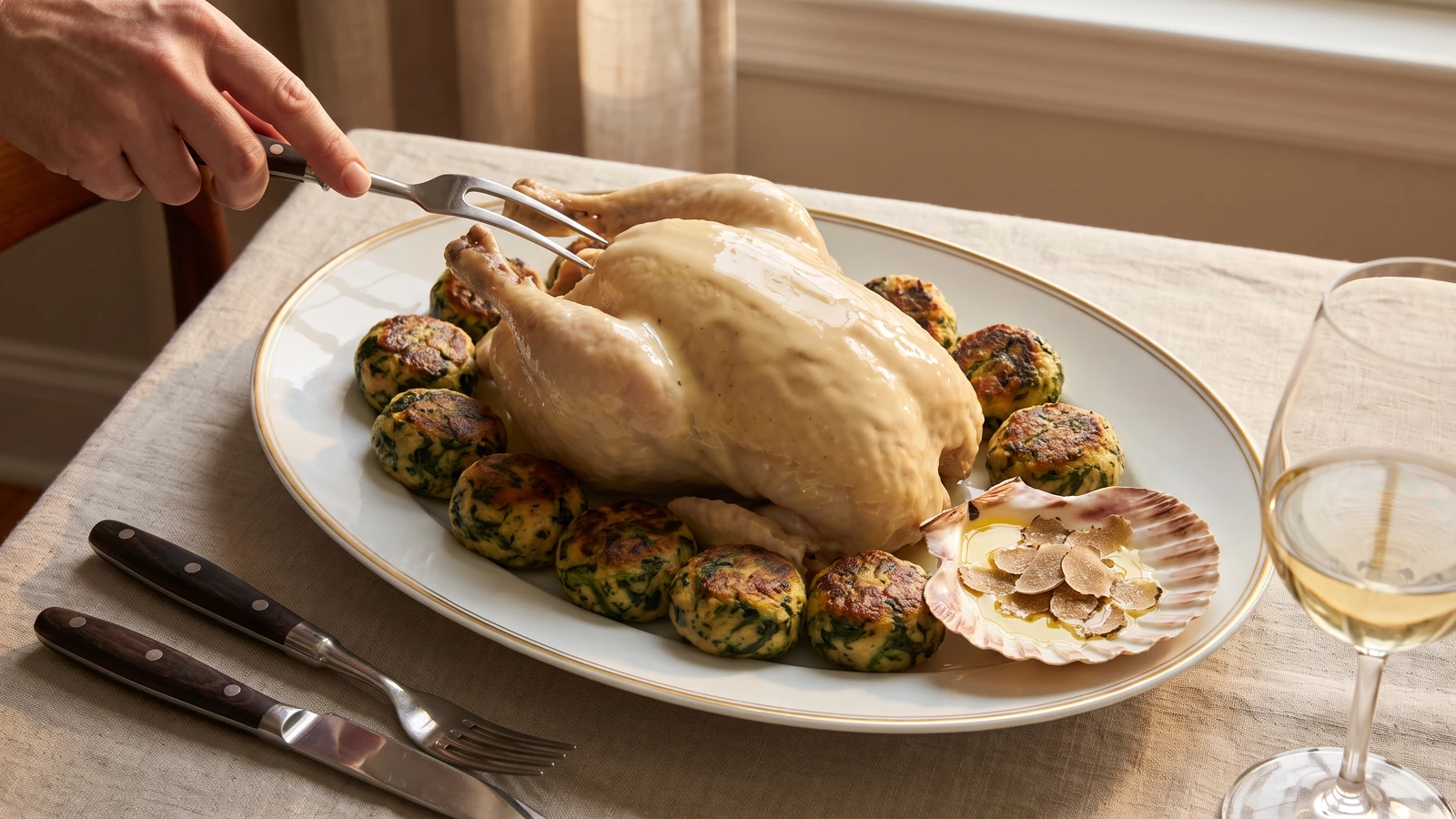
A rice-stuffed poularde poached to tenderness, veiled in sauce suprême, ringed with spinach subrics, and finished with white truffle: a formal composition whose success depends on timing the crisp garnish at the very last moment.
Poularde Princesse Hélène (rice-stuffed poached chicken with sauce suprême) teaches orchestration. The bird must be tender, the sauce must hold its gloss, and the Subrics d’Épinards (No. 2137) must reach the platter crisp at precisely the same moment. One true thing before you touch the pan: fry the subrics only when the sauced poularde is already waiting, because a held subric slumps and weeps.
The original formula assumed a saucier on staff, a stock never off the fire, and spare hands at service. It did not call for a salamander, so neither do you: the subrics are pan-fried. A snug stockpot, a small pan set over warm water, and one skillet are the honest home equivalents. The separate stations are brigade scaffolding and can go. The Pilaff Rice (for the Stuffing of Fowls) (No. 2256), the gentle poach, the suprême coating, the last-minute subrics, and the barely butter-warmed truffle are the dish and must stay. One cook, one stove, one evening.
The poularde arrives pale and generous beneath an ivory sauce, surrounded by green-gold subrics, with the fragrant truffle held separately in its little shell. A clean scallop shell honors the original presentation, but a shallow ramekin performs the same work at home. The step that decides the plate is the last one: cook the subrics to order, warm the truffle without frying it, and serve immediately.
Poularde Princesse Hélène belongs to the Parisian grand-kitchen repertoire of named poultry dishes, where a title identified a fixed garnish and method rather than a region. Its composition passed naturally into bourgeois entertaining because poached fowl, rice stuffing, sauce suprême, spinach subrics, and truffle could be prepared as separate parts and united at service. The formula does not securely identify which Hélène gave the dish its dedication, so the surviving garnish, rather than a romantic patron story, is the honest historical record.
Quantity
1, weighing 4 1/2 to 5 lb (2 to 2.25 kg)
giblets removed
Quantity
2 teaspoons (10 ml / 12 g)
divided
Quantity
1/2 teaspoon (2.5 ml / 1 g)
Quantity
2 cups (475 ml / about 420 g) Pilaff Rice (for the Stuffing of Fowls) (No. 2256)
prepared through its three-quarters-cooked stage and chilled
Quantity
14 cups (3.3 L / about 3.4 kg), or enough to submerge the poularde
Quantity
2 cups (475 ml / about 500 g)
Quantity
2 tablespoons (30 ml / 30 g)
reserved for rescuing the Sauce Suprême if necessary
Quantity
12 Subrics d’Épinards (No. 2137)
prepared and ready for their last-moment cooking
Quantity
1 small truffle, about 1 oz (28 g)
shaved at the last moment
Quantity
2 tablespoons (30 ml / 28 g)
| Ingredient | Quantity |
|---|---|
| poularde or plump whole roasting chickengiblets removed | 1, weighing 4 1/2 to 5 lb (2 to 2.25 kg) |
| fine sea saltdivided | 2 teaspoons (10 ml / 12 g) |
| finely ground white pepper | 1/2 teaspoon (2.5 ml / 1 g) |
| Pilaff Rice (for the Stuffing of Fowls)prepared through its three-quarters-cooked stage and chilled | 2 cups (475 ml / about 420 g) Pilaff Rice (for the Stuffing of Fowls) (No. 2256) |
| good unsalted chicken stock | 14 cups (3.3 L / about 3.4 kg), or enough to submerge the poularde |
| prepared Sauce Suprême | 2 cups (475 ml / about 500 g) |
| cold heavy cream (optional)reserved for rescuing the Sauce Suprême if necessary | 2 tablespoons (30 ml / 30 g) |
| Subrics d’Épinardsprepared and ready for their last-moment cooking | 12 Subrics d’Épinards (No. 2137) |
| fresh white truffleshaved at the last moment | 1 small truffle, about 1 oz (28 g) |
| unsalted butter | 2 tablespoons (30 ml / 28 g) |
Have the Pilaff Rice (for the Stuffing of Fowls) (No. 2256) ready at its specified three-quarters-cooked stage, the Sauce Suprême prepared, and the Subrics d’Épinards (No. 2137) portioned for their own last-moment cooking. Keep the rice and subrics cold. Set a rack over a tray for the cooked bird and warm the serving platter. Put the chicken stock in a snug 7 to 8 quart pot and heat it to about 185°F (85°C), with only a lazy movement at the surface.
Dry the poularde inside and out. Season the cavity and skin with the salt and white pepper, then spoon in the Pilaff Rice (for the Stuffing of Fowls) (No. 2256) loosely. Do not ram it into the cavity, because the partly cooked rice still needs room to swell and finish cooking. Close the opening with two small poultry skewers laced with kitchen twine, tie the legs together, and tuck the wings beneath the body. Stuff the bird only when the poaching stock is ready; raw stuffed poultry must not sit waiting.
Lower the poularde breast-side up into the hot stock. The liquid should cover it; if it floats, settle a small heatproof plate over it to keep it submerged. Bring the stock back to 180 to 185°F (82 to 85°C), then hold it there without boiling for 75 to 90 minutes. The poularde is ready when both the thickest part of the thigh and the center of the rice stuffing register at least 165°F (74°C). The stuffing temperature decides safety, so do not judge by the meat alone. If the stock boils and the skin begins to split, move the pot off the heat until the liquid quiets, then return it over the gentlest flame. Ça se rattrape.
Lift the poularde carefully onto the rack and tip the cavity downward for a few seconds so trapped stock can drain without carrying out the stuffing. Blot the skin dry, then rest the bird for 12 to 15 minutes beneath a loose sheet of parchment or foil. Reserve 1 cup (240 ml / about 245 g) of the poaching stock for adjusting the sauce. Do not wrap the poularde tightly, or moisture collects on the surface and the Sauce Suprême slides off instead of coating it.
While the poularde rests, warm the prepared Sauce Suprême in a small saucepan set over barely simmering water. Bring it to nappe, the coating stage where the sauce clings evenly to the back of a spoon and a fingertip drawn through it leaves a clean line. If it is too thick, whisk in reserved poaching stock a teaspoon at a time. Do not let it boil. If it turns oily or begins to separate, put 1 tablespoon of the cold cream in a clean warm pan and whisk the troubled sauce into it gradually. Ça se rattrape.
Remove the twine and skewers without disturbing the stuffing, then place the poularde breast-side up on the warmed oval platter. Spoon the Sauce Suprême over the breast, wings, and legs in an even ivory coating, allowing a modest pool to gather beneath the bird. Leave the outer edge of the platter clear for the subrics.
Cook the Subrics d’Épinards (No. 2137) now, exactly as their own preparation directs, and transfer them straight from the pan to the platter. Arrange three per serving around the sauced poularde without letting them sit in the sauce. They must not wait. If service is delayed, keep the uncooked portions chilled and cook them only when everyone is seated; reheating a slumped, weeping subric will not restore it.
Melt the butter over the lowest heat in the smallest saucepan you own. Add the white truffle shavings and turn them through the butter for 10 to 15 seconds, only until they glisten and release their perfume. They must not fry. If the butter becomes noisy, lift the pan immediately and set it on a cool surface. Spoon the truffle and butter into a clean scallop shell or shallow ramekin and place it behind the poularde, exactly as the composition requires. Bring the platter directly to the table, carve the bird, and spoon out the rice stuffing with each serving. À table!
1 serving (about 675g)
Culinary guides, cultural storytelling, and the editorial depth that makes cooking meaningful.
Discover Culinary ExplorerChef Juliette
John Dory has the delicacy of sole and the firmness of turbot. A light flouring, a quick butter sauté, and nut-brown beurre noisette show exactly why looks never mattered.

Chef Juliette
Fresh haddock proves its delicacy in the meunière pan: a fine flour crust, moist pearly flakes, and beurre noisette sharpened with lemon and parsley, ready from one skillet in half an hour.

Chef Juliette
Éperlans à l’Anglaise turns small fish into a lesson in disciplined coating: boned smelts under a close, crisp crumb, pan-fried in clarified butter and finished with bright, half-melted maître d’hôtel butter.

Chef Juliette
Tiny smelts, shallot, mushrooms, white wine, gratin sauce, and fine bread raspings meet a fierce oven, where the fish must turn tender in the same breath the buttered crust bronzes.