
Chef Juliette
John Dory (St. Pierre)
John Dory has the delicacy of sole and the firmness of turbot. A light flouring, a quick butter sauté, and nut-brown beurre noisette show exactly why looks never mattered.
A cooking platform built around craft, culture, and the stories behind what we eat.
Created by Chef Juliette
Based on No. 1507, Poularde Princesse, from Le Guide Culinaire (1907) by Auguste Escoffier
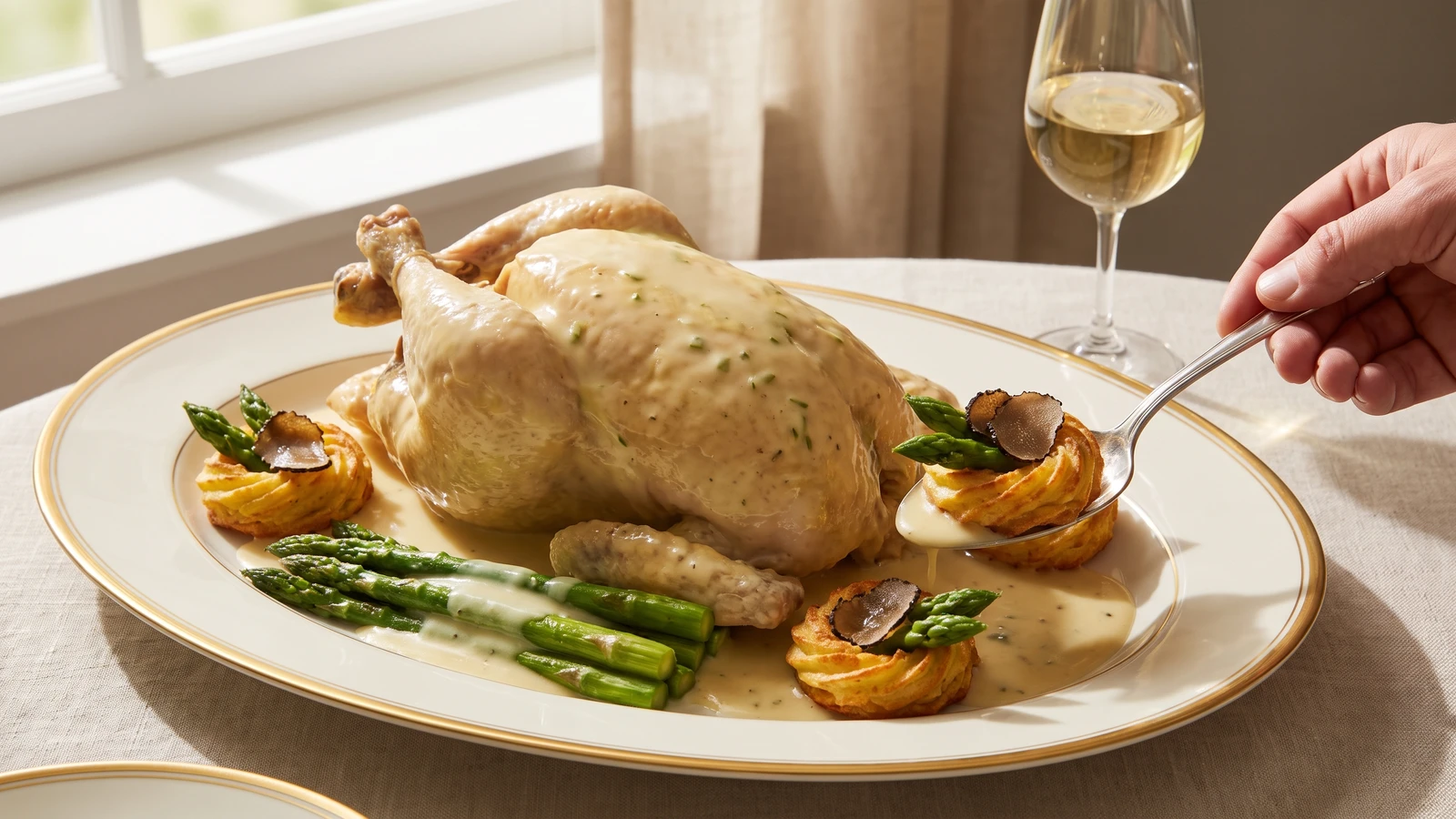
A tender poularde beneath glossy Allemande, its mushroom depth brightened by asparagus-head butter, with crisp Duchesse croustades, green tips, and truffle making the generous ring.
Poularde Princesse (poached pullet with asparagus, truffle, and potato croustades) teaches one hard little rule about finished butter: the asparagus-head butter goes into the Allemande off the heat, always. Boil it afterward and the sauce loses its fresh green character, while the butter can separate from the yolk-thickened sauce. Keep that final heat under control and the dish becomes composed rather than complicated.
The book expected a saucier beside the poacher, stock never off the fire, and a salamander with a drying box to keep the garnishes ready. At home, a narrow stockpot, one saucepan, and a low oven do their work; four croustades form the ring for four people instead of filling a brigade platter. The separate stations and holding cupboards are scaffolding and can go. Gentle poaching, true Allemande, mushroom essence, asparagus-head butter, and the filled croustades are the dish and must stay. One cook, one stove, one evening.
When it arrives, the poularde is tender and ivory beneath a glossy sauce with a quiet green cast, surrounded by crisp potato shells, bright asparagus, and dark slips of truffle. The decisive move comes last: take the Allemande off the fire, then whisk in the asparagus-head butter. Have the bird, croustades, tips, and platter ready before that moment.
Poularde Princesse belongs to the Parisian classical table, where Princesse names a composed garnish centered on green asparagus and paired with delicate poultry. The title is a code from the canon, not reliable evidence that one particular princess inspired the dish: tender poularde, truffle, shaped croustades, and a pale sauce announce its ceremonial register. It passed into bourgeois celebration cooking because its foundations remain familiar, poached chicken, velouté-based Allemande, butter, potatoes, and vegetables arranged with care.
Quantity
1, weighing 4 to 4½ lb (1.8 to 2 kg)
giblets removed and lightly trussed
Quantity
8 cups (1.9 L / 1.9 kg)
divided
Quantity
2 to 4 cups (475 to 950 ml / 475 to 950 g)
as needed to cover the poularde
Quantity
1 medium (about 7 oz / 200 g)
peeled and halved
Quantity
2 medium (about 7 oz / 200 g)
thickly sliced
Quantity
1 medium (about 5 oz / 140 g)
washed and thickly sliced
Quantity
1 stalk (about 2 oz / 55 g)
thickly sliced
Quantity
1
Quantity
8 oz (225 g)
thinly sliced
Quantity
2 lb (900 g)
2½-inch tips cut and stalks reserved for another dish
Quantity
4 small finished croustades
prepared in the Duchesse potato form required for Poularde Princesse
Quantity
6 tablespoons (90 ml / 85 g)
divided
Quantity
3 tablespoons (45 ml / 24 g)
Quantity
½ cup (120 ml / 120 g)
divided
Quantity
2
Quantity
2 teaspoons (10 ml / 10 g)
Quantity
1 small, about ½ oz (15 g)
cut into at least 4 very thin slices
Quantity
2 teaspoons (10 ml / 12 g), plus more to taste
divided
Quantity
½ teaspoon (2.5 ml / 1 g), plus more to taste
| Ingredient | Quantity |
|---|---|
| poularde or plump young chickengiblets removed and lightly trussed | 1, weighing 4 to 4½ lb (1.8 to 2 kg) |
| rich unsalted chicken stockdivided | 8 cups (1.9 L / 1.9 kg) |
| wateras needed to cover the poularde | 2 to 4 cups (475 to 950 ml / 475 to 950 g) |
| yellow onionpeeled and halved | 1 medium (about 7 oz / 200 g) |
| carrotsthickly sliced | 2 medium (about 7 oz / 200 g) |
| leekwashed and thickly sliced | 1 medium (about 5 oz / 140 g) |
| celerythickly sliced | 1 stalk (about 2 oz / 55 g) |
| bouquet garni of parsley stems, thyme, and bay leaf | 1 |
| white button mushroomsthinly sliced | 8 oz (225 g) |
| slender green asparagus2½-inch tips cut and stalks reserved for another dish | 2 lb (900 g) |
| Croûtes et Croustades (No. 2393)prepared in the Duchesse potato form required for Poularde Princesse | 4 small finished croustades |
| unsalted butterdivided | 6 tablespoons (90 ml / 85 g) |
| all-purpose flour | 3 tablespoons (45 ml / 24 g) |
| heavy creamdivided | ½ cup (120 ml / 120 g) |
| large egg yolks | 2 |
| fresh lemon juice | 2 teaspoons (10 ml / 10 g) |
| fresh or preserved black trufflecut into at least 4 very thin slices | 1 small, about ½ oz (15 g) |
| fine sea saltdivided | 2 teaspoons (10 ml / 12 g), plus more to taste |
| finely ground white pepper | ½ teaspoon (2.5 ml / 1 g), plus more to taste |
Reserve 3 cups (720 ml) of the chicken stock for the mushroom essence and Allemande. Combine the remaining 5 cups (1.2 L) with the onion, carrots, leek, celery, bouquet garni, and 1 teaspoon of the salt in a narrow 6-to-8-quart stockpot. Add enough water to cover the poularde later, then simmer the aromatics gently for 15 minutes. The narrow pot matters because it keeps the bird submerged without demanding another stockpot's worth of liquid.
Lower the poularde breast-side up into the liquor and add more water if needed to cover it by about 1 inch. Bring the liquid slowly to 180 to 185°F (82 to 85°C), where the surface barely trembles, then partially cover and poach for 50 to 65 minutes. Do not let it boil: hard bubbling tightens the breast and clouds the liquor. If the pot gets away from you, pull it off the heat for two minutes, lower the burner, and continue. Ça se rattrape. The poularde is ready when the thickest part of the breast reaches 165°F (74°C) and the inner thigh reaches at least 175°F (80°C). Lift it onto a rack over a tray, tent loosely, and rest for 15 minutes.
While the poularde poaches, sort the asparagus tips. Choose 6 tips for the asparagus-head butter, reserve 16 handsome tips for filling the croustades, and keep the remainder for four generous bundles. Blanch the 6 butter tips in well-salted water for 3 to 4 minutes, until completely tender, then blanch all the remaining tips for 75 to 90 seconds, until vivid green and just tender. Chill both batches immediately in iced water and dry them thoroughly. Press the 6 tender tips through a fine sieve, measure 1½ tablespoons (22 ml / 22 g) of purée, and work it into 2 tablespoons (30 ml / 28 g) softened butter. This gives the 50 g of asparagus-head butter needed for the home-scaled sauce. Keep it cool but pliable.
Put the sliced mushrooms and 1 cup (240 ml) of the reserved stock in a small saucepan. Cover and simmer for 5 minutes so the mushrooms surrender their liquor, then uncover and reduce until only about ⅓ cup (80 ml) remains. Strain through a fine sieve, pressing the mushrooms gently, and reserve the concentrated mushroom essence. It should smell unmistakably of mushrooms without becoming dark or muddy.
Melt 2 tablespoons (30 ml / 28 g) of the butter in a heavy saucepan over medium-low heat. Stir in the flour and cook for 3 minutes without letting the roux color; Allemande is a pale sauce, so toastiness has no business here. Gradually whisk in the remaining 2 cups (475 ml) reserved stock, adding each portion only after the last is smooth, then whisk in the mushroom essence. Simmer gently for 15 to 20 minutes, skimming as needed, until the sauce coats the back of a spoon and has reduced to about 1½ cups (360 ml). If lumps appear, stop adding liquid and whisk until smooth; any stubborn ones can be removed through the fine sieve.
Heat the oven to 275°F (135°C) and warm the finished Croûtes et Croustades (No. 2393) for 8 to 10 minutes, just until crisp and hot without taking more color. Melt 2 tablespoons (30 ml / 28 g) butter with 2 tablespoons (30 ml) water in a wide skillet, add the blanched asparagus tips, and roll them gently in the butter until glossy and warmed through. Season with salt and white pepper. Fill each croustade with 4 tips cohered by the butter, then place one fine truffle slice on top. Gather the remaining tips into four neat bundles and keep everything ready on a warm tray. If the poularde has cooled noticeably, lower it into poaching liquor held at about 150°F (66°C) for 5 minutes, then drain and blot it well.
Whisk the egg yolks with 7 tablespoons (105 ml) of the cream, reserving the final tablespoon for rescue. Whisk a ladleful of the hot sauce base into the liaison, then add two more ladlefuls gradually. Return everything to the saucepan and cook over very low heat, stirring constantly, until the Allemande reaches 160 to 165°F (71 to 74°C) and naps the spoon. Never boil it. Adjust with hot poaching liquor if necessary so you have 2 cups (475 ml) of Allemande, holding any excess separately. Take the pan completely off the heat and whisk in the full 50 g of asparagus-head butter, followed by the lemon juice. The green butter goes in off the heat, always. If the liaison freckles or the finished sauce separates, put the reserved cold cream in a clean bowl and whisk the troubled sauce into it a spoonful at a time. Ça se rattrape. Once the green butter is in, do not return the sauce to the fire.
Set the warm poularde on a heated oval platter and spoon the Allemande over it from breast to legs, coating it generously and letting a little sauce pool beneath. Place the four filled croustades at the quarter points of the platter, then set one bundle of butter-glazed asparagus between each pair. Serve any remaining sauce in a warm sauceboat and carve the poularde at the table. À table!
1 serving (about 520g)
Culinary guides, cultural storytelling, and the editorial depth that makes cooking meaningful.
Discover Culinary ExplorerChef Juliette
John Dory has the delicacy of sole and the firmness of turbot. A light flouring, a quick butter sauté, and nut-brown beurre noisette show exactly why looks never mattered.

Chef Juliette
Fresh haddock proves its delicacy in the meunière pan: a fine flour crust, moist pearly flakes, and beurre noisette sharpened with lemon and parsley, ready from one skillet in half an hour.

Chef Juliette
Éperlans à l’Anglaise turns small fish into a lesson in disciplined coating: boned smelts under a close, crisp crumb, pan-fried in clarified butter and finished with bright, half-melted maître d’hôtel butter.

Chef Juliette
Tiny smelts, shallot, mushrooms, white wine, gratin sauce, and fine bread raspings meet a fierce oven, where the fish must turn tender in the same breath the buttered crust bronzes.