
Chef Juliette
John Dory (St. Pierre)
John Dory has the delicacy of sole and the firmness of turbot. A light flouring, a quick butter sauté, and nut-brown beurre noisette show exactly why looks never mattered.
A cooking platform built around craft, culture, and the stories behind what we eat.
Created by Chef Juliette
Based on No. 1502, Poularde à la Paysanne, from Le Guide Culinaire (1907) by Auguste Escoffier
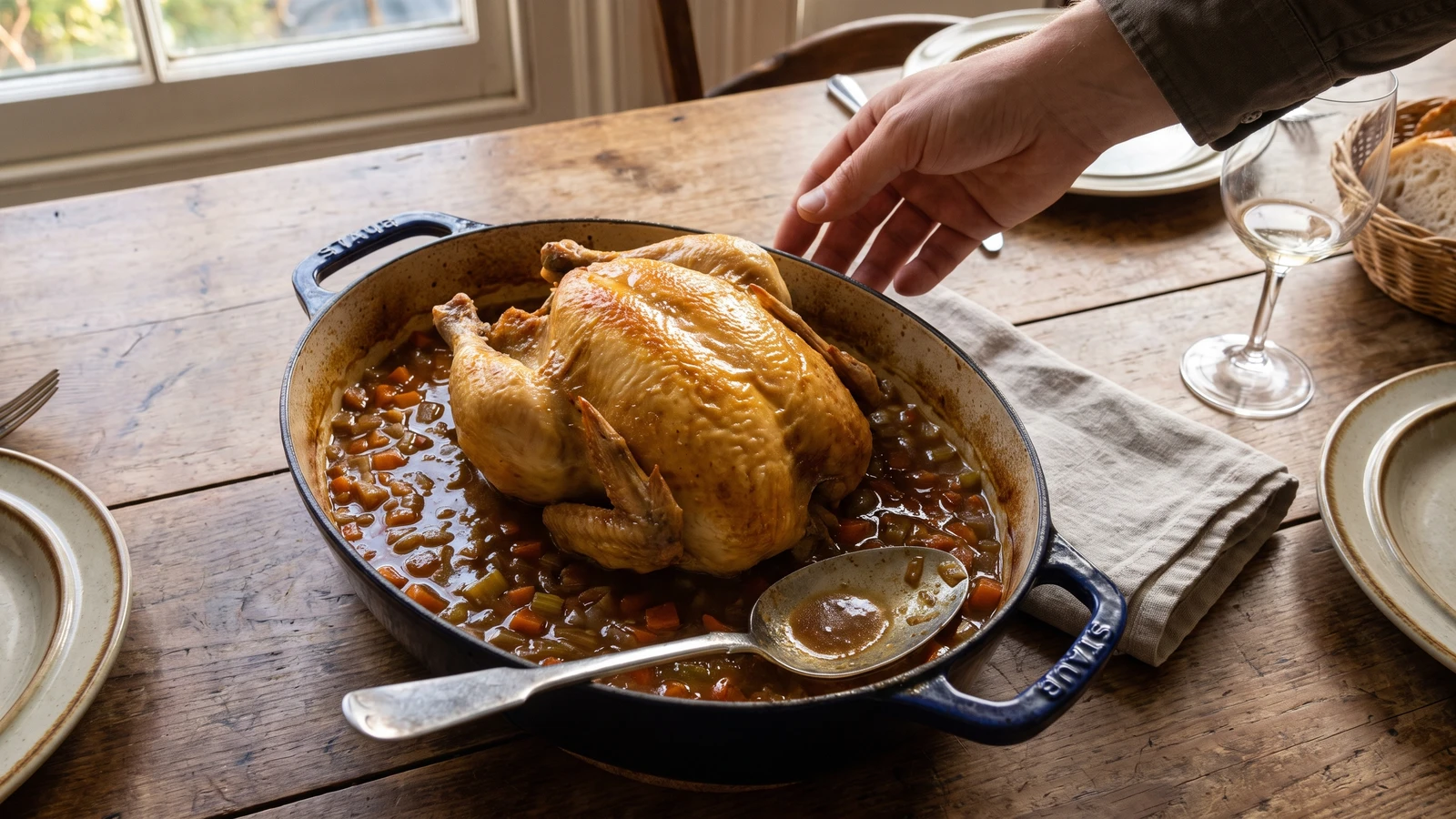
Whole poularde, browned in butter and basted over a fine mince of carrot, onion, and celery, proves that patient spooning and good veal stock can make the vegetables become the sauce.
Poularde à la Paysanne (butter-browned pullet cooked with finely minced vegetables) teaches one true thing before the pan is hot: the carrot, onion, and celery are not decoration. They are the sauce. Cut them fine enough to soften into the bird's butter and juices, but not so fine they become wet paste, then keep them moist with small spoonfuls of stock rather than drowning them.
The classical entry assumes a plump poularde, an oval cocotte, a stockpot never off the fire, and another pair of hands to baste while the rest of supper moves. A home kitchen needs one heavy cocotte, a measured pan of good veal stock kept warm, and a timer. Browning in one pan and transferring to another is brigade scaffolding, so it goes; browning the bird in real butter, preserving the carrot-onion-celery proportions, and basting often are the dish, so they stay. One cook, one stove, one evening.
Done properly, the skin is deep bronze and the finely minced vegetables sit in glossy, savory spoonfuls around the bird, carrying the fond without flour, cream, or a separate sauce. The step that decides everything is the basting: add stock little by little, only as the cocotte asks for it, so the vegetables glaze rather than boil.
Poularde à la Paysanne belongs to France's cuisine bourgeoise, the generous home table where a carefully raised pullet met the disciplined methods of the classical kitchen. Paysanne suggests a country-style vegetable treatment, but this formula is notably exact: carrot, onion, and celery are cut fine, cooked beside the bird, and kept in the cocotte rather than strained away into a separate sauce. What traveled from farm kitchen into the grand repertoire was an economical idea, the bird's juices, storage vegetables, and good stock becoming one preparation served directly from the pot.
Quantity
1 whole (3½ to 4 lb / 1.6 to 1.8 kg)
Quantity
2 teaspoons (10 ml / 12 g)
Quantity
1 teaspoon (5 ml / 2 g)
Quantity
4 tablespoons (60 ml / 57 g)
divided
Quantity
¾ cup (180 ml / 115 g)
finely minced to about ⅛ inch / 3 mm
Quantity
⅔ cup (160 ml / 85 g)
finely minced to about ⅛ inch / 3 mm
Quantity
½ cup (120 ml / 55 g)
finely minced to about ⅛ inch / 3 mm
Quantity
1¼ cups (300 ml / 300 g)
warmed
| Ingredient | Quantity |
|---|---|
| whole poularde or plump young chicken | 1 whole (3½ to 4 lb / 1.6 to 1.8 kg) |
| fine sea salt | 2 teaspoons (10 ml / 12 g) |
| freshly ground black pepper | 1 teaspoon (5 ml / 2 g) |
| unsalted butterdivided | 4 tablespoons (60 ml / 57 g) |
| deep-orange carrot fleshfinely minced to about ⅛ inch / 3 mm | ¾ cup (180 ml / 115 g) |
| yellow onionfinely minced to about ⅛ inch / 3 mm | ⅔ cup (160 ml / 85 g) |
| celeryfinely minced to about ⅛ inch / 3 mm | ½ cup (120 ml / 55 g) |
| good unsalted veal stockwarmed | 1¼ cups (300 ml / 300 g) |
Heat the oven to 375°F / 190°C with a rack in the lower-middle position. Remove any giblets, tuck the wing tips beneath the poularde, and dry the skin and cavity thoroughly. Season inside and out with 1½ teaspoons of the salt and all the pepper. Mince the carrot, onion, and celery evenly, keeping distinct pieces rather than making a wet paste, and warm the veal stock in a small saucepan until it is hot but not boiling.
Melt 3 tablespoons of the butter in the cocotte over medium heat. When the foam subsides, lay in the poularde and brown it patiently, turning it from breast to each side and then onto its back, until every broad surface is a deep butter-gold, about 12 to 15 minutes. Keep the heat moderate so the butter solids turn hazelnut-colored, not black. If the butter blackens, lift out the bird, wipe away the burnt fat, lower the heat, and continue with the reserved butter. Ça se rattrape. Transfer the browned poularde to a plate.
Return the poularde to the cocotte breast-side up. Arrange the minced carrot, onion, and celery closely around it, leaving the browned skin uncovered, and season the vegetables with the remaining ½ teaspoon salt. If the reserved tablespoon of butter was not needed during browning, dot it over the vegetables. Pour ¼ cup (60 ml / 60 g) of the warm veal stock down the side of the cocotte, taking care not to wash the color from the breast, then cover with the lid.
Roast covered for 20 minutes. Uncover and spoon the buttery juices over the poularde and vegetables, adding 2 to 3 tablespoons of warm stock only when the bottom of the cocotte is nearly dry. Cover again and repeat every 12 to 15 minutes. After about 45 minutes of oven cooking, leave the lid off so the skin regains its burnish, then continue until a thermometer in the deepest part of the thigh, clear of bone, reaches at least 165°F / 74°C and the thigh joint moves freely, usually 55 to 70 minutes in all. If the vegetables begin catching before the bird is ready, stir only the darkening outer edge, add 2 tablespoons of stock, and cover for the next interval. If the cocotte looks soupy, stop adding stock and finish uncovered.
Lift the poularde onto a board and rest it loosely covered for 10 to 12 minutes. Set the uncovered cocotte over medium heat and stir the vegetables through the cooking juices, scraping up every bronze trace of fond. Reduce for 3 to 5 minutes, until the mince is tender and held in a glossy, spoonable sauce. If it is dry, loosen it with warm stock one tablespoon at a time; if thin, keep reducing. Do not strain or blend it. Those vegetables are the sauce.
Taste the vegetables and correct the seasoning. Return the whole poularde to the warm cocotte, keeping the vegetable sauce gathered generously around it, and spoon only a little over the legs so the breast remains burnished. Carve at the table or divide it in the kitchen, giving each serving plenty of the carrot, onion, celery, and glossy juices. Serve directly from the cocotte. À table!
1 serving (about 280g)
Culinary guides, cultural storytelling, and the editorial depth that makes cooking meaningful.
Discover Culinary ExplorerChef Juliette
John Dory has the delicacy of sole and the firmness of turbot. A light flouring, a quick butter sauté, and nut-brown beurre noisette show exactly why looks never mattered.

Chef Juliette
Fresh haddock proves its delicacy in the meunière pan: a fine flour crust, moist pearly flakes, and beurre noisette sharpened with lemon and parsley, ready from one skillet in half an hour.

Chef Juliette
Éperlans à l’Anglaise turns small fish into a lesson in disciplined coating: boned smelts under a close, crisp crumb, pan-fried in clarified butter and finished with bright, half-melted maître d’hôtel butter.

Chef Juliette
Tiny smelts, shallot, mushrooms, white wine, gratin sauce, and fine bread raspings meet a fierce oven, where the fish must turn tender in the same breath the buttered crust bronzes.