Culinary Explorer

A cooking platform built around craft, culture, and the stories behind what we eat.
Discover Culinary Explorer
Meat Glaze

Meat Glaze

Created by Chef Juliette

Glace de viande turns unsalted brown stock into a clear amber concentrate that veneers a spoon. The lesson is simple and absolute: as the volume falls, the heat must fall with it.

Sauces & Condiments
French
Make Ahead
Batch Cooking
Freezer Friendly
15 min
Active Time
3 hr cook3 hr 15 min total
YieldAbout 1 to 1½ cups (240 to 360 ml), depending on the stock’s gelatin

Glace de viande (meat glaze) is reduction stripped to its essential lesson. Know one thing before you touch a pan: the heat must fall as the liquid falls. The first quart can boil with confidence; the last cup needs patience, because concentration magnifies both flavor and mistakes.

The original method assumed an open fire, a saucier on staff, a brown stockpot never far from the range, and enough stewpans to step down in size whenever the volume dropped. Your home equivalent is two quarts of finished unsalted stock, three ordinary heavy saucepans, and damp muslin. The saucier, open fire, and brigade volume are scaffolding, so they go. The descending pans, repeated straining, and waning heat stay, because those are the dish. One cook, one stove, one evening.

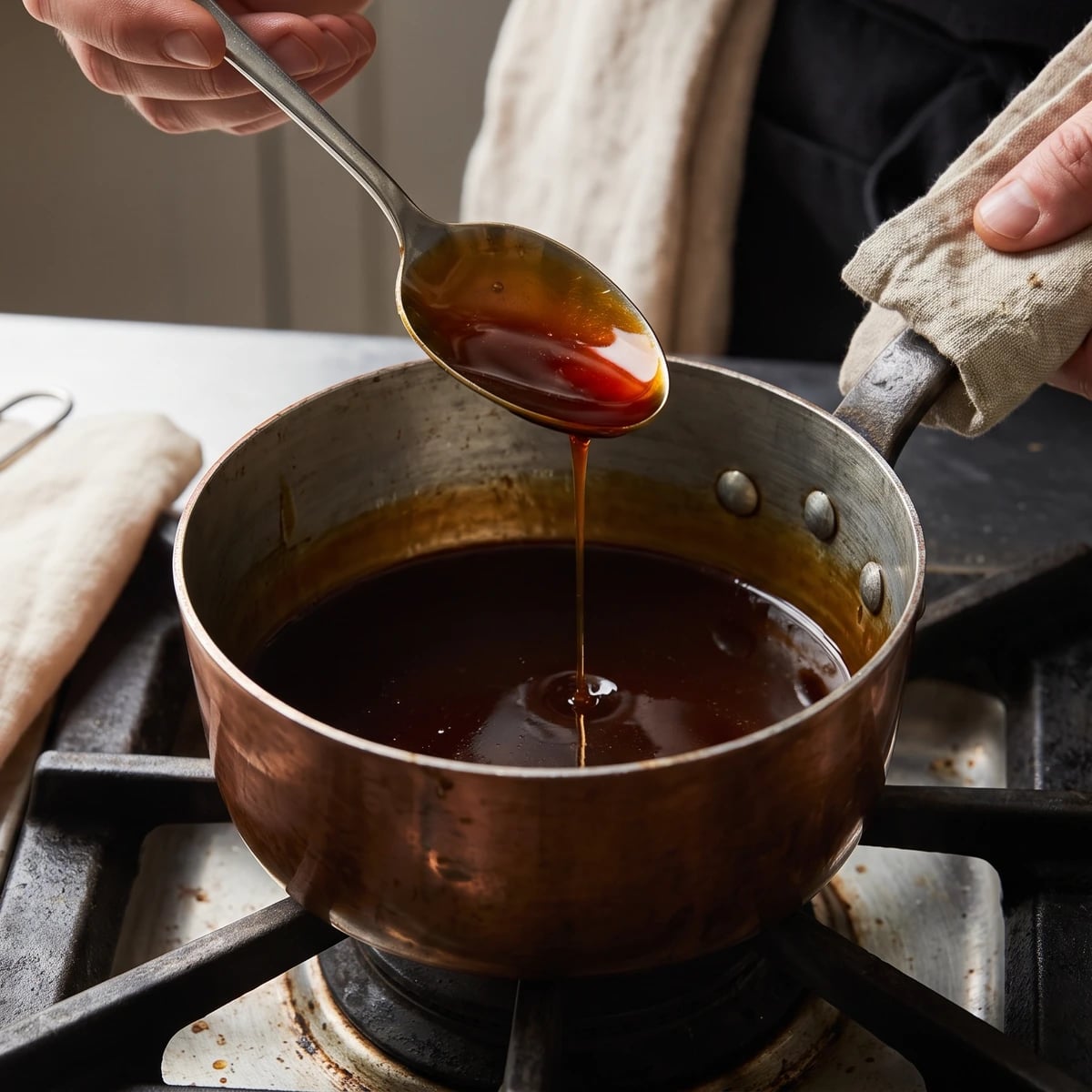
At the finish, the glaze should be clear and deep amber, syrupy while hot and firmly gelatinous when cold. It must evenly veneer a withdrawn spoon, not cling in sticky lumps or run away in watery streaks. Lower the heat before the glaze asks you to. That is the step that matters.

Glace de viande belongs to the Parisian classical sauce kitchen, where working stockpots fed an entire family of sauces and concentrated glazes supplied depth and shine by the spoonful. It passed naturally into the bourgeois home kitchen because a small stored portion could strengthen a pan sauce without rebuilding a stockpot. Despite its name, it is not meant to be ladled on alone: Brown Stock or “Estouffade” (No. 7) gives the darker, more assertive glaze, while Brown Veal Stock (No. 9) is chosen when clarity and neutrality matter.

The technique, the tradition, and the story behind every dish.

Discover Culinary Explorer

Ingredients

unsalted Brown Stock or “Estouffade”

Quantity

2 quarts (1.9 L / about 1.9 kg) Brown Stock or “Estouffade” (No. 7)

unsalted Brown Veal Stock (optional)

Quantity

2 quarts (1.9 L / about 1.9 kg) Brown Veal Stock (No. 9), used instead of the estouffade

room-temperature water (optional)

Quantity

2 tablespoons (30 ml / 30 g)

reserved for loosening the glaze if needed

Equipment Needed

  • 4-quart (3.8 L) heavy stainless-steel saucepan
  • 2-quart (1.9 L) heavy saucepan
  • 1-quart (950 ml) heavy saucepan
  • Fine-mesh sieve
  • Clean muslin or tightly woven cheesecloth
  • Ladle and metal tablespoon
  • 2-cup heatproof storage container
  • Bowl large enough for an ice-water bath

Instructions

  1. 1

    Choose the stock

    Choose one stock, never both. For a dark, forceful glaze, pour the unsalted Brown Stock or “Estouffade” (No. 7) into the 4-quart saucepan. For a lighter and clearer glaze, use the unsalted Brown Veal Stock (No. 9) instead. The stock must be cold, well defatted, and unsalted; salt would concentrate with the liquid and make the glaze unusable before it reaches the proper body.

    Lift away every patch of cold fat before reducing. Fat does not evaporate with the water, so a little left at the beginning becomes a greasy layer at the finish.
  2. 2

    Begin the reduction

    Bring the stock to a full boil over medium-high heat, then maintain a lively but controlled uncovered boil. Skim away foam, fat, and loose proteins as they gather, wiping the inside rim with a damp cloth if deposits form above the liquid. Do not cover the pan or season the stock. This first stage can move briskly because plenty of water remains; reduce until about 1 quart (950 ml) is left.

  3. 3

    Make the first transfer

    Set a fine-mesh sieve lined with damp muslin over the clean 2-quart saucepan. Ladle the reduction through without pressing, and leave the cloudy residue and cooked ring behind in the first pan. Return the strained stock to medium heat and continue reducing uncovered. A brigade repeated this transfer around the range whenever the volume fell appreciably; for this home quantity, two measured transfers preserve the purpose without demanding a row of pans.

  4. 4

    Strain and reduce

    When the stock has reduced to about 2 cups (475 ml), line the cleaned sieve with fresh damp muslin and strain it into the 1-quart saucepan. Lower the heat to medium-low. The bubbles will now look slower, rounder, and glossier, and a sticky amber ring may begin forming at the edge. Do not scrape that ring back into the glaze; concentrated deposits scorch before the liquid beneath them.

  5. 5

    Finish on gentle heat

    Continue at the gentlest heat that maintains a quiet simmer, usually low on a home burner. Dip a clean metal spoon into the center and withdraw it. The glace de viande is ready when a clear, glossy film evenly veneers the entire back of the spoon, with no watery gaps, and falls from the edge in slow broad drops. Let this test decide the finish rather than forcing an exact volume. If the glaze begins catching, lift the pan off the heat at once and do not scrape. Pour the free glaze through clean damp muslin into another clean saucepan, leaving the stuck layer behind, then stir in 1 tablespoon (15 ml / 15 g) of the reserved water off the heat and taste. Ça se rattrape if it remains rounded and meaty; continue over the lowest heat. If it tastes bitter, it has scorched and no honest correction will hide it. If it merely reduced too far without burning, loosen it over gentle heat with the remaining water, a teaspoon at a time.

  6. 6

    Strain, cool, portion

    Pass the finished glaze through fresh damp muslin into a clean heatproof container. Set the container in an ice-water bath and stir occasionally until barely warm, then cover and refrigerate within 2 hours. It will set into a firm, clear jelly when cold. Portion it by the tablespoon for freezing, or keep it covered in the refrigerator for immediate sauce work.

Chef Tips

  • Unsalted means unsalted. Glace de viande may lose most of its original water, and salt follows it all the way down; a pleasantly seasoned stock can become harsh before it veneers the spoon.
  • Use Brown Veal Stock (No. 9) when the glaze must support poultry or another delicate sauce without announcing itself. Brown Stock or “Estouffade” (No. 7) produces the darker glaze with the stronger meat character.
  • Stainless steel lets you see the amber color and any darkening at the bottom. A black cast-iron interior hides both, which is poor company during the final reduction.
  • The spoon test governs the yield. A gelatin-rich stock may reach the proper veneer sooner than a weaker one, so do not reduce a finished glaze simply to meet a number.
  • This is a concentrate, not a sauce to pour by the ladle. Begin with 1 teaspoon per cup of pan sauce, taste, then add more if needed. Cooking well is not cooking fancy.

Advance Preparation

  • The finished Brown Stock or “Estouffade” (No. 7) or Brown Veal Stock (No. 9) may be made and defatted ahead, then refrigerated for up to 4 days or frozen for up to 3 months. Thaw it completely before beginning the reduction.
  • Refrigerate the finished glace de viande for up to 4 days in a clean covered container. Its firm jelly texture when cold is exactly right.
  • For longer storage, freeze the cold glaze in 1-tablespoon portions. Transfer the frozen portions to a sealed container and use within 3 months, adding them directly to simmering sauces and braises.

Frequently Asked Questions

Nutrition Information

1 serving (about 15g)

Calories
15 calories
Total Fat
0 g
Saturated Fat
0 g
Trans Fat
0 g
Unsaturated Fat
0 g
Cholesterol
5 mg
Sodium
30 mg
Total Carbohydrates
0 g
Dietary Fiber
0 g
Sugars
0 g
Protein
4 g

Note: Chef personas and recipes are created with AI assistance. Cook with care: follow safe food-handling practices, check doneness with a thermometer when needed, and adapt for allergies and your kitchen.

Where cooking meets culture.

Culinary guides, cultural storytelling, and the editorial depth that makes cooking meaningful.

Discover Culinary Explorer

More from Fonds de Cuisine

Browse the full collection